 0
0
 0
0
Published: May 30, 2026
Key Developments in Brief
-
Global Concentration: Only six wild poliovirus cases have been confirmed worldwide so far in 2026—all localized within Pakistan and Afghanistan.
-
Volatile Trajectory: Pakistan reported a stark increase to 74 cases in 2024 (up from just 6 in 2023), before aggressive containment reduced numbers through 2025 and into early 2026.
-
Frontline Casualties: More than 200 polio workers and police escorts have been killed by militant factions since the 1990s.
-
Mass Mobilization: Despite severe security threats, a synchronized April 2026 cross-border campaign successfully vaccinated 44.8 million children in Pakistan.
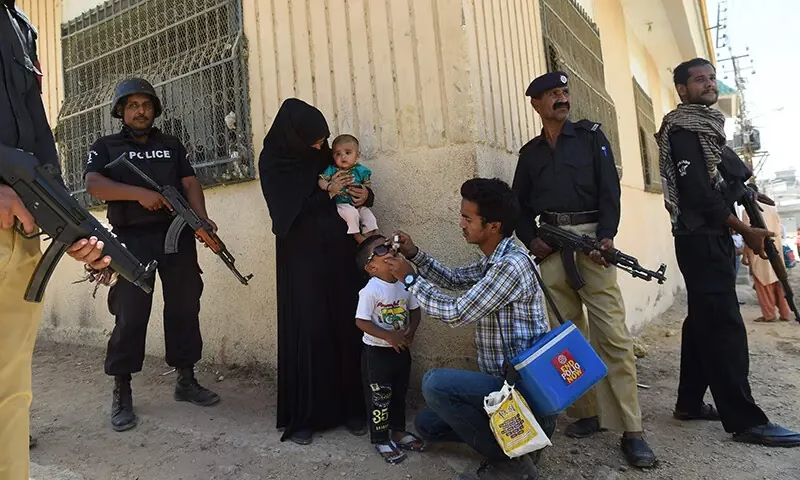
ISLAMABAD, Pakistan — Pakistan stands on the precipice of a historic public health achievement, closer than ever to permanently eradicating wild poliovirus within its borders. Yet, this final-mile effort is being severely throttled by a violent security crisis. Frontline health workers are operating in one of the world’s most perilous environments, where the simple act of delivering a life-saving vaccine has become a frequent target for terrorist organizations.
The deadly friction defining this campaign was laid bare on April 14, 2026. During the second phase of a nationwide anti-polio drive, gunmen ambushed a police vehicle escorting a team of vaccinators in Hangu, a high-risk district in the Khyber Pakhtunkhwa (KPK) province near the Afghan border. The assault left one officer dead and four others wounded. This incident encapsulates a tragic paradox: while the medical tools and operational infrastructure to eliminate polio are fully deployed, the persistent threat of terrorism prevents health workers from safely reaching the last remaining pockets of vulnerable children.
The Current State of Polio in Pakistan
Today, Pakistan and neighboring Afghanistan are the final two countries on Earth where wild poliovirus type 1 (WPV1) remains endemic. According to data from the Global Polio Eradication Initiative (GPEI), only six confirmed cases have been reported globally so far in 2026. However, public health officials warn that these low baseline numbers obscure a highly fragile epidemiological reality.
Pakistan Annual Wild Poliovirus Cases (Recent Years)
=====================================================
2023: █ 6 cases
2024: ███████████████████████████████████████████ 74 cases
2025: █████████████████ ~30 cases
2026: █ 3 cases (Year-to-date)
=====================================================
Pakistan’s recent progress has been highly non-linear. The tenfold explosion of cases in 2024 served as a harsh reminder of how rapidly the virus can exploit gaps in immunization coverage. While intensified immunization sweeps brought the caseload down to approximately 30 in 2025, 2026 has seen three confirmed cases so far. The first of these was detected on March 4, 2026, in a four-year-old girl in the Sujawal district of Sindh province, followed by two subsequent cases identified in the volatile KPK region.
Genetic sequencing conducted by the World Health Organization (WHO) reveals that environmental samples collected from the sewers of Karachi share direct biological links to viral reservoirs in Jalalabad, eastern Afghanistan. This overlap proves that the two nations function as a single epidemiological corridor; the virus moves fluidly across borders alongside migrating populations.
The high stakes of this localized persistence were highlighted by the recent detection of wild poliovirus in wastewater samples as far away as Germany. The discovery underscores an foundational axiom of global health: as long as the virus circulates anywhere, children everywhere remain at risk.
The Geography of Violence and Disease
The primary barrier to interrupting transmission is no longer logistical—it is a matter of physical survival. According to the Global Terrorism Index 2026, Pakistan ranked first globally in terrorism-related fatalities, recording 1,139 deaths in 2025. This marked the country’s sixth consecutive annual increase in militant violence, driven heavily by a 24 percent surge in attacks by the Tehrik-i-Taliban Pakistan (TTP), as documented by the Pak Institute for Peace Studies.
When public health researchers map the exact geographic distribution of wild poliovirus reservoirs, they find that it mirrors Pakistan’s worst terrorism hotspots. The violence is heavily concentrated in the rugged terrains of KPK and Balochistan. Because these provinces suffer from systemic instability, they naturally become the final strongholds where the virus can hide and replicate undisturbed.
Frontline Workers Under Fire
The individuals paying the highest price for this geographic overlap are the vaccinators and their security details. Government tracking data compiled since 2012 paints a grim picture: 96 deaths and 170 injuries have been recorded during targeted attacks on polio campaigns. Among the dead are 61 police officers and 27 health workers.
“Our teams are facing an unprecedented level of threat in the field,” noted Ihtesham Ali, Minister of Health for Khyber Pakhtunkhwa province, in a recent briefing on regional security. “Protecting these workers is now as critical to our success as the cold chain storage of the vaccines themselves.”
The violence has often taken a heavy toll on communities. In November 2024, a single roadside bomb targeted a police van escorting a vaccination team, killing nine people—including five school children who happened to be nearby. Reports from organizations like the Safeguarding Health in Conflict Coalition confirm a sharp upward trend in threats, physical obstruction, and armed violence directed at healthcare infrastructure across the region.
Deconstructing the Militant Opposition
The TTP and its affiliates have explicitly banned door-to-door vaccination campaigns in areas under their operational influence. This hostility stems from a complex mix of historical grievances and deeply entrenched misinformation.
A pivotal turning point occurred in 2011, when it was revealed that the U.S. Central Intelligence Agency (CIA) had utilized a fake Hepatitis B vaccination drive in Abbottabad to collect DNA samples during the hunt for Osama bin Laden. This breach of medical ethics deal a catastrophic blow to public trust, providing militant groups with a powerful, lasting narrative that modern healthcare campaigns are fronts for foreign espionage.
Beyond conspiracy theories of espionage, extremist clerics have long propagated false claims that oral polio vaccines are a Western plot designed to sterilize Muslim children or that the components are religiously impermissible (haram). Despite numerous fatwas (religious edicts) issued by prominent local and international Islamic scholars affirming the safety and religious compliance of the vaccine, militant networks continue to enforce non-compliance through intimidation.
In Balochistan, the challenges are further compounded by ethnic tensions and cross-border movement. Researchers have identified the Chaman border crossing—a bustling transit point linking Quetta to Kandahar, Afghanistan—as a persistent viral corridor. Managing health interventions in this zone is highly difficult due to the shifting tactics of local insurgent factions.
The Trust Deficit: Community Refusals
The threat to eradication does not come exclusively from armed militants; it also manifests as quiet resistance from families. An independent monitoring board of the GPEI reported that more than 420,000 children missed vaccination opportunities during Pakistan’s 2024 campaigns, driven significantly by community-level refusals in KPK.
In these high-risk areas, refusals are rarely based on a simple misunderstanding of biology. Instead, they are deeply tied to socio-political grievances against the state. Because vaccination teams are deployed and funded by government agencies, marginalized communities often view them with suspicion—especially in regions that have experienced military operations, displacement, or a lack of public investment.
Drivers of Vaccine Refusal in High-Risk Districts
┌──────────────────────────────┐
│  • Systemic Distrust of State│ ──► Association of health workers with military/police
│  • Intimidation by Militants │ ──► Direct threats to families accepting drops
│  • Demand-Based Boycotts     │ ──► Leveraging vaccine access for clean water/power
│  • Lingering Misinformation  │ ──► Sterilization myths and religious misconceptions
└──────────────────────────────┘
Field reports from Karachi and rural KPK reveal a growing trend of “demand-based boycotts.” Parents frequently tell health workers that they will only allow their children to receive polio drops if the government also provides basic necessities like clean drinking water, electricity, sanitation, or general medical clinics.
“Families look at us and ask why the state can mobilize thousands of armed guards to deliver two drops of medicine, but cannot fix the broken pipes leaking sewage into their streets,” observed Fakhar Hayat Kakakhel, a Pakistan-based researcher specializing in regional militancy. The U.S. Centers for Disease Control and Prevention (CDC) has similarly noted that a significant portion of community refusals are tied to these non-medical structural demands.
Operational Endurance Amid Crisis
In spite of these profound obstacles, the Pakistan Polio Eradication Program has engineered one of the most sophisticated logistical operations in public health history. The country runs the world’s largest single-disease surveillance network, utilizing 127 environmental sampling sites across 87 districts to catch traces of the virus in wastewater long before clinical paralysis appears in patients.
Furthermore, bilateral coordination between Pakistan and Afghanistan has reached unprecedented levels. In April 2026, a synchronized cross-border campaign successfully immunized 44.8 million children in Pakistan and 12.8 million in Afghanistan over a seven-day period. To build community goodwill and address broader nutritional deficits, health workers co-administered Vitamin A doses to millions of children aged 6 to 59 months.
April 2026 Synchronized Campaign Reach
┌────────────────────────────────────────────────────────┐
│ Pakistan: ████████████████████████████████ 44.8M Boys/Girls │
│ Afghanistan: ██───────── 12.8M Boys/Girls               │
└────────────────────────────────────────────────────────┘
The bedrock of this operational capacity is the Lady Health Worker (LHW) Program. Established in 1994, this network now boasts over 110,000 female community health professionals, with roughly 85 percent directly engaged in polio eradication. Because these women belong to the communities they serve, they are uniquely equipped to navigate cultural sensitivities. Data from the Council on Foreign Relations shows that households regularly visited by an LHW are 15 percent more likely to have their young children fully immunized.
Understanding Polio and the Value of Immunization
To appreciate what is at stake, it is necessary to understand how the poliovirus behaves and why high-coverage vaccination is the only viable path to eradication.
Polio is a highly infectious viral disease that primarily attacks the nervous system. While the vast majority of infections cause mild or asymptomatic illness, a small percentage of cases result in irreversible physical disability.
| Aspect | Medical Reality & Strategic Targets |
| Disease Severity | Approximately 1–2% of infected individuals develop central nervous system disease, which can cause permanent paralysis or death by destroying motor neurons. |
| Vaccine Efficacy | Inactivated Polio Vaccine (IPV) provides $\ge 90\%$ protection against paralytic polio after two doses, rising to $\ge 99\%$ protection after three doses. |
| Vaccine Safety | Modern polio vaccines are exceptionally safe and thoroughly vetted. IPV contains killed virus and cannot cause paralytic polio. |
| Common Side Effects | Side effects are minor and temporary, typically limited to mild soreness at the injection site, low-grade fever, or temporary irritability. |
| Global Eradication Goals | The GPEI framework targets the certification of Wild Poliovirus Type 1 (WPV1) eradication by 2027 and the complete elimination of circulating vaccine-derived polioviruses (cVDPV2) by 2029. |
The Path Forward: Expert Recommendations
Public health experts and security analysts agree that relying solely on heavy police escorts is a fragile long-term strategy. To bridge the gap between security and community trust during the critical window of 2026, experts recommend several strategic shifts:
-
Localized Security Recruitment: Transition away from deploying outside police forces to guard vaccination teams. Instead, recruit and train security personnel from the exact neighborhoods and tribal areas where the campaigns take place to minimize local friction.
-
Early Engagement of Local Governance: Integrate tribal jirgas (councils of elders) and local ulema (religious councils) directly into the operational planning phases rather than treating them as an afterthought. Historically, public endorsements from these local figures have caused refusal rates to plummet.
-
Expansion of the Lady Health Worker Network: Expand the recruitment of female health workers in high-risk districts where their presence remains thin, ensuring that the face of the campaign is a trusted neighbor rather than an armed outsider.
-
Integrated Health Delivery: Fully transition from single-disease campaigns to integrated health services. By delivering polio vaccines alongside clean water, soap, basic medicines, and oral rehydration salts, the program can directly answer community needs and reduce hostility.
Crucially, diplomatic channels must remain protected. The Afghan Taliban has permitted synchronized cross-border vaccination campaigns to proceed throughout 2025 and 2026, even during periods when broader bilateral relations between Islamabad and Kabul deteriorated. Maintaining this specific humanitarian corridor is vital to ensuring that neither country serves as a permanent re-infection source for the other.
A Decisive Moment for Global Health
Pakistan’s fight against polio has reached its most critical juncture. The remaining months of 2026 present a narrow, vital opportunity to finally interrupt viral transmission. However, if the current wave of terrorist violence succeeds in fracturing the campaign’s logistics, the virus could quickly rebound out of its current strongholds, reversing decades of work and billions of dollars in global investments.
The infrastructure is in place, the vaccines are proven, and the dedication of frontline workers is unquestioned. The final victory over polio now depends on whether the international community and Pakistani leadership can successfully protect those who risk their lives to deliver a polio-free future.
Medical Disclaimer
This article is for informational purposes only and should not be considered medical advice. Always consult with qualified healthcare professionals before making any health-related decisions or changes to your treatment plan. The information presented here is based on current research and expert opinions, which may evolve as new evidence emerges.
References
- https://www.atlanticcouncil.org/dispatches/how-terrorism-imperils-pakistans-polio-eradication-efforts/