 0
0
 0
0
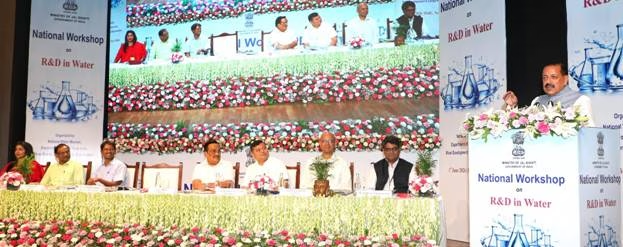
NEW DELHI — In a major move linking environmental engineering with national public health, the Indian government has launched the ₹200-crore MAHA (Missions for Advancement in High-Impact Areas) Water Mission. Announced on June 1, 2026, at the National Workshop on R&D in Water in New Delhi, the five-year joint initiative between the Anusandhan National Research Foundation (ANRF) and the Ministry of Jal Shakti aims to completely reshape how the nation secures clean drinking water.
By funding startups, smaller universities, and grassroots innovators, the mission shifts water security from a bureaucratic engineering problem into a decentralized, tech-driven public health crusade. The initiative seeks to deploy scalable commercial solutions to fix drinking water contamination, optimize water use efficiency, and build climate resilience across both rural and urban India.
Democratizing the Fight for Clean Water
For decades, India’s scientific and medical research funding heavily favored a small handful of elite, established institutions. Dr. Jitendra Singh, Union Minister of State for Science and Technology, explained during the inaugural session that the ANRF was specifically built to disrupt this top-heavy dynamic.
“ANRF is democratizing research funding by expanding opportunities for startups, MSMEs, universities, and innovators across the country,” Dr. Singh stated. He noted that by widening access to resources, the government ensures that vital scientific breakthroughs are no longer confined to isolated laboratories, but are instead fast-tracked into the communities that need them most.
The scale of this entrepreneurial engine is unprecedented. India’s startup ecosystem has grown from just a few hundred entities a decade ago to more than two lakh (200,000) active startups today. Through the MAHA Water Mission, the government is deliberately funneling this massive reservoir of private sector talent into solving critical public health crises. Selected consortia—combining universities, national laboratories, and private startups—can receive up to ₹20 crore each to take an idea from a laboratory prototype to full-scale field deployment.
A Five-Pronged Blueprint for Public Health
Clean water is the absolute baseline of preventative medicine. According to data from the World Health Organization (WHO), waterborne diseases place an immense economic and physical burden on developing nations, with unsafe water causing hundreds of thousands of preventable diarrheal deaths globally each year.
To address these vulnerabilities, the MAHA Water Mission outlines a comprehensive, five-pronged approach to water resource management:
-
Water Resource Assessment and Sustainable Management: Utilizing advanced modeling to map and preserve dwindling groundwater resources.
-
Drinking Water Security: Innovating reliable, scalable delivery systems to ensure every household has access to safe tap water.
-
Water Quality and Ecological Health: Developing rapid testing and treatment technologies to eliminate dangerous pathogens and chemical pollutants.
-
Water Use Efficiency and Circular Economy: Incentivizing wastewater recycling and reducing industrial and agricultural waste.
-
Climate Resilience and Adaptation: Engineering infrastructure capable of withstanding severe droughts and monsoonal flooding.
Union Minister for Jal Shakti, Shri C.R. Patil, reinforced that safeguarding water resources is fundamentally tied to the nation’s human and economic development. “Water security is fundamental to India’s developmental aspirations,” Patil said, emphasizing that merging technical research with robust public participation is the only way forward. As part of this community-led push, officials also unveiled the Jal Sanchay Jan Bhagidari, Citizen Tracking and Reporting (JSJB-CTR) portal and mobile app, empowering everyday citizens to log water conservation efforts and report infrastructure gaps in real time.
Space-Age Diagnostics for Earthbound Diseases
One of the most unique aspects of the newly unveiled mission is its multi-agency, “Whole-of-Government” approach. During the workshop, the Department of Water Resources signed a formal Memorandum of Understanding (MoU) with the Department of Space and the Indian Space Research Organisation (ISRO).
Under this partnership, satellite imaging, geospatial mapping, and deep-space data tracking will be used to locate hidden underground aquifers, track toxic algal blooms in lakes, and monitor contamination pathways in major river basins.
Independent public health experts view this high-tech integration as a potential game-changer for epidemiology. When space satellites map data on groundwater depletion or chemical runoff, health officials can proactively project where waterborne disease outbreaks—such as cholera, typhoid, or chronic fluorosis—are most likely to occur. It allows public health teams to shift from reacting to medical emergencies to preventing them entirely.
The Road Ahead: Challenges and Institutional Hurdles
While the mission’s scope and funding are historic, public health policy analysts urge cautious optimism. Translating a lab-tested prototype into a harsh, real-world rural environment introduces countless variables, from erratic electricity grids to regional maintenance limitations.
Medical history shows that simply installing advanced water purification technology is not a silver bullet. If a local community isn’t thoroughly educated on how to operate, trust, and maintain a new system, infrastructure can quickly fall into disuse. For the MAHA Water Mission to succeed, the engineering startups receiving these ₹20-crore grants must coordinate seamlessly with local public health workers and village councils to ensure long-term behavioral adoption.
Furthermore, balancing the immediate, desperate need for clean drinking water with long-term goals like climate adaptation will require sustained political will and strict financial oversight over the next five years.
What This Means for Your Health
For the average citizen, the launch of the MAHA Water Mission serves as an important reminder of the invisible role water quality plays in daily well-being. Contaminated water isn’t just an acute threat that causes short-term stomach bugs; chronic exposure to heavy metals like arsenic, lead, or excess fluoride in unregulated groundwater can lead to severe, long-term neurological, kidney, and bone diseases.
As the government rolls out new tech-driven filtration and monitoring infrastructure, health-conscious consumers should remain proactive. Utilizing local government testing resources, reporting localized water disruptions through the new JSJB-CTR app, and maintaining certified home filtration systems are simple, highly effective ways families can protect their health while India builds its next-generation water grid.
Reference Section
Government & Institutional Sources
-
Press Information Bureau (PIB) Delhi: “Anusandhan National Research Foundation” (ANRF) is democratising research funding, launches ₹200-crore MAHA Water Mission to support StartUps. Published June 1, 2026.
Medical Disclaimer: This article is for informational purposes only and should not be considered medical advice. Always consult with qualified healthcare professionals before making any health-related decisions or changes to your treatment plan. The information presented here is based on current research and expert opinions, which may evolve as new evidence emerges.