 0
0
 0
0
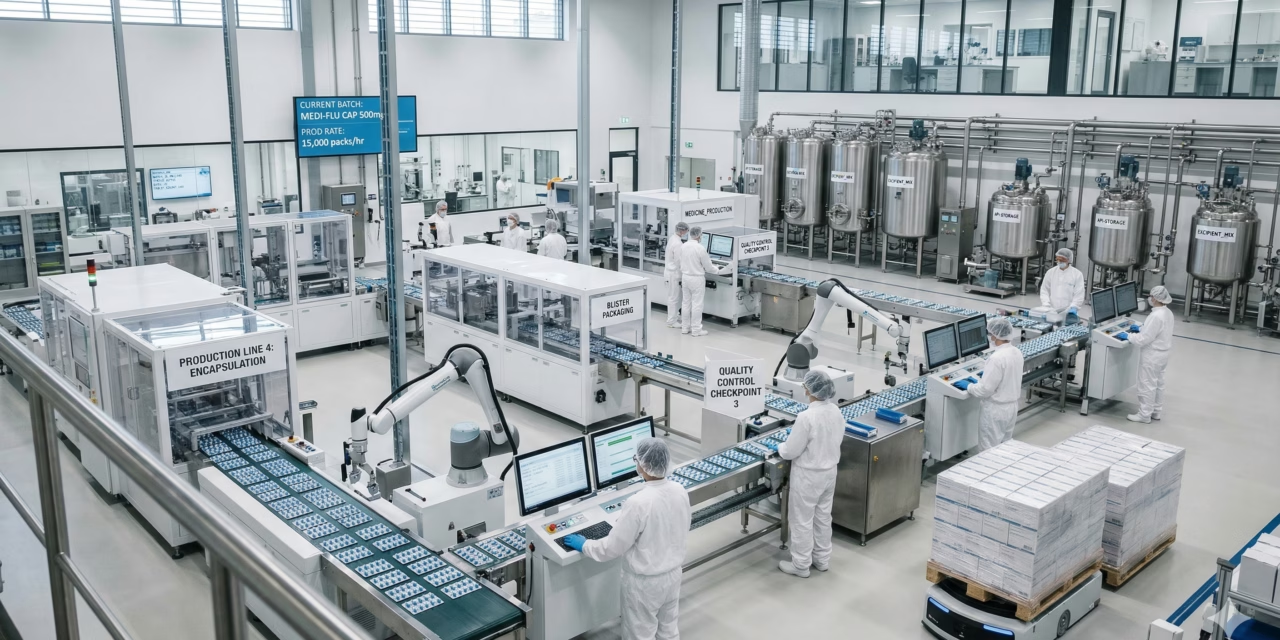
NEW DELHI — In a move that promises to stabilize global medicine supplies and lower the risk of critical drug shortages, India’s ambitious Production Linked Incentive (PLI) schemes for pharmaceuticals have hit a major milestone. According to data released by the Ministry of Chemicals and Fertilizers on March 20, 2026, the initiatives have successfully triggered over ₹46,000 crore in new investments, marking a pivotal shift in how the world’s “pharmacy” produces its most essential ingredients.
For the average patient, this technical-sounding “production incentive” translates to a more resilient supply of everything from common antibiotics to complex cancer treatments. By incentivizing the domestic creation of raw materials, the program seeks to ensure that a supply chain disruption half a world away doesn’t result in an empty shelf at the local pharmacy.
From Dependence to Self-Reliance: The API Revolution
To understand the significance of these figures, one must look at what goes into a pill. Most medications consist of two main parts: the finished dose (the tablet or liquid) and the Active Pharmaceutical Ingredient (API)—the actual “drug” that treats the illness. For decades, India, a global leader in finished generic medicines, relied heavily on imports for these raw chemicals, particularly from a single source: China.
The “PLI Scheme for Bulk Drugs,” launched in 2020, was designed specifically to break this dependency. As of December 2025, the results are tangible. The government reports that 28 critical ingredients are now being manufactured in-house, with a total production capacity of 56,800 metric tonnes per annum.
“This isn’t just about economic growth; it’s about health security,” says Dr. Aris Vrettos, a global supply chain analyst (not involved in the government report). “When a country can produce its own ‘Key Starting Materials’ (KSMs), it protects its population against the price spikes and shortages we saw during the 2020-2022 period.”
By the Numbers: A Surge in Investment
The scale of the pharmaceutical industry’s response has significantly outpaced government expectations:
-
Investment Overdrive: While the government initially targeted ₹17,275 crore in committed investments for the primary pharma scheme, actual cumulative investment reached ₹41,943 crore by late 2025.
-
Export Powerhouse: Of the ₹3.35 lakh crore in cumulative sales generated under the scheme, over ₹2.15 lakh crore came from exports, reinforcing India’s role as a vital supplier to international healthcare systems, including the U.S. and Europe.
-
First-Time Production: In a major technical leap, 191 products are being manufactured in India for the very first time, reducing the need for expensive imports of high-value medicines and complex generics.
What This Means for Patients and Professionals
For healthcare providers, the expansion of the PLI scheme suggests a future with fewer “backorder” notices for essential medications. For consumers, the implications are twofold: affordability and availability.
When raw materials are produced locally, the “landed cost” of manufacturing drops. While this doesn’t always result in an immediate price cut at the counter due to complex insurance and retail structures, it creates a downward pressure on prices for life-saving drugs.
Furthermore, the scheme focuses on “high-value” products, which include biologicals, orphan drugs (for rare diseases), and auto-immune medications. By bringing the production of these complex therapies closer to home, the time between a drug’s development and its availability to the general public can be shortened.
Balancing Growth with Environmental Safety
The rapid expansion of chemical manufacturing often raises red flags regarding environmental impact. Bulk drug manufacturing is classified under the “red category” by Indian regulatory frameworks, meaning it has a high potential for pollution.
Addressing these concerns, Minister of State for Chemicals and Fertilizers, Smt. Anupriya Patel, emphasized that all new units—including six recently commissioned units in the aspirational district of Vishakhapatnam—must adhere to the Environment (Protection) Act of 1986.
“The challenge for India is to become a manufacturing giant without compromising the health of the local ecosystems,” notes environmental health advocate Sunita Narain in recent independent commentary on industrial growth. Companies are required to obtain “Consent to Operate” (CTO) and “Environmental Clearance” (EC) before a single batch of medicine is produced, ensuring that the water and air quality of surrounding communities remain protected.
Limitations and the Road Ahead
Despite the impressive numbers, the scheme is not a cure-all. Industry experts point out several hurdles:
-
Global Competition: While India is scaling up, other nations are also subsidizing their domestic drug manufacturing, leading to a competitive “incentive war.”
-
R&D Gap: The current PLI focus is heavily on manufacturing. Critics argue that for India to truly lead, equal incentives must be placed on original drug discovery and Research & Development (R&D).
-
Gestation Periods: Large-scale chemical plants (Greenfield projects) take years to reach full capacity. The current sales figures are promising, but the full impact on the global market may not be felt until the end of the decade.
Conclusion
The latest data on India’s PLI schemes paints a picture of a nation rapidly fortifying its position as a global healthcare anchor. By exceeding investment targets and successfully manufacturing nearly 200 new products domestically, the initiative is doing more than just boosting GDP—it is building a more stable, self-sufficient foundation for global health.
As the scheme moves into its final phases over the next few years, the focus will likely shift from building factories to ensuring that the medicines produced within them remain affordable, high-quality, and environmentally sustainable.
Medical Disclaimer
Medical Disclaimer: This article is for informational purposes only and should not be considered medical advice. Always consult with qualified healthcare professionals before making any health-related decisions or changes to your treatment plan. The information presented here is based on current research and expert opinions, which may evolve as new evidence emerges.
Reference Section
Primary Data Source:
-
Ministry of Chemicals and Fertilizers, Government of India. (2026, March 20). Production Linked Incentive Scheme for Pharmaceuticals and Bulk Drugs Status Update. Press Information Bureau (PIB), Delhi.