 0
0
 0
0
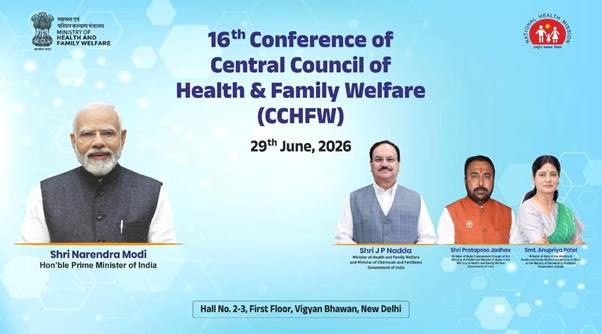
NEW DELHI — In a major push to redefine India’s public healthcare framework and enhance grassroots medical access, the Union Ministry of Health and Family Welfare will convene the landmark 16th Conference of the Central Council of Health and Family Welfare (CCHFW) on Monday, June 29, 2026. Taking place at Vigyan Bhawan, New Delhi, the apex-level assembly will be chaired by the Union Minister for Health and Family Welfare, Shri J.P. Nadda, alongside Ministers of State Smt. Anupriya Patel and Shri Prataprao Jadhav. The conference brings together state health ministers, parliamentarians, and global health experts to forge a unified roadmap for the nation’s healthcare system, highlighted by the highly anticipated launch of next-generation digital health platforms, including Aarogya Setu 2.0.
Constituted under Article 263 of the Constitution of India, the CCHFW acts as the supreme advisory body tasked with reviewing public health policies and solidifying cooperative federalism between the Central government and individual States or Union Territories (UTs). As India faces the double burden of managing non-communicable diseases (NCDs) while striving to meet international development timelines, this year’s thematic sessions focus on three pillars: National Health Mission (NHM) – SDG Goals & Priorities, Food & Drug Reforms, and the formalization of Allied Health Services.
Aligning the National Health Mission with Global SDG Targets
A central priority of the 16th CCHFW conference is evaluating India’s progress toward the United Nations Sustainable Development Goals (SDGs)—specifically SDG 3, which mandates ensuring healthy lives and promoting well-being for all ages by 2030. The National Health Mission (NHM) has served as the execution vehicle for these goals, expanding rural and urban health clinics across diverse topographies.
Public health metrics from the World Health Organization (WHO) and India’s National Family Health Survey (NFHS-5) emphasize that while maternal and infant mortality rates have dramatically dropped over the last decade, regional disparities in healthcare infrastructure persist. The session will focus on strategies to reduce the out-of-pocket expenditure that frequently pushes vulnerable households into financial distress.
“True cooperative federalism in health means that policy successes in one state must easily translate into executable blueprints for another,” notes Dr. K. Srinath Reddy, a distinguished public health specialist and former President of the Public Health Foundation of India (PHFI), who is not directly involved in the CCHFW planning. “Aligning the NHM with the 2030 SDG targets requires a flexible, data-driven approach that empowers local community health centers while utilizing central resource allocations effectively.”
Driving Food and Drug Reforms: Easing Import Controls and Raising Quality
As India continues its role as a prominent global provider of pharmaceuticals, the conference will address critical structural overhauls within the country’s drug regulatory frameworks. The Ministry of Health and Family Welfare recently proposed significant changes to international supply logistics, notably replacing the rigid requirement that imported medications hold more than 60 percent of their residual shelf life with a streamlined, minimum 12-month shelf life standard at the time of entry.
The discussions will also look at the rollout of unified technical infrastructures:
-
The National Drug Registry: A single source of truth tracking pharmaceutical production, batches, and distribution channels.
-
Common LOINC Codes for India (CLCI): A standardized system for identifying medical laboratory observations to prevent data interpretation errors across facilities.
-
Bharat Health Terminology Service (BHTS): An interoperability tool ensuring that electronic health records use uniform medical terms nationwide.
These reforms aim to balance robust quality assurance with bureaucratic efficiency. However, domestic health advocates caution that relaxing residual shelf-life rules requires highly sensitive, climate-controlled logistics networks to prevent the degradation of vital therapeutics before they reach patients in remote districts.
The Next Era of Digital Health: The Launch of Aarogya Setu 2.0
Coinciding with the CCHFW policy deliberations, the National Health Authority (NHA) and the National Resource Centre for EHR Standards (NRCeS) will officially debut a suite of public-facing digital tools designed to accelerate digital health adoption.
Chief among these is Aarogya Setu 2.0. Transitioning from its historical roots as a pandemic contact-tracing utility, the reimagined application serves as a comprehensive Personal Health Record (PHR) hub. Through the app, citizens can seamlessly generate and manage their unique Ayushman Bharat Health Account (ABHA), securely store laboratory reports, sync biometric data from consumer wearables, and use artificial intelligence to receive contextual health insights.
Complementing this platform is the upgraded Ayushman App and Ayushman Sarathi, a conversational WhatsApp chatbot. These tools are specifically engineered to assist beneficiaries of the Ayushman Bharat Pradhan Mantri Jan Arogya Yojana (PM-JAY)—the world’s largest government-funded health assurance scheme—in verifying eligibility, searching for paneled hospitals, tracking treatment histories, and filing real-time grievances.
Integrating Allied Health Services into Mainstream Medicine
The final thematic block targets the structural formalization of India’s massive, yet frequently underutilized, allied health workforce. Comprising medical laboratory technicians, radiographers, physiotherapists, and speech therapists, these professionals form the logistical backbone of diagnostic and rehabilitative medicine.
The council will review regulatory pathways to standardize education, licensing, and professional career progression under the National Commission for Allied and Healthcare Professions Act. Integrating these providers into primary healthcare frameworks is essential for easing the workload of physicians and addressing the chronic shortage of clinical staff in rural areas.
Public Health Implications, Limitations, and the Road Ahead
For the everyday health consumer, the decisions reached at Vigyan Bhawan will directly impact how care is sought and received. The convergence of unified digital tools means patients will no longer need to transport thick binders of paper records between diagnostic labs and specialists; a secure, permission-based digital token can transfer complete medical histories instantly.
Balancing Technology and Grassroots Realities
Despite the clear benefits, independent medical analysts stress the importance of realistic implementation timelines. While digital applications like Aarogya Setu 2.0 and WhatsApp chatbots offer unparalleled convenience for tech-literate populations, a digital divide remains in rural hinterlands where stable internet connectivity and smartphone access are limited.
Additionally, data privacy advocates emphasize that handling sensitive personal health information via cloud systems necessitates uncompromising cybersecurity protections to avoid data vulnerabilities. The CCHFW must ensure that the transition to digital healthcare complements—rather than replaces—the expansion of physical medical facilities and the hiring of in-person healthcare staff.
Ultimately, the 16th CCHFW Conference represents an essential step forward. By aligning state-level execution with national policy and utilizing modern digital public infrastructure, the council aims to shift the Indian healthcare paradigm from reactive, episodic treatment to proactive, accessible wellness for all citizens.
References
-
Press Information Bureau (PIB) Delhi: Official Pre-Event Release, Ministry of Health and Family Welfare, Union Ministry of Health to Convene 16th Conference of the Central Council of Health and Family Welfare on 29th June at Vigyan Bhawan, Published June 27, 2026. [PRID: 2278346].
Medical Disclaimer: This article is for informational purposes only and should not be considered medical advice. Always consult with qualified healthcare professionals before making any health-related decisions or changes to your treatment plan. The information presented here is based on current research and expert opinions, which may evolve as new evidence emerges.