 0
0
 0
0
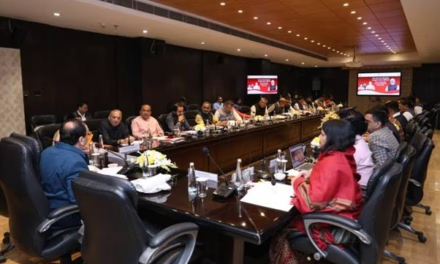
NEW DELHI — In a major bid to reform India’s medical education pipeline and alleviate unprecedented stress on millions of applicants, a parliamentary committee has formally recommended dismantling the country’s monolithic, single-day medical entrance system. The Parliamentary Standing Committee on Education, Women, Children, Youth and Sports has urged the central government to transition the National Eligibility-cum-Entrance Test Undergraduate (NEET-UG) into a multi-phase or multi-window examination. Furthermore, the panel has advocated for splitting the mammoth test into distinct, separate entrance exams for MBBS, AYUSH (traditional medicine), and nursing courses to significantly reduce candidate load and logistical vulnerabilities.
The sweeping recommendations, presented in a comprehensive review, aim to overhaul the operational and psychological landscape of medical admissions. However, the proposal has immediately run into systemic friction. The National Testing Agency (NTA), which administers the exam, informed the panel that implementing separate examinations or multiple testing windows remains highly impractical under existing regulatory frameworks. The NTA emphasized that any structural departure from the current format would require sweeping policy revisions and direct inter-ministerial intervention from the Union Ministry of Health and Family Welfare alongside respective statutory councils.
Decongesting the Gateway: The Key Recommendations
The central thrust of the parliamentary report focuses on decentralizing an examination that has grown exponentially in scale, drawing nearly 2.5 million candidates simultaneously on a single day.
CURRENT MODEL                      PROPOSED REFORM MODEL
┌───────────────────────────┐      ┌───────────────────────────┐
│          NEET-UG          │      │   Multi-Phase / Window    │
│  (Single Day, All-in-One) │ ───> │     NEET-UG Structure     │
└─────────────┬─────────────┘      └─────────────┬─────────────┘
              │                                  │ Split by Stream
              ▼                                  ▼
   [MBBS / BDS / AYUSH / B.Sc]        [MBBS]  [AYUSH]  [Nursing]
To mitigate these intense operational and security pressures, the committee proposed two primary structural shifts:
-
Multi-Phase and Multi-Window Testing: Conducting NEET-UG across staggered phases in different states or opening multiple testing windows throughout the academic year. This mirrors global standardized testing models, offering students a secondary buffer if they face localized disruptions or personal setbacks on a single test date.
-
Disaggregation of Healthcare Streams: Establishing separate, specialized entrance examinations for distinct disciplines. Rather than evaluating a future public health nurse, an Ayurvedic practitioner, and a cardiothoracic surgeon via the exact same physics, chemistry, and biology paper, the panel suggested isolating the candidate pools by professional stream.
The Systemic Counter-Argument: Operational Reality Check
While the proposed reforms address long-standing concerns regarding candidate burnout, testing experts and administrative officials urge a cautious approach. The NTA highlighted critical roadblocks inherent to high-stakes testing at this scale.
The foremost challenge lies in score normalization. When an exam is administered across multiple dates or formats, ensuring absolute statistical equivalence between different question papers is remarkably complex. Even marginal variations in difficulty can lead to intense legal challenges from candidates who feel disadvantaged by a specific session’s psychometric scaling.
Furthermore, education policy analysts warn of severe logistical gridlock regarding the national counseling timeline. India’s centralized seat-allotment process is tightly bound to a rigid academic calendar. Introducing multiple testing phases or distinct exams for nursing and AYUSH could significantly lengthen the admission cycle, potentially delaying the commencement of the academic term for medical colleges nationwide.
Expert Perspectives: Balancing Resiliency Against Fragmentation
Independent medical education specialists view the parliamentary intervention as a necessary, if complicated, catalyst for debate.
“The single-day, high-stakes model creates an unhealthy pressure cooker environment that doesn’t necessarily select for the best bedside clinicians,” notes Dr. Sandeep Hariharan, a medical education consultant not involved in the panel. “A multi-window system introduces crucial systemic resiliency. If a paper leak or a natural disaster occurs in one region, it doesn’t paralyze the entire national system. However, splitting the exam into separate tests for nursing and AYUSH must be done carefully to avoid lowering the baseline scientific rigor expected of all allied healthcare professionals.”
Conversely, public health administration experts express concern over structural fragmentation. A unified NEET-UG was originally introduced to standardize quality and eliminate the corruption associated with dozens of independent institutional entrance exams. Reverting to separate tests requires strong regulatory oversight to ensure that parallel merit systems do not compromise long-term healthcare workforce planning.
Public Health Implications: Mental Health vs. Workforce Planning
From a public health standpoint, the human cost of the current system remains a driving force behind the committee’s recommendations. Chronic exam anxiety, depression, and acute stress among young aspirants have emerged as a significant secondary health crisis in coaching hubs across India. By offering repeat attempts within the same calendar year, a multi-phase system could substantially lower the psychological stakes.
| Admission Model | Anticipated Psychological Impact | Administrative & Security Strain | Effect on Academic Calendar |
| Current Single-Day NEET | High acute stress; no room for error or localized disruption. | Concentrated, high-risk vulnerability on a single date. | Highly predictable; single counseling window. |
| Proposed Multi-Phase/Stream | Reduced single-day panic; clear fallback options. | Distributed risk, but requires expanded infrastructure year-round. | High risk of prolonged admissions and delayed terms. |
What This Means for Students and Parents
For the immediate future, parents and medical aspirants must recognize that NEET remains the definitive, unchanged qualifying test. The Standing Committee’s report functions strictly as a policy recommendation aimed at prompting structural reviews; it does not alter current eligibility criteria, exam patterns, or admission rules for the upcoming cycles.
Any transition toward multi-phase windows or stream-specific testing will require extensive inter-ministerial consensus, detailed statutory amendments by the National Medical Commission (NMC), and pilot testing to guarantee absolute fairness. For now, candidates are strongly advised to maintain their current preparation strategies focused on the unified NEET framework, while viewing these developments as a blueprint for long-term systemic evolution.
Reference Section
-
“Standing Committee urges separate entrance exams for MBBS, AYUSH, and Nursing; NTA cites practical limitations.” NDTV Health & Education Bureau, June 30–July 1, 2026
Medical Disclaimer: This article is for informational purposes only and should not be considered medical advice. Always consult with qualified healthcare professionals before making any health-related decisions or changes to your treatment plan. The information presented here is based on current research and expert opinions, which may evolve as new evidence emerges.