 0
0
 0
0
NEW DELHI — In a major push to strengthen public trust and elevate safety standards for traditional healthcare systems, the Pharmacopoeia Commission for Indian Medicine & Homoeopathy (PCIM&H) officially concluded a intensive five-day capacity-building training program on May 22, 2026. Held under the aegis of the Ministry of Ayush, the initiative brought together state drug regulators, quality control personnel, and top manufacturing stakeholders to fortify enforcement, laboratory testing, and manufacturing compliance across the Ayurveda, Siddha, Unani, and Homoeopathy (ASU&H) sectors.
The five-day program, which ran from May 18 to May 22, aimed to bridge the gap between traditional medicine manufacturing and modern scientific rigor. A cohort of 28 selected participants from across India—spanning regulatory bodies, state research councils, pharmaceutical companies, and key academic institutions—underwent rigorous training designed to standardize how traditional medicines are evaluated and regulated before reaching consumers.
Standardizing the Traditional: Why This Matters for Consumers
As global and domestic interest in holistic healthcare continues to expand, ensuring that natural remedies are safe, unadulterated, and consistent has become a vital public health priority. For the average consumer, a bottle of an Ayurvedic or Unani formulation can appear inherently safe because it is “natural.” However, public health experts have long warned that without stringent quality control, natural products run the risk of contamination, variable potency, or improper processing.
The training program directly tackled these vulnerabilities by immersing drug enforcement officers and manufacturers in high-level laboratory protocols and structural regulations.
┌────────────────────────────────────────────────────────┐
│               FIVE-DAY TRAINING FOCUS                  │
├────────────────────────────────────────────────────────┤
│  • Days 1-2: Botanical Fingerprinting & Chemistry      │
│  • Day 3:    Shelf-Life Studies & Factory Audits       │
│  • Day 4:    Microbiology & Contaminant Screening      │
│  • Day 5:    Heavy Metal Safety & Bio-Standardization  │
└────────────────────────────────────────────────────────┘
The initial phase of the program focused heavily on pharmacognosy—the study of medicines derived from natural sources—and phytochemistry, which analyzes the specific chemical compounds within plants. Participants were trained in laboratory methods to perform botanical and chemical “fingerprinting.” This process ensures that raw herbs gathered from the wild or farms are authentic and have not been substituted with cheaper, look-alike plant species.
Field Inspections and Heavy Metal Standardization
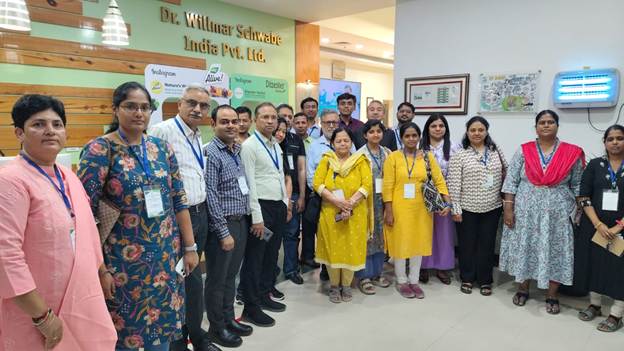
A major highlight of the mid-week sessions involved analyzing product stability, shelf-life, and statutory regulatory frameworks. To see these frameworks in action, participants left the lecture halls for on-site industrial inspections at major manufacturing hubs, including Dr. Willmar Schwabe India Pvt. Ltd. and Hamdard Laboratories. These visits provided real-world exposure to Good Manufacturing Practices (GMP)—the internationally recognized system that ensures products are consistently produced and controlled according to strict quality standards.
The latter half of the curriculum focused on critical safety metrics:
-
Microbiological Evaluation: Training regulators to detect harmful bacterial or fungal contamination that can occur during harvesting or packaging.
-
Heavy Metal Standardization: Developing precise technical competencies for evaluating metal and mineral-based formulations, particularly in traditional Bhasma preparations (purified elemental formulations).
Because mineral-based traditional drugs rely heavily on meticulous, ancient purification processes, modern scientific standardization is absolutely vital to verify that these elements are rendered completely non-toxic and therapeutically safe before they are distributed to pharmacies.
Leadership Visions and Public Health Implications
The inaugural session was opened by Chief Guest Jaspal Kaur Pradyot, Chief Controller of Accounts for the Ministry of Health & Family Welfare, alongside Abdul Qayum, Director (Technical) and Deputy CEO of the National Medicinal Plants Board. Raman Mohan Singh, Director of PCIM&H, welcomed the specialized cohort, emphasizing that robust regulation is the cornerstone of validating Indian medicine on the global stage.
At the closing valedictory session, Maneesha Upendra Kothekar, Chairperson of the National Commission for Indian System of Medicine, served as Chief Guest, joined by Pramod Kumar Pathak, Principal Consultant and Retired Special Secretary to the Ministry of Ayush. The leadership consensus underscored a shifting paradigm: traditional medicine is no longer viewed as separate from mainstream biomedical scrutiny.
“This is an essential evolutionary step for public health in India,” says Dr. Anand Rao, an independent public health policy analyst and researcher in integrated medicine, who was not involved in organizing the training. “When a consumer walks into a pharmacy, they deserve identical assurances of safety and quality whether they are purchasing a conventional antibiotic or a traditional Ayurvedic formulation. By training the very enforcement officers who audit these factories, the Ministry is actively building a modern defensive shield against substandard manufacturing.”
Balancing Progress with Structural Limitations
While the training program marks a significant milestone, independent healthcare experts point out that structural challenges remain. A class of 28 participants, though highly focused, represents a modest cross-section of a vast national industry. India features thousands of small-scale traditional drug manufacturing units spread across remote regions, many of which struggle to match the infrastructure of large enterprises like Hamdard or Schwabe.
Furthermore, integrating modern laboratory assays into decentralized state testing labs requires substantial, ongoing capital investment. Experts note that keeping pace with advanced adulteration techniques will require continuous training pipelines, expanded testing infrastructure, and more aggressive market surveillance beyond centralized workshops.
What This Means for Your Daily Health Choices
For health-conscious consumers, this regulatory push provides a reassuring layer of transparency. However, self-care safety still begins at home. When purchasing traditional or homoeopathic medicines, medical professionals advise taking several active precautions:
-
Look for Verification: Always look for official GMP certification symbols, manufacturer details, and batch numbers on product labels.
-
Avoid Unbranded Sources: Refrain from purchasing unlabelled raw powders or loose traditional mixtures from unverified or informal vendors online or in open markets.
-
Consult Professionals: Treat traditional medications with the same respect as conventional pharmaceuticals. Inform your primary healthcare provider about any traditional remedies you are taking to prevent potential, unintended herb-drug interactions.
By systematically elevating the technical capabilities of its frontline regulators, India’s Ministry of Ayush is taking verifiable steps to transition traditional medicine from an art form into a highly reproducible, strictly monitored science—protecting public health one standardized batch at a time.
Reference Section
1. Official Program Source
-
Press Information Bureau (PIB) Delhi. Pharmacopoeia Commission for Indian Medicine & Homoeopathy Concludes 5-Day Capacity Building Training Program for ASU&H Drug Regulators and Stakeholders. Ministry of Ayush, Government of India. Published May 22, 2026.
Medical Disclaimer: This article is for informational purposes only and should not be considered medical advice. Always consult with qualified healthcare professionals before making any health-related decisions or changes to your treatment plan. The information presented here is based on current research and expert opinions, which may evolve as new evidence emerges.