 0
0
 0
0
ISLAMABAD — Pakistan has reached a monumental crossroad in its three-decade struggle against wild poliovirus. World health leaders have officially declared that the nation possesses a “historic opportunity” to halt local transmission of the crippling virus within the next 6 to 12 months, provided current immunization drives and surveillance networks are aggressively maintained.
The announcement follows a high-level joint delegation to Islamabad led by Dr. Hanan Balkhy, the World Health Organization’s (WHO) Regional Director for the Eastern Mediterranean, alongside leaders from the global Polio Oversight Board (POB). Meeting directly with Pakistani Prime Minister Shehbaz Sharif on July 7, 2026, international health partners evaluated epidemiological data showing that wild poliovirus transmission in the country has dropped to its lowest geographic footprint in history.
“This is not just a milestone; this is a finish line within sight,” Dr. Balkhy remarked following strategic reviews with national health officials. “Discussions with national authorities and experts, together with the available evidence, show that Pakistan has a genuine opportunity to interrupt poliovirus transmission.”
A 99.8% Decline: Inside the Epidemiological Turnaround
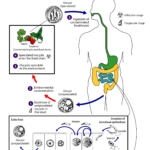
Poliomyelitis—commonly known as polio—is a highly infectious disease caused by a virus that attacks the central nervous system. In approximately 1 out of 200 infections, it leads to irreversible paralysis, typically in the legs. In severe cases, the virus paralyzes the muscles used for breathing, which can prove fatal. Because the virus spreads through person-to-person contact via the fecal-oral route or, less commonly, contaminated water and food, high population immunity is the only barrier against its spread.
Thirty years ago, Pakistan registered an estimated 20,000 cases of paralytic polio annually. By 2025, through coordinated mass vaccination efforts, that figure was cut down to 31 cases nationwide.
In the first half of 2026, Pakistan has reported just three cases of wild poliovirus type 1 (WPV1). Crucially, genetic testing reveals that residual endemic transmission is now almost exclusively concentrated in localized pockets within southern Khyber Pakhtunkhwa province.
          PAKISTAN'S 30-YEAR POLIO CASE TRAJECTORY

   20,000 | █
   (1994) | █
          | █
          | █
          | █
       31 | ▄ (2025)
        3 | ▂ (2026 YTD)
          +--------------------------------------------
High-Level Political Mobilization
During meetings in Islamabad, Prime Minister Sharif designated polio eradication as a top-tier national security and public health priority, ordering federal and provincial agencies to reinforce operations in remaining hotspots.
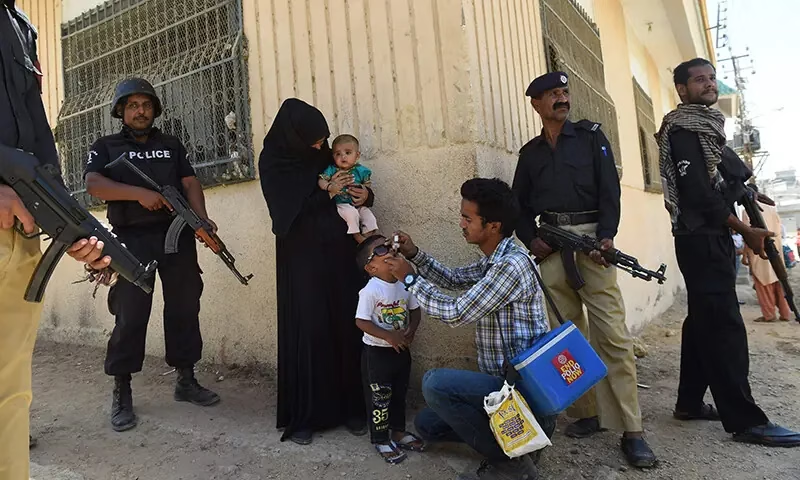
To achieve total interruption, Pakistan’s government, backed by the Global Polio Eradication Initiative (GPEI), has mobilized a army of frontline health workers—numbering over 400,000. Women make up roughly 60% of this workforce. Their participation is vital, as cultural norms in many conservative communities allow female health workers unique access to enter homes and directly vaccinate infants and young children. Together, these teams administer oral polio vaccine (OPV) droplets to more than 45 million children under age five during nationwide and targeted subnational campaigns each year.
Global Stakes and the Cross-Border Threat
While Pakistan’s progress is celebrated, public health epidemiologists warn against premature celebration. Today, wild poliovirus type 1 remains endemic in only two nations on Earth: Pakistan and neighboring Afghanistan.
Because poliovirus respects no international borders, unimmunized populations thousands of miles away remain at risk until global transmission reaches zero. The fragility of global immunity was highlighted in November 2025, when health authorities detected wild poliovirus in Germany via wastewater surveillance—an occurrence linked to international travel from endemic zones.
“The goal is within reach, and the cost of inaction—for Pakistan, the region, and the world—would far outweigh the investment needed to finish the job,” warned Dr. Balkhy.
International Funding and Logistics
Financing the final stage of eradication requires massive resource allocation for cold-chain storage (maintaining vaccines at sub-zero temperatures), transport, and personnel safety.
In January 2026, Rotary International allocated a $9.9 million grant to WHO Pakistan—part of a total $14.9 million operational commitment for the country this year—specifically aimed at vaccinating 27 million children in high-risk zones. Over the lifetime of the program, Rotary has poured nearly $500 million into Pakistan’s health infrastructure.
“Rotary’s long-standing commitment is crucial in our journey towards a polio-free world,” stated Dr. Luo Dapeng, WHO Representative in Pakistan, emphasizing that multi-agency support from partners like Gavi, the US CDC, UNICEF, and the Gates Foundation ensures door-to-door distribution remains fully resourced.
Geographic Obstacles and Remaining Challenges
Despite historic gains, the final phase of any disease eradication campaign is notoriously the most difficult. Epidemiologists point to three core vulnerabilities that could derail progress over the coming months:
-
Security Concerns & Access Limitations: In parts of southern Khyber Pakhtunkhwa, ongoing security instability and sporadic targeted violence against vaccination teams occasionally disrupt access to vulnerable children.
-
Cross-Border Population Movement: The highly porous border between Pakistan and Afghanistan sees millions of nomadic populations and families crossing annually. If poliovirus remains active on one side of the border, it can easily seed fresh outbreaks on the other. Health authorities in both nations are currently holding synchronized immunization dialogues to coordinate vaccination posts along major transit corridors.
-
Environmental Tracking vs. Clinical Cases: To find the virus before it paralyses a child, health workers routinely test environmental sewage samples. Environmental surveillance networks across Pakistan continue to detect low-level viral presence in wastewater even where no clinical paralysis cases have been reported, demonstrating that silent transmission persists in small pockets.
The “Roadmap to Zero”: What Lies Ahead
To navigate the next 12 months, Senator Ayesha Raza Farooq, the Prime Minister’s Focal Person for Polio Eradication, introduced Pakistan’s updated “Roadmap to Zero Polio.”
The strategy focuses on fusing polio campaign logistics with the country’s broader Expanded Programme on Immunisation (EPI). By bundling the oral polio vaccine with routine childhood shots (such as measles, tetanus, and hepatitis B), public health teams can boost overall childhood immunity while addressing vaccine fatigue among local populations.
If Pakistan successfully interrupts transmission within this six-to-twelve-month window, and maintains zero cases for three consecutive years under rigorous surveillance, poliomyelitis will become only the second human infectious disease in history to be completely eradicated from the planet, following smallpox in 1980.
Medical Disclaimer
This article is for informational purposes only and should not be considered medical advice. Always consult with qualified healthcare professionals before making any health-related decisions or changes to your treatment plan. The information presented here is based on current research and expert opinions, which may evolve as new evidence emerges.
References
-
World Health Organization Eastern Mediterranean Regional Office (WHO EMRO). “WHO Regional Director reaffirms support as Pakistan intensifies ‘critical’ efforts to interrupt polio transmission over the next 6 months.” Published July 27, 2026. WHO EMRO Report