 0
0
 0
0
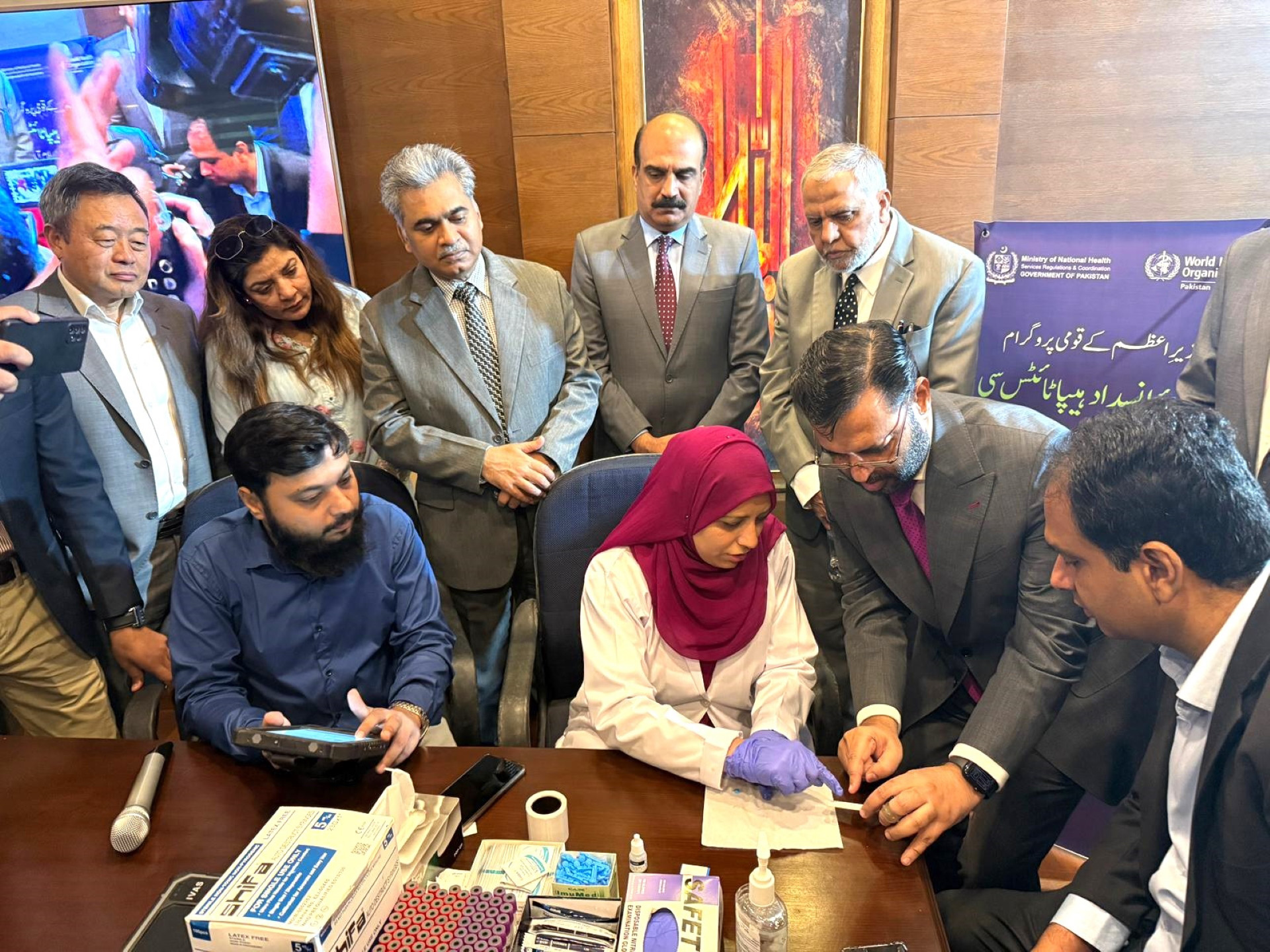
14 May 2026, Islamabad, Pakistan – Pakistan and the World Health Organization (WHO) today launched the Prime Minister’s National Programme for the Elimination of Hepatitis C in the Islamabad Capital Territory (ICT) with the goal of reaching 1.6 million people in the area over the next 6 months, and over 164 million across the country in subsequent phases. The main goal is to eliminate hepatitis C as a public health threat by 2030, as agreed upon by the World Health Assembly.
With 10 million of the almost 50 million estimated cases worldwide, Pakistan has the heaviest burden of hepatitis C globally. Worldwide, only 1 in 3 affected people know that they are living with this disease. It is estimated that 110,000 people are infected with hepatitis C in Pakistan each year – primarily, 62% due to unsafe medical injections (including blood transfusions) and 38% due to injection drug use.
With technical support from WHO – and under the leadership of the Ministry of National Health Services, Regulations and Coordination – the programme aims to prevent, detect and provide life-saving treatment to those who test positive for hepatitis C.
“Elimination of hepatitis C in Pakistan is not optional. We must do it. Launching this programme in Islamabad is a paradigm shift. Health is a national security issue, and an economic issue,” said Federal Health Minister Syed Mustafa Kamal. “With technical support from the World Health Organization we can and we must use the best science-based practices to eliminate this disease and protect our people and our families from this deadly disease, which is curable and preventable if we all follow good blood and injection safety measures. We know that prevention is better than cure.”
Over the next 5 years, the programme could generate savings amounting to 1.3 billion Pakistani rupees (PKR) (US$ 4.6 million) in treatment costs, and over 2 billion Pakistani rupees (US$ 7 million) in hospitalization costs, totaling savings of 3.3 billion Pakistani rupees (close to US$ 12 million). By 2030, it is estimated that the national return on investment would be US$ 8 for every US$ 1 invested.
The pilot phases conducted in specific provinces have provided critical insights into operational feasibility, challenges, and best practices for nationwide scale-up.
“The Prime Minister’s Programme is a major step towards achieving the 2030 global goal of eliminating hepatitis C as a public health threat. The programme could also avert 850,000 deaths and 1.1 million new infections by 2050. WHO will stand with Pakistan and its people to implement this initiative following medical science and adapting to the Pakistani context the best practices and lessons learned from around the world,” said WHO Representative in Pakistan Dr Luo Dapeng. “Detecting and treating hepatitis is essential, but prevention is the key to end the disease, including preventing mother-to-child transmission, safe injections and blood transfusions, and harm reduction.”