 0
0
 0
0
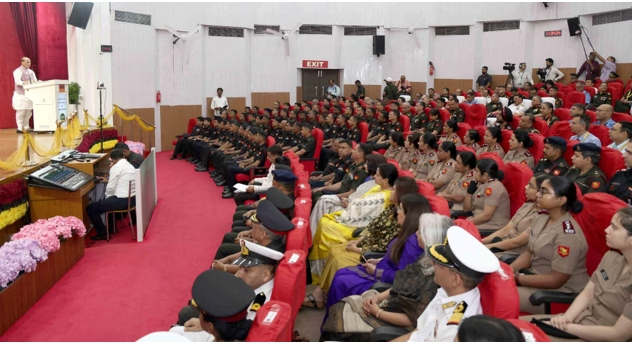
DELHI CANTT — In a move set to redefine the landscape of military healthcare in India, Raksha Mantri Shri Rajnath Singh laid the foundation stones for three specialized medical centers at the Army Hospital (Research & Referral) and a massive infrastructure overhaul at the Base Hospital on April 6, 2026. The ceremony, marking the 262nd Army Medical Corps (AMC) Raising Day, signals a strategic shift toward high-tech tertiary care, personalized medicine, and pharmaceutical self-reliance for the nation’s defense forces and their families.
The expansion includes dedicated centers for Ophthalmology, Oncology, and Joint Replacement, alongside a 998-bed facility at the Base Hospital equipped with a 100-bed crisis expansion wing. These facilities aim to provide cutting-edge treatment to serving personnel, veterans, and their dependents, ensuring that those who protect the nation have access to world-class health security.
Precision and Protection: Strengthening the Medical Frontline
The new centers at Army Hospital (R&R) are designed to address the increasing complexity of modern healthcare needs within the military.
-
Oncology: The new center will focus on early detection and personalized cancer therapies.
-
Ophthalmology: Enhanced capabilities for complex eye surgeries, building on the AMC’s success in treating cataracts and glaucoma.
-
Joint Replacement: Specialized infrastructure for orthopedic interventions, critical for both aging veterans and active-duty personnel recovering from trauma.
“Health security is as pivotal as border security,” Shri Rajnath Singh stated during his address. He emphasized that when soldiers are confident in the medical support behind them, they execute missions with greater resolve. The Raksha Mantri’s vision extends beyond domestic care, noting that India’s military medical services have become a pillar of “soft power,” providing essential eye care and surgical interventions to neighboring nations like Nepal.
From Generics to Innovation: The Push for Self-Reliance
While India is often called the “pharmacy of the world” due to its massive export of generic drugs, the Raksha Mantri issued a candid call for evolution. He highlighted that the country remains dependent on external sources for high-end drug innovation and deep research.
The Minister urged the Armed Forces Medical Services (AFMS) to integrate with MSMEs and start-ups to foster an innovation-driven pharmaceutical ecosystem. He specifically pointed to the need for:
-
Advanced Predictive Models: Utilizing data to forecast cardiovascular diseases.
-
Neuro-research: Addressing mental health through dedicated neurological studies.
-
Clinical Trial Reform: Moving toward a framework where research, treatment, and innovation are equally prioritized, similar to industry-sponsored models in advanced nations.
Bridging Ancient Wisdom and Modern Science
In a unique directive, the Raksha Mantri encouraged the AFMS to blend modern medical science with “ancient philosophy.” This holistic approach seeks to create a healthcare model that is not just reactive—treating illness as it appears—but proactive and preventive.
To support this evidence-based transition, the Minister released a new medical text titled ‘Precision Protocols in Early Neurodevelopmental Intervention’. The book aims to standardize diagnosis for neurodevelopmental conditions, reflecting a growing academic rigor within the military medical fraternity.
Balancing the Burden: Research vs. Patient Care
Acknowledging the “heavy workload” faced by military doctors, the Raksha Mantri noted that the demands of surgery and daily outpatient departments often leave little room for research and teaching. He suggested a “brownfield” approach to expansion—upgrading existing Command and Base Hospitals across India to the standards of the Research & Referral (R&R) facility, rather than relying solely on building new institutions from scratch.
Expert Commentary: The Path Forward
Independent healthcare analysts suggest that the integration of digital health data is the next logical step for the AFMS.
“The establishment of a national-level data pool for military health, as suggested by the Raksha Mantri, could be a game-changer,” says Dr. Ananya Sharma, a public health consultant not involved in the project. “By standardizing protocols and sharing clinical experiences through systemic channels, the AFMS can validate new medical practices at a scale rarely seen in the private sector.”
However, some experts caution that “self-reliance” in high-end pharmaceuticals is a long-term goal. “Transitioning from a generic-heavy industry to one led by original research requires sustained funding and a significant shift in patent-related infrastructure,” notes a representative from the Indian Pharmaceutical Association.
Implications for the General Public
While these facilities are primarily for the defense community, the innovations developed here often trickle down to the civilian sector. The push for better cancer detection and cardiovascular predictive models within the AFMS is expected to contribute to the broader goals of the Ayushman Bharat initiative, enhancing the overall national healthcare standard.
Awards for Excellence
The ceremony concluded with the presentation of the Raksha Mantri Trophy:
-
Best Hospital (AFMS): Command Hospital (Southern Command), Pune.
-
Second Best Hospital: INHS Asvini, Mumbai.
These awards recognize excellence in patient care and administrative efficiency, setting a benchmark for the new centers under construction in Delhi.
Medical Disclaimer: This article is for informational purposes only and should not be considered medical advice. Always consult with qualified healthcare professionals before making any health-related decisions or changes to your treatment plan. The information presented here is based on current research and expert opinions, which may evolve as new evidence emerges.
Reference Section
Primary Sources:
-
Press Information Bureau (PIB). “Raksha Mantri lays foundation stones of Ophthalmology, Oncology & Joint Replacement Centres at Army Hospital (R&R).” April 6, 2026.