 0
0
 0
0
April 10, 2026
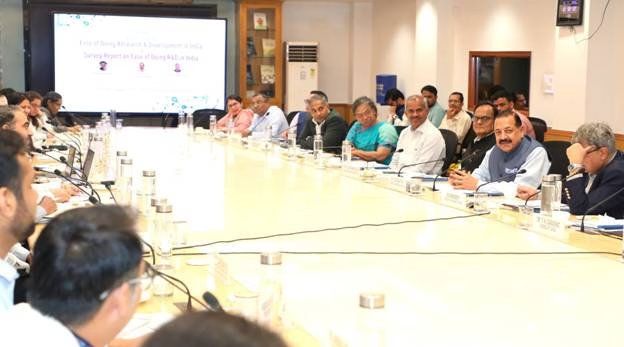
NEW DELHI — In a bid to transform India from a regional research hub into a global innovation powerhouse, Union Minister for Science & Technology Dr. Jitendra Singh issued a clarion call on Thursday for the private sector to bridge the nation’s R&D investment gap. Speaking at the release of two pivotal NITI Aayog reports, Dr. Singh emphasized that while the government has deregulated strategic sectors like space and nuclear energy, the mantle of sustainable innovation must now be shared by private industry. The move signals a major shift in policy intended to reduce bureaucratic “bottlenecks” and foster a culture of philanthropy to accelerate medical and technological breakthroughs.
The Push for a “Mindset Change”
The centerpiece of the Minister’s address was the urgent need for “Ease of Research.” Despite India’s vast human resource potential, the Minister noted a persistent mismatch between scientific capability and the administrative systems that support it.
“There is no denying that research can flourish only when there are no impediments, no slowdowns, and no avoidable interruptions,” Dr. Singh stated. He argued that for India to achieve its health and economic goals, the focus must shift from how systems look on paper to how they are actually experienced by researchers in the lab.
To facilitate this, the government has introduced the Research, Development, and Innovation (RDI) fund, a dedicated mechanism designed to incentivize private players. However, Dr. Singh acknowledged that industry readiness remains “uneven,” calling for a systemic change in how corporate India views scientific investment.
Addressing the Funding Gap
A critical takeaway from the NITI Aayog reports is the lopsided nature of R&D funding in India. Currently, the lion’s share of research expenditure is borne by the public sector, a model that experts say is unsustainable for a modern economy.
-
CSR Underutilization: The Minister flagged that even existing Corporate Social Responsibility (CSR) allocations are not being fully utilized for R&D purposes.
-
Administrative Friction: Suman Bery, Vice Chairman of NITI Aayog, noted that inefficiencies often occur at the “intersections of systems”—where funding meets execution.
-
The TSA Framework: Prof. A.K. Sood, Principal Scientific Adviser, highlighted specific hurdles like the Treasury Single Account (TSA) framework and low funding success rates that continue to hamper the “ease of doing science.”
Expert Perspectives: A “Point of Transition”
Outside the government, the medical and scientific community views these reforms as long overdue. Dr. V.K. Saraswat, Member of NITI Aayog, described the current ecosystem as being at a “point of transition.”
Independent analysts suggest that for health-conscious consumers, these reforms could mean faster access to locally developed vaccines, medical devices, and precision medicine. “When you reduce the time between a laboratory discovery and its clinical application by cutting administrative red tape, you effectively save lives,” says Dr. Arvinder Singh (not affiliated with the research), a health policy consultant. “The emphasis on ‘One Nation, One Subscription’ for research journals is a massive step in democratizing knowledge for doctors and researchers alike.”
Implications for Public Health
The Minister’s push for private R&D has direct implications for the healthcare sector. By encouraging private pharmaceutical and biotech firms to invest more deeply in basic research, the government hopes to:
-
Lower Costs: Locally researched and manufactured medical technologies are typically more affordable than imported alternatives.
-
Tailored Solutions: R&D focused on the Indian genome and local disease profiles can lead to more effective treatments for the domestic population.
-
Speed of Innovation: As seen during the COVID-19 pandemic, a robust R&D-industry link is vital for rapid response to public health emergencies.
Challenges and Counterarguments
While the vision is ambitious, critics point to significant hurdles. Skeptics argue that the private sector’s “uneven readiness” is due to a lack of long-term ROI (Return on Investment) clarity in basic research.
Furthermore, the NITI Aayog reports admit that “incremental improvements” in routine processes—like approvals and funding flows—are still needed. Without these, even the most generous RDI fund may fail to attract cautious private investors. There is also the concern that a heavy reliance on private funding might skew research toward “profitable” diseases rather than “neglected” tropical diseases that affect the poorest demographics.
The Way Forward
Dr. Jitendra Singh’s closing remarks served as a reminder of the collaborative nature of modern science: “Science today is too serious a subject to be left to scientists alone.”
The government’s strategy moving forward involves a three-pronged approach:
-
Institutional Autonomy: Giving researchers more freedom to manage funds.
-
Coordinated Reforms: Aligning top-down policy with ground-level execution.
-
Global Alignment: Adopting international best practices to make Indian research competitive on the world stage.
As India seeks to expand its innovation capacity, the success of these reforms will depend on whether the private sector views R&D as an expensive risk or a necessary pillar of future growth.
Medical Disclaimer
Medical Disclaimer: This article is for informational purposes only and should not be considered medical advice. Always consult with qualified healthcare professionals before making any health-related decisions or changes to your treatment plan. The information presented here is based on current research and expert opinions, which may evolve as new evidence emerges.
Reference Section
Official Reports & Government Sources:
-
NITI Aayog (2026). Easing Research and Development Processes in India: A Path to Innovation. Released April 9, 2026.
-
Press Information Bureau (PIB). Dr. Jitendra Singh calls for systemic reforms, change of mindset for Ease of Research. Posted 09 APR 2026. [PIB Delhi].