 0
0
 0
0
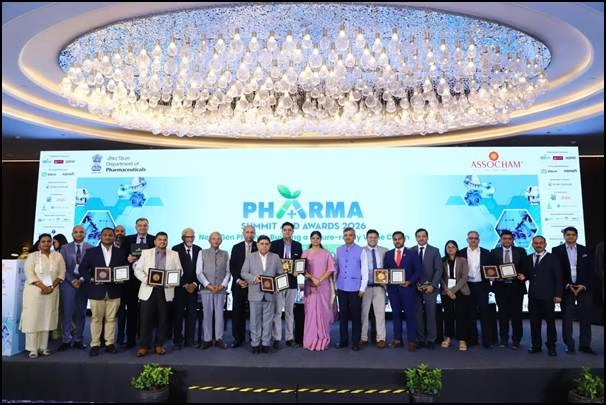
NEW DELHI — In a major policy shift aimed at transforming the global landscape of advanced medicine, the Government of India has unveiled a sweeping framework to transition the country from the “pharmacy of the world” for traditional generic drugs into a dominant powerhouse for complex biological therapies. Speaking at the 2nd Pharma Summit & Awards 2026 organized by the Associated Chambers of Commerce and Industry of India (ASSOCHAM) on Thursday, June 11, 2026, Smt. Anupriya Patel, Union Minister of State for Chemicals & Fertilizers, announced the implementation of the ₹10,000 crore Biopharma SHAKTI initiative. The flagship mission mandates the domestic development and launch of at least 100 novel biologics and biosimilars by 2047, directly targeting the global expansion of advanced, affordable medical treatments for chronic diseases.
The aggressive policy push arrives at a critical juncture for international healthcare. Biopharmaceuticals—complex medicines manufactured in or extracted from living biological sources—are rapidly eclipsing traditional chemical-based pills. According to data highlighted by the Ministry, biologics are projected to account for nearly 40% of all global prescription drug markets by 2031. By anchoring this five-year, ₹10,000 crore fiscal roadmap within its national health strategy, India intends to aggressively disrupt the high-cost biopharma monopoly currently held by a handful of Western nations, lowering the financial barriers to lifesaving treatments for patients worldwide.
Shifting From Chemical Generics to Living Therapeutics
For decades, traditional small-molecule drugs—synthesized through predictable chemical formulations like common aspirin or standard blood pressure tablets—have formed the bedrock of affordable medicine. Biologics, however, represent an entirely different frontier of biomedical engineering. These therapeutics include monoclonal antibodies (mAbs), advanced vaccines, gene therapies, and recombinant proteins. Because they are cultivated within living cells (such as mammalian, bacterial, or yeast cultures), their molecular structures are highly complex, often hundreds of times larger than traditional chemical compounds.
Understanding the Therapeutic Divide
To help visualize how the next generation of medicine compares to traditional pharmaceuticals, the baseline characteristics below outline the fundamental differences in manufacturing, molecular structure, and pricing models:
| Characteristic | Traditional Small-Molecule Drugs | Advanced Biologics & Biosimilars |
| Production Method | Predictable chemical synthesis in a laboratory setting | Cultivated within living cells, organisms, or biological systems |
| Molecular Structure | Simple, small, and stable structures (e.g., Aspirin) | Massive, highly complex 3D structures (e.g., Monoclonal Antibodies) |
| Generic Equivalent | Exact chemical replicas (Generics) are easily produced | “Highly similar” biological copies (Biosimilars); exact replicas are impossible |
| Global Cost Impact | Consistently low cost; highly accessible | Historically high cost, frequently leading to restricted patient access |
“India has established undisputed global leadership in supplying low-cost, small-molecule generic medicines,” Minister Patel noted during her address. “However, the future of modern healthcare is being fundamentally reshaped by biopharmaceuticals. We are committed to aggressively strengthening our domestic innovation, clinical research infrastructure, and regulatory pathways to ensure our nation stands at the absolute vanguard of this therapeutic evolution.”
The “SHAKTI” acronym (Strategy for Healthcare Advancement through Knowledge, Technology, and Innovation) outlines an end-to-end overhaul of the pharmaceutical supply chain. The Department of Pharmaceuticals is orchestrating this transition by building upon pre-existing frameworks like the National Biopharma Mission and the Promotion of Research and Innovation in Pharma (PRIP) scheme. Furthermore, industrial and manufacturing innovations are receiving immediate funding injections through specialized Biotechnology Industry Research Assistance Council (BIRAC) mechanisms, including the Biotech Ignition Grant, SBIRI, and BIPP programs.
Re-Engineering Clinical Trials via Non-Animal Methodologies
A key pillar of the Biopharma SHAKTI mission is its radical departure from legacy drug-testing protocols. In an effort to dramatically accelerate drug discovery while cutting the prohibitive costs traditionally passed on to consumers, the scheme prioritizes the integration of Non-Animal Methodologies (NAMs) for preclinical safety and efficacy screenings.
Rather than relying entirely on traditional animal models, which can fail to accurately replicate human physiological responses, the government is funding advanced alternatives. These include:
-
Organoids: Three-dimensional, micro-scaled versions of human organs grown from stem cells.
-
Organ-on-a-chip technologies: Microfluidic chips lined with living human cells that mimic the organ-level physiology of a real patient.
-
3D Bioprinting: Fabricating complex human tissue architectures to test cellular responses to novel biological drugs.
To support this shift, the government is establishing three new National Institutes of Pharmaceutical Education and Research (NIPERs) and upgrading seven existing campuses into specialized centers of translational research excellence. Crucially, the plan details the creation of a national network comprising over 1,000 accredited clinical trial sites, ensuring robust data collection and compressed drug development timelines.
Public Health Implications: Combating the Chronic Disease Burden
The strategic focus on biologics and their highly precise biological copies, biosimilars, is heavily driven by a shifting global and domestic public health crisis. Non-communicable diseases (NCDs)—including aggressive cancers, diabetes, and severe autoimmune disorders—now account for approximately 63% of all annual deaths in India, mirroring a rising tide of chronic illnesses globally.
While biologics offer highly targeted, effective treatments for these conditions by binding to specific disease-causing proteins in the body, their current price tags place them far out of reach for average consumers. A single course of imported monoclonal antibody therapy for oncology can cost thousands of dollars, forcing millions into healthcare-induced poverty or treatment abandonment.
“The real victory of the Biopharma SHAKTI mission won’t just be measured in macroeconomic growth, but in domestic and international patient access,” says Dr. Aranya Sen, an independent public health policy researcher and epidemiologist not involved in the government formulation. “By scaling up domestic biosimilar manufacturing to a global scale, India has the distinct potential to cut the market price of these critical biological drugs by 30% to 70%. This could democratize cancer and diabetes care in low- and middle-income nations in the exact same way Indian generics transformed global HIV treatment two decades ago.”
Echoing the necessity for systemic durability, Shri Manoj Joshi, Secretary of the Department of Pharmaceuticals, emphasized that achieving true self-reliance requires absolute infrastructural security. Addressing the summit, Joshi stressed that the industry must simultaneously build a highly skilled biotechnological workforce and establish exceptional supply chain resilience to withstand geopolitical friction or raw material shocks.
Navigating Structural Hurdles and Expert Skepticism
Despite the optimistic multi-decade horizon outlined by the government, seasoned industry analysts and medical professionals urge balanced caution. Transforming a generic-centric manufacturing ecosystem into an advanced biotech sector presents immense regulatory and biological hurdles.
Unlike chemical generics, which can be easily replicated, biosimilars are grown in living systems, meaning no two batches are ever perfectly identical. This inherent variability demands incredibly rigorous quality control standards to ensure batch-to-batch consistency, safety, and efficacy.
“The primary challenge lies in our regulatory architecture and clinical trial oversight,” notes Dr. Sen. “Relying heavily on Non-Animal Methodologies like organoids is scientifically progressive, but global regulatory bodies like the US FDA and European Medicines Agency are still evolving their compliance standards for these technologies. If India’s newly developed biologics face friction during international regulatory audits, it could delay global adoption.”
Furthermore, industry critics point out that while the ₹10,000 crore allocation is a substantial step forward for public financing, global pharmaceutical giants typically spend upwards of $1 billion to bring a single novel biologic to market. Consequently, the success of the Biopharma SHAKTI vision will hinge entirely on the government’s ability to trigger massive, sustained co-investments from the private sector, venture capital, and multinational pharmaceutical alliances.
What This Means for Global Consumers
For health-conscious consumers and patients managing long-term illnesses, the unfolding policy shift signals a major transition in how treatments will be accessed and budgeted for in the coming decade.
-
Expanded Therapeutic Portfolios: Over the next several years, a significantly wider array of biosimilar options will enter the global pipeline, providing alternative choices for individuals prescribed expensive biological therapies for conditions like rheumatoid arthritis, psoriasis, and various cancers.
-
Gradual Downward Price Pressure: As competitive domestic manufacturing scales up, the steep costs associated with advanced biologics are expected to steadily decline, making highly effective therapies standard components of basic hospital care.
-
Heightened Standards of Safety: The integration of human-centric testing tools like organoids means emerging drugs will undergo localized, highly precise safety profiling, reducing adverse event rates during later clinical deployment.
As the global pharmaceutical sector moves toward a highly digitized, future-ready value chain, India’s deliberate pivot toward advanced living therapies marks a pivotal chapter. If the collaborative framework between public policy, academic NIPER centers, and private manufacturing holds firm, the path toward 2047 may well rewrite the economics of modern medical care.
Reference Section
-
Primary Policy Source: Press Information Bureau (PIB) Delhi, Ministry of Chemicals and Fertilizers, Department of Pharmaceuticals. Press Release: “Biopharmaceuticals Are Shaping the Future of Modern Healthcare; India Well-Positioned to Emerge as a Global Leader : Smt. Anupriya Patel.” Published June 11, 2026. [PRID: 2271807].
Medical Disclaimer
Medical Disclaimer: This article is for informational purposes only and should not be considered medical advice. Always consult with qualified healthcare professionals before making any health-related decisions or changes to your treatment plan. The information presented here is based on current research and expert opinions, which may evolve as new evidence emerges.