 0
0
 0
0
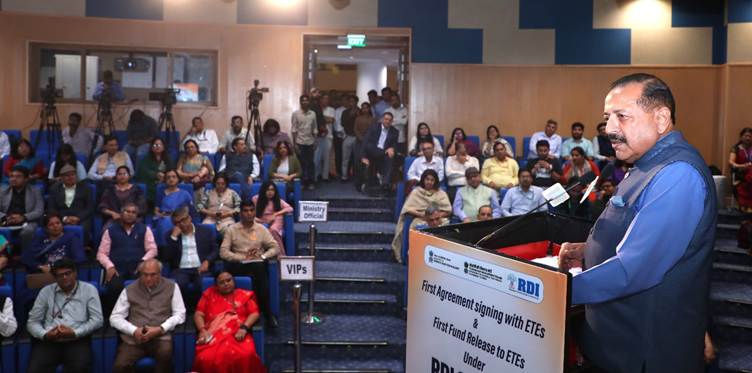
NEW DELHI — In a major move to secure India’s technological future, the Union Ministry of Science and Technology on May 16, 2026, launched the first phase of its ambitious Research, Development and Innovation (RDI) Fund Scheme. Speaking at the Dr. Ambedkar International Centre, Union Minister Dr. Jitendra Singh announced that national growth, public health resiliency, and national security will be defined by “quantum and Artificial Intelligence (AI) sovereignty.”
The landmark event saw the Technology Development Board (TDB) sign agreements for five high-impact deep-tech projects, culminating in the first electronic fund disbursement under the national initiative. Among the chief beneficiaries is the healthcare sector, receiving substantial backing to pioneer next-generation cell therapies and AI-driven emergency lifelines designed specifically for rural populations.
The RDI Fund: Catalyzing Private Innovation
For decades, private sector investment in high-risk deep-tech research within India remained conservative. The RDI Fund aims to change that. According to TDB Secretary Shri Rajesh Kumar Pathak, the initiative received 124 project proposals within a short window, representing a massive market demand worth over ₹25,000 crore.
“Unlike conventional models where governments expect industry participation independently, India has adopted a proactive approach by creating institutional and financial support mechanisms,” Dr. Singh stated.
The initiative positions startups, micro, small, and medium enterprises (MSMEs), and public corporations as long-term innovation partners. Of the 22 companies selected for funding, 15 were scouted via a nationwide search ahead of the global Bharat Innovates 2026 showcase in France.
Transforming Public Health: From Blindness to Rural ICUs
While the RDI initiative spans multiple sectors like aerospace and clean energy, its most immediate, human-centric triumphs lie in advanced medical technology and regenerative medicine. Two major clinical breakthroughs received substantial backing during the event.
1. Incurable Diseases Target of ₹50 Crore Cell Therapy Grant
Bengaluru-based Eyestem Research Private Limited received the event’s inaugural electronic fund transfer—a massive ₹50 crore tranche. The capital is designated for the clinical advancement and commercialization of first-in-class cell therapies targeting two globally devastating and currently incurable conditions:
-
Geographic Atrophy (GA): An advanced, irreversible form of Age-related Macular Degeneration (AMD) that leads to progressive and permanent vision loss.
-
Idiopathic Pulmonary Fibrosis (IPF): A chronic, progressive lung disease causing severe lung scarring, making breathing increasingly difficult over time.
According to global epidemiological data from organizations like the World Health Organization (WHO), age-related vision impairment and chronic respiratory illnesses represent ballooning public health crises. If successful, Eyestem’s indigenous cell platforms could democratize access to regenerative medicine, lowering the cost of treatments that are typically price-prohibitive in Western markets.
2. AI-Powered “ICUs on Wheels” for Rural India
Addressing the stark rural-urban healthcare divide, Uttar Pradesh-based Noccarc Robotics signed an agreement to develop the Intelligent Mobile Life Support System (iMLSS).
The iMLSS is a portable, ICU-grade emergency platform explicitly designed to withstand rugged Indian field conditions. It integrates:
-
Advanced ventilator and patient monitoring hardware.
-
AI-assisted clinical guidance to assist remote medical staff.
-
Multilingual voice support to break down language barriers during critical care situations.
This system aims to solve a persistent public health failure: the high mortality rate associated with transporting critical patients from rural villages to tier-1 city hospitals without stabilization.
Beyond Medicine: Satellites, Drones, and Green Energy
The remaining agreements under the RDI Fund illustrate India’s multifaceted approach to self-reliance (Atmanirbhar Bharat):
| Innovator | Project/Technology | Primary Public Impact |
| e-TRNL Energy Pvt. Ltd. (Maharashtra) | Patented 3D Electrode Architecture (3DEA) Lithium-ion battery cells. | Boosts domestic green energy manufacturing and EV battery life. |
| Dhruva Space Private Limited (Hyderabad) | “Project Garud” — 500 kg-class modular satellite platform. | Strengthens resilient communication networks for disaster response. |
| Endure Air Systems Private Limited (Noida) | “Project Sabal-200” — Unmanned heavy-lift helicopter (200kg+ payload). | Rapid medical and logistics delivery in high-altitude, disaster-struck terrain. |
The Clock is Ticking: Preparing for “Q-Day”
A pivotal highlight of the convention was the release of the “Quantum-Safe Ecosystem in India” report. Government officials turned attention to an impending digital vulnerability known colloquially in cybersecurity circles as “Q-Day”—the hypothetical point at which quantum computers become powerful enough to break existing cryptographic standards.
Principal Scientific Adviser to the Government of India, Prof. Ajay Kumar Sood, warned that current encryption systems safeguarding banking, telecommunications, governance, and sensitive healthcare databases will eventually become vulnerable.
“The country must prepare proactively,” Prof. Sood emphasized, advocating for immediate national infrastructure upgrades.
Dr. Jitendra Singh added that while India originally set an eight-year target to achieve a 2,000 km quantum-secure communication capability under the National Quantum Mission, the country has remarkably achieved nearly half that benchmark in under four years. Post-quantum cryptography (PQC) and quantum key distribution (QKD) are being institutionalized to prevent malicious actors from potentially compromising state infrastructure or civilian health data records.
Public Health Implications and Practical Reality
For the everyday citizen, these high-tech developments carry concrete implications. A robust, secure digital infrastructure means personal electronic health records (EHRs) remain shielded from data breaches. Furthermore, domestic manufacturing of cell therapies and portable medical devices means life-saving interventions could soon become accessible at local community health centers, rather than being confined to premier metropolitan research hospitals.
However, medical experts urge balanced optimism. While a ₹50 crore funding injection dramatically accelerates biotechnology pipelines, cell therapies require rigorous, multi-phase human clinical trials to definitively prove safety and efficacy. These regulatory steps inherently take years to complete.
Nevertheless, by establishing an integrated ecosystem that links private tech talent with aggressive state funding, India is systematically mitigating its reliance on foreign intellectual property—paving a self-directed path toward its Viksit Bharat 2047 vision of a fully developed nation.
References
-
Government Announcement: Press Information Bureau (PIB) Delhi, Ministry of Science & Technology. “Quantum and AI sovereignty, along with indigenous ecosystems will define India’s next-generation growth: Dr Jitendra Singh.” Published May 16, 2026.
Medical Disclaimer: This article is for informational purposes only and should not be considered medical advice. Always consult with qualified healthcare professionals before making any health-related decisions or changes to your treatment plan. The information presented here is based on current research and expert opinions, which may evolve as new evidence emerges.