 0
0
 0
0
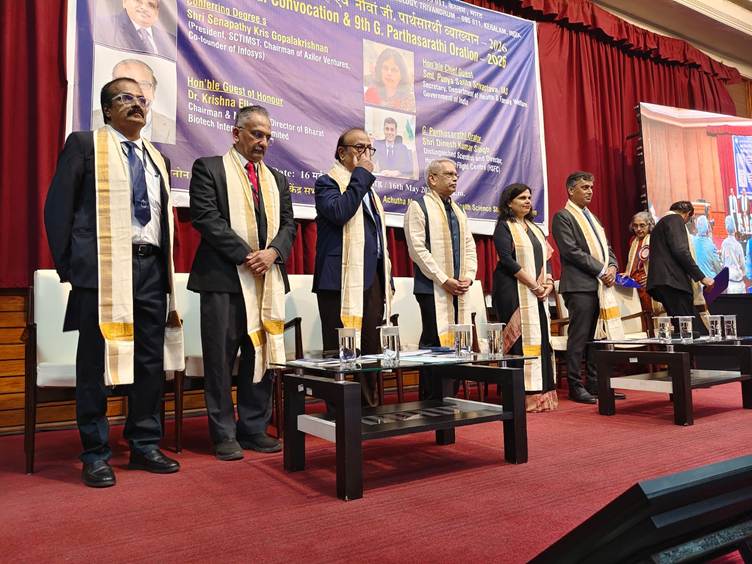
THIRUVANANTHAPURAM, KERALAM — In a major milestone for India’s medical research and healthcare infrastructure, 130 medical specialists, public health professionals, and scientists graduated from the Sree Chitra Tirunal Institute for Medical Sciences and Technology (SCTIMST) during its 42nd annual convocation on May 16, 2026. The ceremony, which coincided with the institute’s Golden Jubilee celebrations, highlighted India’s aggressive shift toward indigenous medical device manufacturing and an integrated, digital-first public health ecosystem designed to mitigate the country’s rising burden of chronic diseases.
Addressing the graduates virtually, Shri Jitendra Singh, Union Minister of State (Independent Charge) for Science and Technology and Earth Sciences, lauded the Institute of National Importance for its unique dual-expertise approach, which blends advanced biomedical engineering with specialized clinical care. Concurrently, Union Health Secretary Smt. Punya Salila Srivastava, attending as the Chief Guest, outlined sweeping regulatory reforms and massive digital expansions under the Ayushman Bharat framework aimed at enhancing patient care continuity across the nation.
Driving Cost-Effective, World-Class Medical Innovation
A central focus of the convocation was the critical need for domestic medical technology to lower healthcare costs. India has historically relied heavily on imported medical hardware, which frequently inflates treatment costs for complex cardiovascular and neurological procedures.
Shri Jitendra Singh emphasized that SCTIMST’s core strength lies in breaking this dependency.
“The unique focus of the institute is in the making of medical devices which are world-class, highly effective, and at the same time indigenous and cost-effective,” Singh stated.
To demonstrate this ongoing pipeline, the minister announced that seven newly developed medical technologies are being transferred to commercial industry partners this year alone.
Furthermore, the expansion of the institute’s physical and clinical footprint was prominently highlighted. The Ministry of Health and Family Welfare’s establishment of a new nine-floor Pradhan Mantri Swasthya Suraksha Yojana (PMSSY) block alongside a four-floor services block will effectively transform the facility into one of the largest specialized hubs for neurosurgery and cardiac sciences in South Asia. Additionally, an approved faculty expansion will nearly double the institute’s operational capacity.
Ayushman Bharat and the ‘Continuum of Care’
Taking the podium, Union Health Secretary Smt. Punya Salila Srivastava contextualized these institutional achievements within India’s national healthcare strategy. She explained that the foundational philosophy of the National Health Policy is transitioning away from reactive, crisis-based medicine toward a proactive, “continuum of care” model.
[Primary Care Screening] ──> [Secondary/Tertiary PM-JAY Hospitals] ──> [Longitudinal Digital Records via ABHA]
“The concept of Ayushman Bharat is aimed at ensuring a continuum of care so that citizens live long and live well,” Srivastava noted, adding that the flagship insurance program, Pradhan Mantri Jan Arogya Yojana (PM-JAY), now covers more than 600 million citizens.
Srivastava explained that by widening primary care screening at localized Ayushman Arogya Mandirs to include non-communicable diseases (NCDs), mental health, geriatrics, and palliative care, the government hopes to detect severe cardiovascular and neurological conditions much earlier. Early clinical intervention at the primary level directly reduces the overwhelming surgical burden currently placed on tertiary referral hospitals.
Scaling Digital and AI Health Ecosystems
A crucial component of maintaining this continuum of care is the Ayushman Bharat Digital Mission (ABM). Through the Ayushman Bharat Health Account (ABHA) system, citizens can establish longitudinal digital health records. This consent-based framework allows distinct medical facilities to securely access a patient’s integrated medical history across their lifespan, significantly optimizing referral accuracy and enabling precision healthcare.
The health secretary also shed light on the government’s foray into cutting-edge computational health, citing a newly launched Artificial Intelligence (AI) strategy developed in collaboration with IIT Kanpur. To ensure these tools are robust and safe, the National Health Authority has deployed ‘Bhashini’, an open data platform engineered to benchmark and validate AI-based diagnostic and healthcare tools before clinical rollout.
Slashing Red Tape for Generic Drugs and Medical Devices
Acknowledging that rigid bureaucracy can unintentionally stifle medical breakthroughs and delay affordable care, Srivastava announced that the Central Drugs Standard Control Organization (CDSCO) is executing comprehensive regulatory overhauls.
The targeted reforms aim to simplify licensing and documentation procedures for low-risk pharmaceuticals and medical equipment. Specifically, the government is relaxing and streamlining compliance parameters surrounding bioavailability and bioequivalence (BA/BE) testing for essential generic drugs. These scientific studies ensure that a generic drug delivers the same amount of active ingredient into the bloodstream at the same rate as its brand-name counterpart. By removing redundant administrative hurdles for safe, low-risk categories, the government intends to accelerate the timeline for bringing low-cost generic drugs and novel medical hardware to the public market.
Interdisciplinary Synergy and Public Health Implications
The 130 graduands represented a highly specialized cross-section of modern healthcare. Degrees were awarded to 29 specialists in highly advanced sub-disciplines—including Interventional Neuroradiology, Cardiac Imaging, and Neuro-anaesthesia—alongside seven MCh surgeons specializing in cardiovascular, thoracic, and neurosurgery. Crucially, the graduating class also featured 40 Master of Public Health (MPH) graduates and 11 PhD scholars.
| Specialized Academic Programs | Number of Graduates |
| DM Programs (Cardiology, Neurology, Neuroradiology, etc.) | 29 |
| MCh Programs (Cardio-thoracic, Vascular, & Neurosurgery) | 7 |
| Master of Public Health (MPH) | 40 |
| Post-doctoral Fellowships & Certificates | 19 |
| PhD Scholars | 11 |
| Diplomas and Post-Graduate Diplomas | 22 |
| Advanced Certificate Programs (ACP) | 2 |
This blend of medical practitioners, engineers, and public health experts reflects the evolving demands of modern healthcare. Complex public health challenges require clinicians who understand epidemiology and engineers who understand physiology.
To expand this cooperative approach nationally, Shri Jitendra Singh praised SCTIMST’s newly forged eight-institution Memorandum of Understanding (MoU), which aligns the facility with seven other premier national institutions to create a synergistic research ecosystem. Furthermore, an ongoing collaboration with the Indian Space Research Organisation (ISRO) in the niche domain of space medicine is expected to pioneer new clinical insights into human physiology that can eventually be translated back into everyday bedside care.
Balanced Perspective and Implementation Challenges
While the technological and policy advancements celebrated at the convocation are substantial, independent public health analysts emphasize that large-scale execution remains a monumental challenge. The integration of digital health IDs via the ABHA system, for instance, faces persistent infrastructure and digital literacy hurdles in deep rural pockets of the country. Furthermore, transitioning from a deeply entrenched acute-care mindset to a preventive, wellness-oriented primary care model requires sustained funding, community trust, and a massive retention of healthcare workers in underserved areas.
Srivastava directly addressed this systemic talent gap, explicitly urging the new generation of highly trained graduates to dedicate their skills to remote and underserved regions, leveraging the 22 newly constructed AIIMS institutions to bridge urban-rural healthcare inequities.
Medical Disclaimer
This article is for informational purposes only and should not be considered medical advice. Always consult with qualified healthcare professionals before making any health-related decisions or changes to your treatment plan. The information presented here is based on current research and expert opinions, which may evolve as new evidence emerges.
References
Government and Institutional Sources
-
Press Information Bureau (PIB) Delhi: Official proceedings, address highlights, and policy statements from Union MoS Shri Jitendra Singh and Union Health Secretary Smt. Punya Salila Srivastava at the 42nd Convocation of SCTIMST (Published 16 May 2026).