 1
1
 0
0
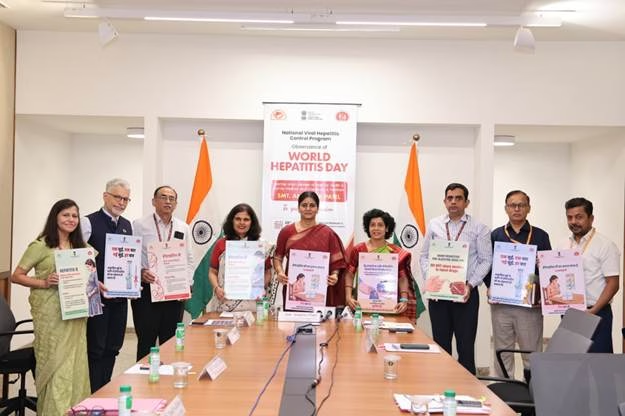
NEW DELHI — Marking World Hepatitis Day 2026 under the global banner “Hepatitis: Let’s Break It Down,” India’s Union Ministry of Health and Family Welfare convened health leaders and international stakeholders on July 28 to evaluate the nation’s ongoing fight against viral hepatitis. The event highlighted eight years of the National Viral Hepatitis Control Programme (NVHCP) and reaffirmed India’s strategic push to eliminate viral hepatitis as a major public health threat by 2030, aligning with Sustainable Development Goal (SDG) Target 3.3.
Addressing the assembly in New Delhi, Union Minister of State for Health and Family Welfare, Smt. Anupriya Patel, called for a united effort across state administrations, healthcare professionals, and civil society to achieve a “Hepatitis-Mukt Bharat” (Hepatitis-Free India).
Escalating Screening and Decentralized Treatment Networks
Viral hepatitis—primarily caused by the hepatitis B and C viruses—leads to chronic liver inflammation, cirrhosis, and hepatocellular carcinoma (liver cancer). Often termed “silent killers,” these infections frequently progress without noticeable symptoms until advanced organ damage occurs.
To combat this silent burden, the NVHCP was launched under the National Health Mission in 2018. Over its eight years of operation, the initiative has shifted from centralized tertiary management to primary-level healthcare integration.
                                  NVHCP MILESTONES AT A GLANCE
┌──────────────────────────────┬──────────────────────────────┬──────────────────────────────┐
│        >210 Million          │          >600,000            │            1,153             │
│    Beneficiaries Screened    │       Patients Treated       │      Treatment Centres       │
└──────────────────────────────┴──────────────────────────────┴──────────────────────────────┘
According to Union Health Secretary Smt. Punya Salila Srivastava, the programme’s key clinical and logistical metrics include:
-
Expanded Diagnostic Reach: Over 21 crore (210 million) individual beneficiaries screened nationwide.
-
Targeted Patient Care: Over 6 lakh (600,000) patients provided with direct-acting antivirals and viral management protocols free of cost.
-
Infrastructure Scaling: Establishment of 1,153 functional treatment centres across the country, exceeding the initial goal of one facility per district, supported by over 70 specialized tertiary care sites.
-
Primary Healthcare Integration: Scaling screening and therapeutic services to over 1.85 lakh Ayushman Arogya Mandirs (grassroots health and wellness centres).
Universal Access and Cost Reduction Drive
India stands among a limited group of developing nations offering universal, cost-free treatment for Hepatitis C alongside clinical management for Hepatitis B within public healthcare systems.
Through bulk procurement and local pharmaceutical manufacturing, direct-acting antiviral therapies (DAAs) for Hepatitis C—which can cure more than 95% of infected individuals within 12 weeks—have seen dramatic cost reductions. Therapeutic regimens that previously cost thousands of dollars globally have been brought down to less than one dollar per treatment course in India’s public sector, drastically lowering barriers to care.
“India is among the few countries providing free-of-cost treatment for Hepatitis C and management of Hepatitis B, while continuing to improve access and affordability of services,” noted Smt. Anupriya Patel. “The cost of medicines has been reduced to less than one dollar, while quality diagnostics are being made increasingly accessible to facilitate early identification and timely treatment.”
Maternal Health Strategies and Perinatal Transmission
Preventing mother-to-child (perinatal) transmission remains a critical focus of the NVHCP. Vertical transmission of Hepatitis B from mother to child carries up to a 90% risk of developing chronic infection in infants if unmanaged, compared to less than 10% when acquired in adulthood.
To break this transmission cycle, the NVHCP leverages structural convergence with the Reproductive and Child Health (RCH) Programme:
-
Antenatal Screening: Over 7.64 crore (76.4 million) pregnant women have been screened for Hepatitis B surface antigen (HBsAg). Current national screening rates among pregnant women stand at approximately 65%, with federal directives urging states to achieve 100% universal screening.
-
Infant Immunization: The Hepatitis B birth-dose vaccine—introduced into the Universal Immunization Programme (UIP) in 2011—has achieved a national coverage rate exceeding 92%.
-
Immunoglobulin Interventions: For infants born to Hepatitis B-positive mothers, the administration of Hepatitis B Immunoglobulin (HBIG) within 24 hours of birth provides immediate passive immunity alongside the birth-dose vaccine. Over 2.24 lakh (224,000) at-risk infants have received HBIG under the scheme to date.
Institutional Convergence and Digital Surveillance
A core strategy of the NVHCP involves inter-departmental integration. By linking with the National AIDS Control Programme (NACP), the ministry delivers targeted screening, harm reduction, and education to high-risk populations, including Injecting Drug Users (IDUs). Concurrently, targeted vaccination programs protect healthcare personnel against occupational viral exposure.
To ensure longitudinal patient care and combat loss to follow-up, health authorities are expanding the NVHCP Case-Based Management Information System (CPMIS). Integrated with the Ayushman Bharat Digital Mission (ABDM), this platform enables end-to-end digital tracking of patient diagnostics, prescription adherence, and viral load suppression across state borders.
Expert Perspectives and Public Health Outlook
Independent public health specialists emphasize that while India’s programmatic expansion is significant, addressing remaining diagnostic gaps is essential to meet the 2030 elimination target.
Dr. Yvan J.-F. Hutin, WHO Representative to India, who attended the commemoration alongside senior health leadership including Director General of Health Services (DGHS) Dr. Lavneet Gopal Krishna, noted during global consultations that eliminating viral hepatitis globally requires aggressive, community-level screening to find “missing” undiagnosed cases.
Epidemiologists point out that because Hepatitis B and C remain asymptomatic for years, routine screening must become standard practice in all clinical settings. Addressing lingering social stigma attached to blood-borne and viral infections is equally critical to encourage voluntary testing.
To address these awareness gaps, the Health Ministry released updated Information, Education, and Communication (IEC) materials at the event, detailing transmission vectors—such as unscreened blood transfusions, unsafe injection practices, and perinatal routes—and clarifying the availability of free diagnostics at primary health centers.
What This Means for Patients and the Public
For the general public, the expansion of the NVHCP simplifies access to preventative and curative liver care:
-
Free Testing: Individuals can request basic viral hepatitis screening at their nearest local Ayushman Arogya Mandir or district hospital without direct costs.
-
Curability of Hepatitis C: Hepatitis C is entirely curable with a short course of oral medication available through government clinics.
-
Managing Hepatitis B: While Hepatitis B is not currently curable, daily antiviral medications can suppress the virus, prevent liver damage, and lower the risk of transmission.
-
Pregnancy Screening: Expectant mothers should ensure Hepatitis B screening is included in their routine antenatal panel to protect newborns immediately upon delivery.
Limitations and Future Challenges
Despite substantial progress, programmatic challenges remain:
-
Screening Coverage Gap: Expanding maternal screening from 65% to 100% requires higher engagement in remote rural regions and private-sector prenatal clinics.
-
Loss to Follow-up: Ensuring that individuals who test positive in screening drives are successfully connected to specialized treatment centers for viral load testing and therapy initiation remains an ongoing logistical goal.
-
Public Awareness: A significant portion of the population remains unaware of silent viral hepatitis transmission routes, underscoring the need for sustained public education campaigns across regional languages.
References
-
Press Information Bureau (PIB) India. (2026, July 28). Union Health Ministry observes World Hepatitis Day 2026; marks eight years of National Viral Hepatitis Control Programme (NVHCP). Ministry of Health and Family Welfare, Government of India. PIB Delhi Release ID: 28 JUL 2026 3:35PM.
Medical Disclaimer: This article is for informational purposes only and should not be considered medical advice. Always consult with qualified healthcare professionals before making any health-related decisions or changes to your treatment plan. The information presented here is based on current research and expert opinions, which may evolve as new evidence emerges.