 0
0
 0
0
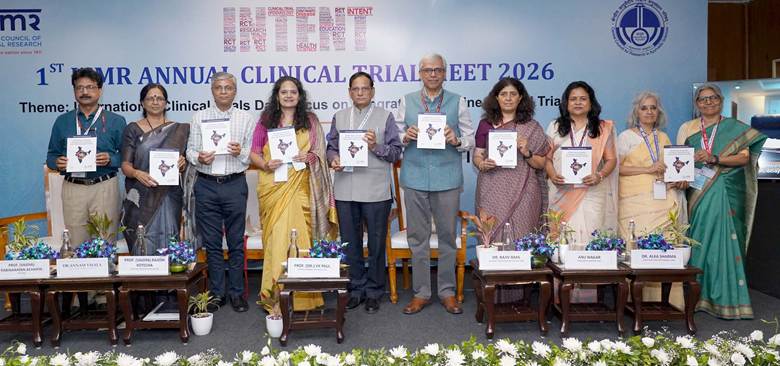
NEW DELHI — In a major move to modernize its healthcare ecosystem, the Indian Council of Medical Research (ICMR) on Wednesday hosted its inaugural Annual Clinical Trial Meet 2026. The landmark event, held on May 20 to mark International Clinical Trials Day, introduced rigorous new frameworks designed to accelerate early-stage drug development, slash bureaucratic red tape for multi-hospital studies, and provide definitive scientific validation for traditional herbal treatments.
The national convention brought together top government policymakers, leading scientists, and federal regulatory authorities. Together, they debuted data from a massive 4,000-person clinical trial and launched standardized operational guidelines aimed at transforming India from a generic manufacturing hub into a global leader in high-end medical innovation.
Traditional Remedies Pass Modern Scientific Tests
The focal point of the convention was the release of data from a rigorous, large-scale medical study tackling iron deficiency anemia—a persistent public health crisis that affects over 50% of women of reproductive age in India, according to the National Family Health Survey (NFHS-5).
The Phase III Randomized Controlled Trial (RCT)—the gold standard in medical research—was conducted jointly by the ICMR and the Central Council for Research in Ayurvedic Sciences (CCRAS). The study tracked 4,000 non-pregnant women aged 18 to 49 with moderate anemia over a 90-day period. Researchers compared standard iron-folic acid (IFA) supplements against two traditional Ayurvedic formulations: Punarnavadi Mandura (an iron-based herbal tablet) used alone, and used in combination with Drakshavaleha (a herbal jam).
The findings revealed that the traditional therapies were “therapeutically equivalent” to standard Western iron supplements in raising hemoglobin levels, but with a crucial advantage: significantly fewer gastrointestinal side effects, such as nausea and constipation, which frequently cause patients to stop taking standard iron pills.
“For decades, integrative medicine lacked the massive, multi-center data required to convince the global scientific community,” said Dr. Rajiv Bahl, Director General of the ICMR, during the event. “This study changes that. We are applying the exact same uncompromising scientific metrics to traditional formulations that we apply to synthetic blockbuster drugs.”
Overcoming Gastrointestinal Barriers in Anemia Care
Public health experts not involved in the trial point out that this data could reshape how nutritional deficiencies are managed globally. Traditional iron supplements are notorious for causing stomach upset, leading many patients to quietly discontinue their treatment.
“In clinical practice, patient compliance is our biggest hurdle with oral iron therapy,” explained Dr. Sunita Sharma, a Delhi-based hematologist independent of the study. “If an herbal formulation can deliver the same hemoglobin bump as standard iron-folic acid but without the stomach pain and constipation, it represents a massive win for public health. It gives clinicians an evidence-based alternative for patients who cannot tolerate standard care.”
Accelerating Early-Stage Drug Development
Beyond traditional medicine, the ICMR took aggressive steps to position India as a destination for cutting-edge pharmaceutical discovery by launching a blueprint report titled, “Advancing First-in-Human Phase 1 Clinical Trials in India.”
“First-in-human” trials represent the incredibly sensitive first stage of testing an experimental drug on humans to evaluate safety and dosage. Historically, global pharmaceutical firms have avoided conducting these early-stage trials in India due to rigid, slow-moving regulatory pathways, preferring to bring drugs to the country only during later Phase II or Phase III stages.
The new report, compiled via a intensive Delphi study involving 37 leading experts from drug companies, academia, and regulatory bodies, maps out a strategy to eliminate these bottlenecks. The framework outlines plans to upgrade specialized clinical infrastructure, train high-tech research personnel, and establish a highly responsive, synchronized approval process between institutional review boards and federal regulators.
Slashing Red Tape for Multi-Hospital Research
In a parallel effort to eliminate bureaucratic delays, the ICMR released its new “Operational Guidelines for Single Ethics Review of Multicentre Research in India.”
Previously, if a medical researcher wanted to test a new therapy across 15 different hospitals, the protocol had to be individually reviewed and debated by 15 separate institutional ethics committees. This redundant process routinely delayed vital public health studies by 6 to 12 months.
The newly launched guidelines establish a unified, centralized ethics review system. Under this harmonized framework, a single lead ethics committee can evaluate and approve the scientific and ethical integrity of a study, allowing secondary hospitals to accept the approval and activate the trial immediately.
Balancing Innovation with Participant Safety
While the medical community has widely praised these developments, independent bioethicists urge measured caution, particularly regarding early-phase human trials.
“Streamlining regulatory pathways to foster innovation is excellent, but speed must never come at the cost of human safety,” cautioned Dr. Ananya Bannerjee, a bioethics consultant and researcher. “Phase 1 trials involve untested chemical entities. As India opens its doors wider to first-in-human studies, our oversight mechanisms must be flawless. We need absolute transparency, robust insurance protections for trial participants, and rigorous monitoring to ensure vulnerable populations are never exploited.”
Furthermore, medical experts emphasize that while the anemia trial results are highly encouraging, patients should not self-prescribe herbal remedies without medical supervision. Moderate anemia is a complex condition that requires accurate diagnostic tracking to avoid severe underlying complications.
The Road Ahead for Public Health
The decisions finalized at the 2026 meet signal a profound paradigm shift. By creating clear pathways to integrate traditional knowledge with rigid Western science and simplifying the regulatory landscape for clinical testing, India is building a self-reliant medical ecosystem. For the everyday patient, this systematic approach promises a future of safer, cheaper, and highly validated treatment options tailored to global standards.
Medical Disclaimer
This article is for informational purposes only and should not be considered medical advice. Always consult with qualified healthcare professionals before making any health-related decisions or changes to your treatment plan. The information presented here is based on current research and expert opinions, which may evolve as new evidence emerges.
References and Sources
-
Primary Event Source: Press Information Bureau (PIB) Delhi, Government of India. 1st ICMR Annual Clinical Trial Meet 2026 highlights India’s emerging leadership in integrative medicine research. Published May 21, 2026