 0
0
 0
0
NEW DELHI — In a major effort to elevate India’s global standing in scientific publishing and intellectual property protection, Union Minister Dr. Jitendra Singh announced the launch of a new digital portal on June 4, 2026. Supported by the Anusandhan National Research Foundation (ANRF), the platform is designed to provide structured training and assistance in patent filing and research paper writing for scientists, students, and innovators across the country.
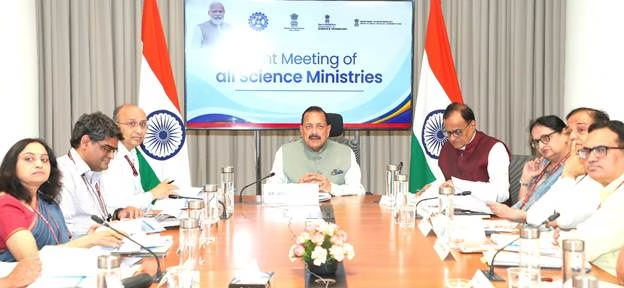
The announcement took place during a Joint Review Meeting of India’s primary scientific bodies, including the Department of Science & Technology (DST), the Department of Biotechnology (DBT), the Department of Scientific and Industrial Research (DSIR), and the Ministry of Earth Sciences (MoES). The initiative marks a strategic shift toward capacity-building, aiming to help Indian researchers convert their raw scientific discoveries into legally protected assets and high-impact publications.
Bridging the Gap from Lab Bench to Patent Office
While India has grown to host the world’s third-largest startup ecosystem and produces a high volume of science and engineering graduates, researchers frequently encounter bottlenecks when translating their findings into peer-reviewed journals or international patents. Navigating legal jargon, intellectual property (IP) laws, and the rigid structures of top-tier medical and scientific journals remains a significant challenge for younger academics.
India's Scientific Ecosystem Metrics (2026)
┌────────────────────────────────────────────────────────┐
│ 🌐 global Startup Ecosystem Rank: 3rd                  │
├────────────────────────────────────────────────────────┤
│ 🧪 Key Constraint Identified: Technical IP & Writing    │
├────────────────────────────────────────────────────────┤
│ 💡 ANRF Portal Solution: Structured Training & Guidance │
└────────────────────────────────────────────────────────┘
According to Dr. Jitendra Singh, the newly unveiled portal will act as a centralized capacity-building resource. By providing step-by-step guidance on scientific writing, formal publication steps, and patent-related procedures, the platform aims to maximize the real-world impact of public investments in science and technology.
“Improving access to such resources will strengthen the quality of research output, enhance innovation outcomes, and help researchers translate scientific work into publications and intellectual property assets,” Dr. Singh stated during the review.
Breaking Down Institutional Silos
A core focus of the high-level meeting—attended by Principal Scientific Adviser Prof. Ajay Kumar Sood, DBT Secretary Dr. Rajesh S. Gokhale, and ANRF CEO Dr. Shivkumar Kalyanaraman—was the integration of India’s fragmented scientific departments.
The Minister observed that several public laboratories frequently carry out complementary or overlapping work without adequate awareness of developments in neighboring departments. To resolve this, Dr. Singh directed the establishment of structured information-sharing mechanisms. Under this new framework:
-
Rotational Presentations: Scientific institutions will regularly showcase their technical achievements during cross-departmental reviews to encourage cross-learning.
-
Resource Leveraging: Specialized equipment and expertise housed within one department (such as biotechnology) must be seamlessly accessible to researchers in another (such as earth sciences).
-
Integrated Outreach: Departments will utilize a unified science communication strategy involving digital platforms and social media to make complex scientific breakthroughs accessible to startups, students, and the public.
Public Health Implications: Why Medical Literacy Matters
For the health-conscious consumer and healthcare professional, the optimization of India’s research ecosystem has direct, long-term public health benefits. India is a global hub for pharmaceutical manufacturing and biomedical research. However, clinical discoveries can only improve public health outcomes if they are validated through rigorous, transparent peer review and successfully scaled via patent protection.
When local clinical trials or biomedical innovations are held back by poor paper writing or delayed patent applications, the public loses out on timely access to affordable therapies, diagnostic tools, and preventive health strategies. By training medical and life-science researchers to document their data to global publication standards, the ANRF portal could accelerate the pipeline that brings safe, evidence-based medical interventions from Indian laboratories to local pharmacies.
Expert Perspectives and Critical Considerations
Independent public health analysts and research ethics advocates have expressed cautious optimism about the initiative, while highlighting potential limitations that the digital portal must address.
“Providing institutional training on patenting and paper writing is an excellent step toward democratizing science,” says Dr. Anita Rao, an independent bioethics consultant and former medical faculty member based in Mumbai, who was not involved in the government meeting. “Historically, premier institutions had dedicated legal cells for intellectual property, while smaller provincial medical colleges lacked these resources. This portal could level the playing field.”
However, Dr. Rao emphasized that a digital platform is only as effective as its implementation. “Writing a high-quality scientific paper or drafting a robust patent claim requires iterative feedback. A static portal with video modules or downloadable templates may not be enough. There must be active human mentorship, robust data privacy safeguards for innovators uploading sensitive data, and ongoing technical support to guide a user through actual rejections from patent offices or journal editors.”
Furthermore, education experts note that for the portal to achieve meaningful reach among its target demographic of young innovators, it must be adapted to account for varying levels of digital literacy and language barriers across different states.
Streamlining Science Administration
The meeting concluded with a review of administrative performance indicators, including file disposal times, public grievance redressal, and project expenditure. Dr. Singh advocated for expanding the Capacity Building for Science Administration initiative, integrating it with the government’s ongoing Mission Karmayogi program. This integration is designed to ensure that scientists moving into administrative and leadership roles are thoroughly trained in governance procedures, financial regulations, and modern institutional management systems.
Officials also finalized early preparations for the upcoming Emerging Science and Technology International Conference (ESTIC 2026), which will serve as a global stage to showcase India’s evolving technology capabilities, healthcare innovations, and startup ecosystem to international experts.
Reference Section
Government & Official Sources
-
Press Information Bureau (PIB) Delhi: Official press release issued by the Ministry of Science & Technology, Government of India. “Dr Jitendra Singh Announces ANRF Portal for Training in Patent Filing and Research Paper Writing; Reviews Progress of Scientific Departments.” Published June 4, 2026. PIB Source Link
Medical Disclaimer: This article is for informational purposes only and should not be considered medical advice. Always consult with qualified healthcare professionals before making any health-related decisions or changes to your treatment plan. The information presented here is based on current research and expert opinions, which may evolve as new evidence emerges.