 0
0
 0
0
Read Time:5 Minute, 50 Second
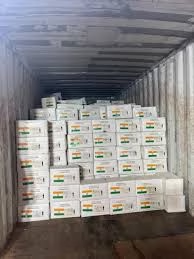
NEW DELHI, August 9, 2026 — India’s Ministry of External Affairs (MEA) announced today the dispatch of an eight-metric-tonne consignment of life-saving and essential pharmaceuticals to Bolivia. The emergency humanitarian shipment aims to shore up Bolivia’s struggling public healthcare system, where state hospitals and social insurance pharmacies have faced severe inventory depleted over the past year. Driven by foreign exchange constraints and local fiscal bottlenecks, the shortages have compromised access to critical therapies for thousands of South American patients managing chronic, complex, and acute medical conditions.
Describing Bolivia as an essential partner in the Global South, the MEA framed the relief effort as a pledge of solidarity and shared progress. While government representatives confirmed the dispatch, official statements did not release a detailed manifest of the shipment, leaving clinicians and public health experts uncertain about the specific therapeutic classes, dosage formats, or regional distribution plans for the incoming supplies.
Anatomy of a Healthcare Crisis: Inside Bolivia’s Shortages
Essential medicines, as defined by the World Health Organization (WHO), represent treatments intended to satisfy the priority healthcare needs of a population. WHO standards stipulate that these drugs must remain continuously accessible within functioning health systems in adequate amounts, appropriate dosage forms, guaranteed quality, and at prices individuals and communities can afford.
Bolivia’s pharmaceutical supply chain, however, has suffered prolonged disruption. Investigations conducted in July 2025 by Bolivia’s Ombudsman’s Office revealed alarming deficits across 11 major public-sector institutional pharmacies and nine facilities operated by the Caja Nacional de Salud—the nation’s primary social health insurance system.
                                 BOLIVIA PHARMACEUTICAL SHORTAGE

 +---------------------------+     +---------------------------+     +---------------------------+
 |   Foreign Exchange &      | --> |  Procurement Delays &     | --> | Critical Pharmacy         |
 |   Macroeconomic Strain    |     |  Import Cost Spikes       |     | Deficits in Public System |
 +---------------------------+     +---------------------------+     +---------------------------+
                                                                                   |
                                                                                   v
                                                                     +---------------------------+
                                                                     |  Disrupted Patient Care:  |
                                                                     |  Oncology, Diabetes,      |
                                                                     |  Hypertension, Surgical   |
                                                                     +---------------------------+
The review found widespread stockouts of crucial therapies, including:
-
Oncology Treatments: Chemotherapy agents and supportive care medications.
-
Renal Therapies: Dialysis consumables and end-stage renal disease management drugs.
-
Cardiovascular & Endocrine Drugs: Antihypertensives, insulin, and oral hypoglycemics.
-
Basic Surgical Supplies: Essential antiseptics, analgesics, and perioperative consumables.
Susana Salinas, head of the Ombudsman’s Investigative Unit, noted in reporting from the agency that foreign-currency scarcity was severely hampering international procurement tenders, inflating the cost of imported raw active pharmaceutical ingredients (APIs) and finished drug products. Subnational budget shortfalls further compounded the issue, leaving public hospitals unable to fulfill routine procurement contracts.
Technical Analysis: Measuring the Impact of 8 Metric Tonnes
While an eight-metric-tonne delivery represents a significant logistical undertaking, public health economists emphasize that gross weight is an imperfect metric for evaluating clinical efficacy.
| Cargo Metric | Public Health Interpretation | Clinical Variable |
| Gross Tonnage (8 MT) | Indicates total freight weight, including secondary packaging and cold-chain insulation. | Does not distinguish between high-volume fluids and high-potency solids. |
| Formulation Type | Determines storage, transport, and therapeutic utility. | Intravenous (IV) fluids account for high weight but few doses; microgram-dosage tablets yield millions of treatment cycles per tonne. |
| Therapeutic Scope | Defines which patient populations receive immediate relief. | Broad-spectrum antibiotics versus specialized oncology agents. |
“Evaluating a medical donation solely by weight can be misleading,” explains Dr. Elena Rostova, an independent global health supply chain consultant not involved in the dispatch. “Eight metric tonnes of heavy intravenous saline solutions might supply a single regional trauma center for a few weeks. Conversely, eight tonnes of oral antihypertensives or solid-form anti-infectives can supply tens of thousands of chronic disease patients across multiple provinces for months. Transparency regarding the drug formulations is essential for effective integration into local hospital formularies.”
South-South Cooperation and Emergency Response
This shipment builds upon established health assistance agreements between New Delhi and La Paz. In July 2025, India delivered 300,000 doses of measles-rubella (MR) vaccines along with specialized administration ancillary kits to El Alto International Airport in La Paz, supporting Bolivia’s national outbreak containment efforts.
While vaccines serve primary preventive public health goals, essential therapeutic medicines address secondary and tertiary clinical management.
                  DUAL TRACKS OF GLOBAL HEALTH ASSISTANCE

        PREVENTIVE INTERVENTIONS           CURATIVE / SUPPORTIVE CARE
     +----------------------------+      +----------------------------+
     | Measles-Rubella Vaccines   |      | Essential Pharmaceuticals  |
     | (300k Doses, July 2025)    |      | (8 Metric Tonnes, Aug 2026) |
     +----------------------------+      +----------------------------+
                   |                                   |
                   v                                   v
     +----------------------------+      +----------------------------+
     | Disease Prevention         |      | Symptom Control            |
     | Interruption of Chains     |      | Chronic Management         |
     | Population-Level Immunity  |      | Acute Disease Intervention |
     +----------------------------+      +----------------------------+
India’s pharmaceutical sector—often characterized as the “pharmacy of the Global South”—supplies a vast proportion of global generic medicines and vaccines. However, experts stress that international aid consignments, while vital during acute emergencies, serve as temporary stabilization measures rather than permanent solutions for structural health system weaknesses.
Quality Compliance, Logistics, and Global Guidelines
To ensure patient safety, drug donations must adhere strictly to international standards. The WHO Guidelines for Medicine Donations outline core principles:
-
Expressed Demand: All donated items must meet expressed national needs and align with the recipient country’s National Essential Medicines List (NEML).
-
Quality Standards: Donated products must meet the quality standards of both the exporting and receiving countries, holding valid market authorizations.
-
Shelf-Life Viability: Products should arrive with adequate remaining shelf life (ideally over 12 months) to allow for effective internal distribution before expiration.
-
Labeling and Documentation: Containers must be clearly labeled in a language understood by local medical staff (e.g., Spanish for Bolivia), using International Nonproprietary Names (INN).
Proper cold-chain maintenance during transit is vital for temperature-sensitive items such as biologicals, insulin, or certain injectable antibiotics.
Guidance for Patients and Clinical Providers
For healthcare workers and patients in Bolivia, the arrival of new pharmaceutical stocks requires careful clinical navigation:
-
Patient Guidance: Patients managing chronic conditions like hypertension, diabetes, or cancer should not alter their dosing regimens without consulting their treating clinician. If a donated product features different packaging or brand identification, patients must verify with a pharmacist that the active ingredient (INN) and strength match their original prescription.
-
Clinical Monitoring: Hospital staff and pharmacists must review incoming batches for expiration dates, lot numbers, storage condition logs, and Spanish-language package inserts prior to dispensing.
-
System Transparency: Public health advocates encourage regional authorities to publish transparent distribution reports outlining where the supplies are deployed to prevent maldistribution and ensure equitable access across urban and rural health networks.
Systemic Challenges and Next Steps
An emergency aid shipment provides temporary relief to overstretched health systems, but long-term pharmaceutical security requires sustainable national financing, robust supply chain forecasting, and resilient procurement mechanisms. As Indian aid arrives in Bolivia, success will ultimately depend on how efficiently local health authorities log, store, and distribute these essential drugs to the clinics and patients who need them most.
References
-
Ministry of External Affairs, Government of India. “India sends 8 MT of life-saving medicines to Bolivia to support public healthcare.” August 9, 2026. Reported by The Hans India. thehansindia
Medical Disclaimer: This article is for informational purposes only and should not be considered medical advice. Always consult with qualified healthcare professionals before making any health-related decisions or changes to your treatment plan. The information presented here is based on current research and expert opinions, which may evolve as new evidence emerges.


Happy
0 %

Sad
0 %

Excited
0 %

Sleepy
0 %

Angry
0 %

Surprise
0 %