 0
0
 0
0
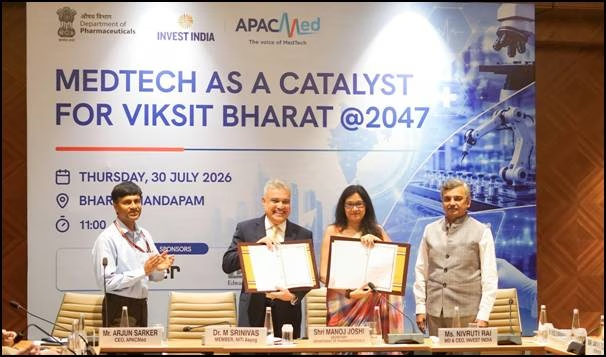
NEW DELHI — In a major move aimed at transforming India’s healthcare landscape, Invest India, the nation’s primary investment promotion agency, signed a strategic Memorandum of Understanding (MoU) with the Asia Pacific Medical Technology Association (APACMed) on Thursday at Bharat Mandapam.
The high-level agreement establishes a collaborative framework between government authorities and global healthcare technology leaders. The goal is clear: accelerate investment, streamline regulatory pathways, scale up domestic manufacturing, and expand access to advanced medical devices across India’s vast and diverse population.
The ceremony was attended by key policymakers, including Shri Manoj Joshi, Secretary of the Department of Pharmaceuticals, and Dr. M. Srinivas, Member of NITI Aayog, alongside chief executives from 26 global medical technology companies, including Medtronic, Abbott, Johnson & Johnson, GE Healthcare, and Boston Scientific.
Pivoting from Imports to Innovation: The 45% Target
For decades, India’s medical technology ecosystem has relied heavily on imports for high-end medical equipment, including diagnostic imaging systems, advanced orthopedic implants, and precision surgical tools. Current estimates suggest that domestic value addition—the percentage of a device manufactured or sourced locally— hovers around 25%.
During the CEO Roundtable following the MoU signing, titled “MedTech as a Catalyst for Viksit Bharat @2047,” Department of Pharmaceuticals Secretary Manoj Joshi outlined the government’s ambitious roadmap to shift this balance.
“Our vision is to strengthen domestic value addition, particularly in high-end medical devices and imaging equipment, by developing a strong component manufacturing ecosystem and increasing domestic value addition from the current level of around 25% to 40–45%,” said Shri Manoj Joshi.
To achieve this, the Ministry of Chemicals and Fertilisers is actively planning the next phase of the Production Linked Incentive (PLI) Scheme, targeting local manufacturing of core components, reagents, and diagnostic tools.
| MedTech Transformation Metrics | Current Baseline | Target / Vision |
| Domestic Value Addition | ~25% | 40% – 45% |
| Focus Areas | Basic consumables, assembly | High-end imaging, diagnostics, active implants |
| Strategic Pillars | Import reliance | Local component ecosystems, global export hubs |
Bridging the Gap: What This Means for Patients and Providers
While industrial policies like the PLI scheme focus on manufacturing, the ultimate beneficiaries of a robust domestic MedTech industry are patients and healthcare providers.
Currently, high reliance on imported technology drives up capital expenditure for hospitals, an expense often passed on to patients out-of-pocket. By shifting production, component supply chains, and research facilities closer to home, experts anticipate several key public health benefits:
-
Lower Costs for Advanced Care: Localized manufacturing reduces supply chain overhead, import duties, and currency fluctuation risks, potentially lowering the cost of high-tech procedures like MRI scans, cardiac catheterizations, and robotic-assisted surgeries.
-
Tailored Medical Solutions: Devices developed and tested in India are engineered specifically to handle local environmental conditions, rural infrastructure challenges, and diverse patient demographics.
-
Faster Access to Next-Gen Therapies: Stronger integration between global MedTech leaders and Indian hospitals speeds up clinical trial timelines and regulatory approvals for life-saving innovations.
“India’s MedTech capability is recognized globally now,” noted Ms. Nivruti Rai, Managing Director and CEO of Invest India. “A device that works here works anywhere, because it has been tested against a diverse population.”
Fostering R&D and Global Capability Centres
The MoU focuses heavily on regulatory alignment, tech transfer, and digital health integration. Dr. M. Srinivas, Member of NITI Aayog, emphasized that hardware alone cannot solve healthcare challenges—the merger of clinical expertise and digital software is crucial.
“The convergence of clinical expertise with technology, research and digital innovation can help strengthen healthcare delivery and expand access to high-quality care,” Dr. Srinivas said. “Continued collaboration between Government, industry, academia and innovators will be essential to advance R&D.”
Global firms are increasingly looking at India not just as a consumer market, but as an R&D hub. Many MedTech giants have opened Global Capability Centres (GCCs) in cities like Bengaluru, Hyderabad, and Pune. These centers leverage local talent in software development, artificial intelligence, and biomechanical engineering to design devices for global markets.
Arjun Sarker, CEO of APACMed, highlighted that the agreement creates a stable framework for industry players to deepen their investments. “The MoU between APACMed and Invest India represents a shared commitment to advancing India’s MedTech ecosystem through stronger industry and government collaboration,” Sarker stated.
Balancing Rapid Growth with Regulatory Integrity
Despite the optimism surrounding the agreement, independent public health experts urge a balanced approach. Moving rapidly to expand domestic manufacturing requires equal vigilance in quality assurance and patient safety.
Healthcare policy analysts point out that expanding local production must be paired with stringent enforcement of international standards, such as ISO certifications and updated Medical Device Rules. Maintaining safety parity between imported and locally manufactured devices is paramount to gaining the trust of doctors and patients alike.
Addressing these concerns, Shri Manoj Joshi reassured industry leaders that regulatory frameworks will evolve in step with growth: “As we move forward, we need our medical devices sector to evolve into a more robust and well-regulated ecosystem that promotes quality, patient safety and global competitiveness.”
Looking Ahead
As India continues to modernize its public healthcare infrastructure under national health programs, building a resilient, self-reliant medical device industry is no longer just an economic goal—it is a public health necessity.
By uniting government facilitation through Invest India with the commercial and technical expertise of APACMed’s global network, India is laying the groundwork to become a global hub for affordable, high-quality medical technology over the next decade.
References
-
Press Information Bureau (PIB), Delhi: Government and Industry Join Hands to Accelerate Investment, Innovation and Manufacturing in India’s MedTech Sector. Published July 30, 2026.
Medical Disclaimer: This article is for informational purposes only and should not be considered medical advice. Always consult with qualified healthcare professionals before making any health-related decisions or changes to your treatment plan. The information presented here is based on current research and expert opinions, which may evolve as new evidence emerges.