 0
0
 0
0
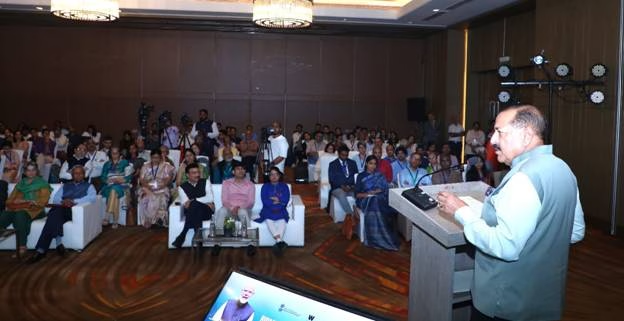
NEW DELHI — In a major move to solidify its position at the forefront of the global life sciences sector, the Government of India has officially launched Phase-III of the Biomedical Research Career Programme (BRCP). The announcement, made by Union Minister Dr. Jitendra Singh on July 15, 2026, details a massive joint funding injection of ₹1,500 crore (approximately $180 million USD) over the next phase.
The initiative is co-funded by India’s Department of Biotechnology (DBT), which is committing ₹1,000 crore, and the London-based charitable foundation Wellcome Trust, UK, contributing ₹500 crore. Channeled through the DBT-Wellcome Trust India Alliance, the flagship program aims to scale up fellowships, fund translational research grants, and cultivate a highly competitive workforce capable of tackling both domestic and international healthcare challenges.
Speaking at the launch event in New Delhi, Dr. Singh stated that biotechnology is no longer confined to laboratory walls but has evolved into a cornerstone of national economic strategy. “The next industrial revolution will be driven by biotechnology, and India is prepared to lead it,” Dr. Singh said, pointing to a dramatic surge in India’s bioeconomy from $10 billion in 2014 to over $195 billion in 2025. The sector is currently projected to reach $300 billion by 2030.
Fueling the Biotech Engine: Key Objectives of Phase-III
Originally established in 2008, the BRCP has transformed India’s scientific landscape over the past 18 years, supporting more than 500 primary researchers and training thousands of early-career scientists across 200 institutions.
Phase-III introduces a structured shift toward interdisciplinary, team-based science and “translational research”—a medical term referring to the process of turning fundamental laboratory discoveries into practical, bedside clinical tools like diagnostics, vaccines, and therapies.
According to program documents, the funding will be utilized to:
-
Expand Fellowship Tiers: Provide robust financial and institutional backing for basic scientists, clinician-researchers, and public health experts at various career stages.
-
Enhance Research Infrastructure: Support cross-institutional collaborations to break down academic silos.
-
Support Auxiliary Roles: Fund training for critical ecosystem drivers, including science communicators and research managers, ensuring that data is both effectively managed and accurately communicated to the public.
Prof. Rajesh S. Gokhale, Secretary of the Department of Biotechnology, noted that the long-term approval framework for this phase provides much-needed stability. This continuity allows institutions to invest in high-risk, high-reward scientific talent without the looming threat of sudden budget expirations.
Bridging the Gap: What This Means for Public Health
For the general public, long-term investments in biomedical research are the invisible scaffolding behind modern medicine. The real-world impact of programs like the BRCP is felt when laboratory insights evolve into affordable healthcare solutions.
Historically, India relied heavily on importing high-end diagnostic kits and specialized therapeutics, which often drove up healthcare costs for everyday citizens. By fostering a domestic workforce trained in advanced biomedical techniques, the initiative aims to catalyze the development of locally manufactured, cost-effective medical solutions.
Public health experts suggest that strengthening internal research capabilities directly improves a country’s pandemic readiness and its ability to manage chronic conditions, such as cardiovascular diseases, diabetes, and localized infectious threats like dengue or tuberculosis.
Independent Perspectives and Structural Challenges
While the scientific community has widely welcomed the financial injection, independent experts emphasize that funding is only part of the equation. To successfully translate a ₹1,500 crore investment into concrete medical breakthroughs, India must navigate deep-seated systemic challenges.
“An injection of capital into early and mid-career fellowships is an exceptional step, but the critical bottleneck in Indian biomedical science has often been the slow pace of institutional bureaucracy,” says Dr. Vineeta Bal, a prominent immunologist and former scientist at the National Institute of Immunology, who was not involved in the BRCP announcement. “For scientists to remain globally competitive, funding mechanisms must be accompanied by procurement reforms. If acquiring a necessary reagent takes months due to administrative red tape, our researchers lose their competitive edge, regardless of the size of the grant.”
Furthermore, health policy analysts point out that despite hosting nearly 12,000 biotechnology startups, India still faces hurdles in moving discoveries from the lab bench through the regulatory approval pipeline.
Dr. Singh acknowledged this gap during his address, issuing a call for increased participation from private industry and philanthropic bodies. He emphasized that government funding alone cannot sustain the late-stage clinical trials required to bring new drugs and diagnostics safely to the public market.
A Model for Global Scientific Philanthropy
Despite these hurdles, international observers view the partnership between the Indian Government and the Wellcome Trust as a benchmark for cross-border scientific collaboration.
Prof. Dame Fiona Powrie, Deputy Chair of the Board of Governors at the Wellcome Trust, highlighted that Phase-III will explicitly prioritize solutions tailored to local health realities while maintaining global scientific standards. She emphasized that international collaboration ensures Indian scientists remain structurally integrated into global research networks, facilitating the rapid sharing of epidemiological and genomic data.
As the program rolls out, the ultimate metric of its success will not merely be the expansion of India’s bioeconomy to its $300 billion target, but how effectively its scientific discoveries lower the burden of disease for the individual patient.
Reference Section
I. Institutional Declarations and Press Releases
-
Press Information Bureau (PIB), Government of India: “Dr. Jitendra Singh Launches Phase-III of ‘Biomedical Research Career Programme’ (BRCP) with collaborative funding by Department of Biotechnology, GoI and Wellcome Trust, UK.” Published July 15, 2026. PIB Delhi.
- Medical Disclaimer: This article is for informational purposes only and should not be considered medical advice. Always consult with qualified healthcare professionals before making any health-related decisions or changes to your treatment plan. The information presented here is based on current research and expert opinions, which may evolve as new evidence emerges.