 0
0
 0
0
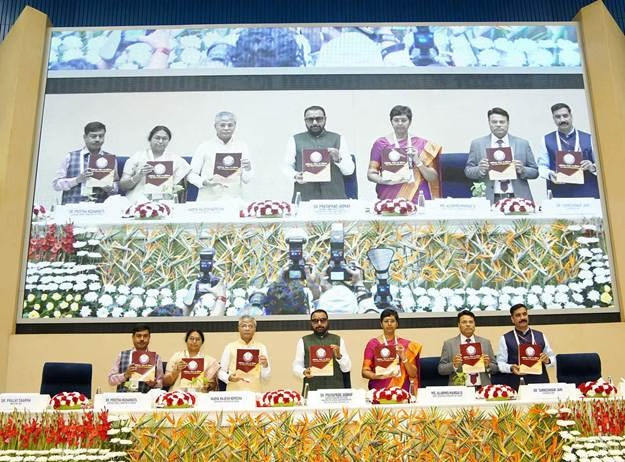
NEW DELHI — On April 10, 2026, the Ministry of Ayush marked World Homoeopathy Day with a high-level national symposium at Vigyan Bhawan, signaling a pivotal shift toward “sustainable health.” The event, which commemorates the 271st birth anniversary of Dr. Samuel Hahnemann, served as a platform for the Indian government to unveil a roadmap for the integration of homoeopathy into the mainstream public health system through rigorous scientific validation, digital infrastructure, and regulatory reform.
Led by Shri Prataprao Jadhav, Union Minister of State for the Ministry of Ayush, the celebration underscored India’s emerging role as a global laboratory for integrated medicine. With over 345,000 registered practitioners and nearly 300 educational institutions, the nation is transitioning homoeopathy from a popular alternative to an evidence-based pillar of universal health coverage.
A Shift Toward “Sustainable Healthcare”
The theme for 2026, “Homoeopathy for Sustainable Health,” addresses the growing global need for cost-effective, patient-centric treatments that can ease the burden on overstretched primary healthcare systems.
“Over the years, India has developed a strong and expanding homoeopathy workforce,” stated Minister Jadhav during his inaugural address. “Organizations such as the Central Council for Research in Homoeopathy (CCRH) and the National Commission for Homoeopathy (NCH) are continuously strengthening the scientific foundation and public trust through research and quality healthcare delivery.”
The Minister emphasized that the future of the sector relies on three pillars:
-
Evidence-Based Advancement: Moving beyond anecdotal success to clinical trial data.
-
Interdisciplinary Collaboration: Working alongside conventional (allopathic) medicine.
-
Digital Integration: Utilizing the “Ayush Grid” and Health Management Information Systems (HMIS) to track patient outcomes.
Infrastructure and Digital Transformation
Vaidya Rajesh Kotecha, Secretary of the Ministry of Ayush, detailed the government’s investment in the “Ayush Grid,” a comprehensive digital ecosystem designed to bring transparency to traditional medicine. By integrating AI-enabled knowledge platforms and the Indian Research Information Network System (IRINS), the Ministry aims to make research findings accessible to both practitioners and the public.
“We are modernizing education and training systems to build a skilled, future-ready workforce,” Kotecha noted. The introduction of a National Register for Practitioners is expected to enhance accountability, ensuring that only qualified professionals provide care.
The Research Gap: Addressing the Critics
While the Ministry of Ayush reports significant growth, homoeopathy remains a subject of intense debate within the global medical community. The core principle of homoeopathy—”like cures like” and the use of highly diluted substances—often faces skepticism from advocates of conventional pharmacology, who argue that ultra-dilutions lack enough active molecules to produce biological effects beyond a placebo.
To address these concerns, the CCRH released several key scientific publications at the event, including:
-
The Indian Journal of Research in Homoeopathy (Vol 20): Featuring peer-reviewed clinical studies.
-
Scientific Perspectives of Homoeopathic Medicines: A practitioner’s guide focused on standardized clinical applications.
-
Monographs on Bio-active Sources: Detailed research on substances like Acorus calamus (Sweet Flag) to establish pharmaceutical standards.
Dr. Subhash Kaushik, Director General of the CCRH, explained that the goal is to “translate scientific knowledge into meaningful public health outcomes.” By focusing on chronic disease management and preventive care, the Ministry hopes to demonstrate homoeopathy’s utility in reducing the long-term cost of care for conditions like allergies, respiratory issues, and lifestyle disorders.
Expert Perspectives: A Balanced View
Medical professionals not directly involved in the Ayush Ministry highlight both the potential and the responsibility of this expansion.
“The integration of traditional systems into the public health framework is a pragmatic move for a country of India’s size,” says Dr. Anirudh Verma, a public health consultant (unaffiliated with the event). “However, the ‘evidence-based’ claim must be supported by large-scale, independent, and reproducible clinical trials. The focus on digital tracking through the Ayush Grid is a step in the right direction, as it allows for real-world data collection.”
Dr. Tarkeshwar Jain, Chairperson of the National Commission for Homoeopathy, countered that the sheer volume of practitioners—exceeding 3.45 lakh—proves that the system is already a “mainstream” reality for millions of Indians. “We are strengthening transparency and ethical standards to further enhance the credibility of the system,” Jain added.
What This Means for Consumers
For the health-conscious consumer, the 2026 initiatives promise several practical changes:
-
Standardized Care: New rules and regulations from the NCH aim to ensure that homoeopathic clinics and pharmacies meet consistent quality benchmarks.
-
Informed Choices: The release of the “Practitioner’s Guide” and public-facing digital content aims to help patients understand when homoeopathy is an appropriate complementary option.
-
Increased Accessibility: With the expansion of Ayush wings in district hospitals, patients will have more choices within the public health system.
Conclusion: A Holistic Vision
The World Homoeopathy Day 2026 celebrations reveal a government committed to a “pluralistic” healthcare model. By marrying ancient philosophy with modern digital surveillance and research protocols, India is attempting to set a global standard for how traditional and complementary medicines can coexist with modern science.
As the Ministry of Ayush continues its “Homoeopathic Awareness Week,” the message remains clear: the path to a sustainable health future is not found in a single pill, but in a multi-faceted approach that prioritizes the patient’s overall well-being.
Reference Section
Official Sources & Statistics:
-
Ministry of Ayush (2026): “Press Release: World Homoeopathy Day Celebrations.” PIB Delhi.
Medical Disclaimer: This article is for informational purposes only and should not be considered medical advice. Always consult with qualified healthcare professionals before making any health-related decisions or changes to your treatment plan. The information presented here is based on current research and expert opinions, which may evolve as new evidence emerges.