 0
0
 0
0
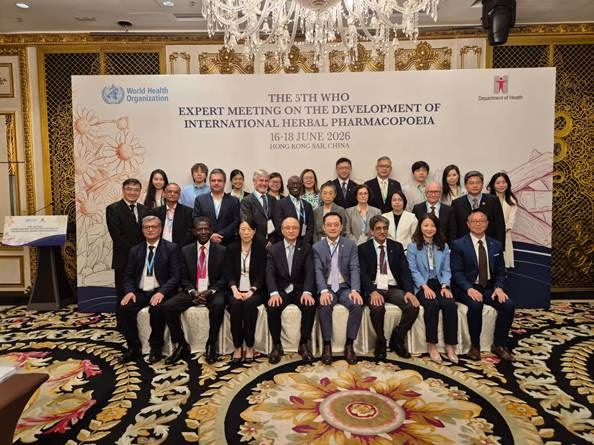
HONG KONG SAR, CHINA — In a milestone event for global healthcare integration, international medical authorities assembled today at the 5th World Health Organization (WHO) Expert Meeting on the Development of the International Herbal Pharmacopoeia (IHP). Running from June 16 to June 18, 2026, the high-level convention features a prominent delegation from India’s Pharmacopoeia Commission for Indian Medicine & Homoeopathy (PCIM&H), operating under the Ministry of Ayush. The delegation is presenting authoritative herbal monographs designed to synchronize traditional Indian medical frameworks with uniform, international benchmarks for safety, purity, and clinical quality.
The three-day summit addresses a long-standing challenge in global health: the high variability and lack of standardized quality controls in the multi-billion-dollar global herbal medicine market. By drafting a universally recognized reference text, the WHO and its Member States aim to provide clinicians and consumers with identical assurance standards for botanical therapies as those mandated for conventional pharmaceuticals.
Establishing Global Rules for Traditional Therapies
A pharmacopoeia serves as an official legal and scientific compendium, establishing the precise identification tests, purity thresholds, and chemical assay methods that a health product must satisfy to be legally marketed. While conventional small-molecule drugs rely on rigid, standardized manufacturing practices, herbal medicines face distinct hurdles due to agricultural variations, regional biodiversity, and potential contamination.
At the summit, Dr. Raman Mohan Singh, Director of PCIM&H, is representing India as an appointed expert member on the central council. Supporting the mission virtually is a specialized technical working group from Ghaziabad, Uttar Pradesh, comprising:
-
Dr. Jayanthy A — Principal Scientific Officer (Pharmacognosy)
-
Dr. Vijay Gupta — Principal Scientific Officer (Ayurveda)
-
Dr. Anupam Maurya — Scientific Officer (Chemistry)
-
Dr. V. Vijayakumar — Scientific Officer (Siddha)
-
Dr. Nikhil Jirankalgikar — Scientific Officer (Ayurveda)
The Indian delegation has introduced finalized herbal monographs—meticulously drafted in coordination with the WHO IHP Secretariat—for detailed peer review. These texts serve as scientific blueprints detailing the botanical definitions, macroscopic and microscopic characteristics, impurity profiles, and active chemical markers for key therapeutic plants native to South Asia.
Bridging the Gap: Safety, Standardization, and Science
The World Health Organization reports that an estimated 80% of the world’s population utilizes traditional or complementary medicine for primary healthcare needs. Despite this widespread utilization, natural products are frequently vulnerable to heavy metal contamination, pesticide residues, and accidental species substitution or deliberate adulteration.
Global Standardization Framework (WHO IHP)
 │
 ├── WG1: Herbs & Raw Herbal Materials (Authentication & Botany)
 ├── WG2: Herbal Extracts & Preparations (Solvent Profiles & Chromatography)
 └── WG3: Finished Herbal Products (Dosage Forms & Heavy Metal Thresholds)
By institutionalizing a unified International Herbal Pharmacopoeia, the WHO creates a structured vetting framework across three distinct core working groups:
-
Herbs and Raw Materials (WG1): Focuses on genetic and botanical validation to prevent misidentification.
-
Herbal Extracts and Preparations (WG2): Establishes chemical fingerprints using high-performance liquid chromatography (HPLC) to verify active ingredient concentrations.
-
Finished Herbal Products (WG3): Sets toxicological boundaries for microbial limits, heavy metals (such as lead, arsenic, and mercury), and synthetic adulterants.
Independent Medical Commentary: The Need for Rigor
While the integration of traditional medicine into international regulatory frameworks marks a progressive shift, mainstream medical experts urge a balanced and cautious approach.
“Harmonizing the physical and chemical standards of herbal products is an essential victory for consumer safety,” notes Dr. Elizabeth Vance, an independent clinical pharmacologist and public health policy analyst based in London, who is not involved in the WHO proceedings. “However, the global medical community must maintain a clear distinction between quality control and clinical efficacy. Verifying that a botanical supplement is 100% pure does not automatically prove it is safe or effective for treating a specific medical condition. Rigorous, randomized, double-blind clinical trials remain the gold standard for therapeutic validation.”
Dr. Vance emphasized that consumers frequently operate under the cognitive bias that “natural” inherently translates to “safe.” In reality, active botanical compounds can exert potent physiological effects and cause dangerous herb-drug interactions. For example, widely used herbs can alter the metabolic pathways of standard blood thinners, cardiac medications, or immunosuppressants, occasionally leading to severe clinical complications.
What This Means for Global Consumers and Healthcare Providers
For health-conscious consumers, the development of the IHP is poised to significantly reduce market confusion. Once implemented by national regulatory bodies, these international standards will allow individuals to buy verified herbal supplements with verified identity and purity metrics, minimizing the risk of toxic exposures.
For healthcare professionals, an international standard provides a reliable baseline of data. Doctors and integrative medicine practitioners will gain access to transparent, peer-reviewed monographs outlining known contraindications, standardized dosing ranges, and potential side effects, enabling safer, evidence-based patient consultations.
The active role of the Ministry of Ayush and PCIM&H highlights India’s objective to position its traditional systems—such as Ayurveda and Siddha—not merely as regional practices, but as validated components of global, evidence-based integrative healthcare.
References & Sources
-
Regulatory Notice: Press Information Bureau (PIB) Delhi, Ministry of Ayush, Government of India. PCIM&H Represents India at 5th WHO Expert Meeting on International Herbal Pharmacopoeia. Published June 16, 2026. (Release ID: 2273545).
Medical Disclaimer: This article is for informational purposes only and should not be considered medical advice. Always consult with qualified healthcare professionals before making any health-related decisions or changes to your treatment plan. The information presented here is based on current research and expert opinions, which may evolve as new evidence emerges.