 0
0
 0
0
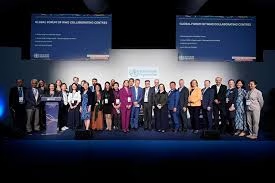
LYON, FRANCE – In a historic push for global health security, the World Health Organization (WHO) concluded its first-ever Global Forum of Collaborating Centres on April 9, 2026. The landmark event gathered more than 800 premier scientific institutions from 80 countries, signaling a transition from isolated research projects toward a unified, “dynamic” scientific front.
The three-day forum, held in the sidelines of the international One Health Summit, arrives at a critical juncture. As geopolitical tensions and funding cuts threaten international stability, the WHO is pivoting toward a decentralized model of innovation to ensure the world is not caught off guard by the next major health threat
Standing with Science: A New Global Mandate
The forum was the centerpiece of the World Health Day 2026 campaign, themed “Together for health. Stand with science.” This initiative aims to restore public trust in evidence-based medicine while streamlining how life-saving research moves from the laboratory to the bedside.
“WHO’s network of collaborating centres is an immensely valuable but under-utilized resource for global health,” said Dr. Tedros Adhanom Ghebreyesus, WHO Director-General. “It brings together the world’s leading institutions to translate evidence into action to support countries, strengthen health systems, and protect populations.”
Since 1949, the WHO has relied on external “Collaborating Centres” (CCs)—existing universities and research institutes—rather than building its own laboratories. This week’s forum marks the first time this entire global brain trust has been convened to synchronize their efforts against common enemies like antimicrobial resistance (AMR), climate-driven diseases, and “Disease X.”
The Hunt for “Disease X”
A major highlight of the summit was the expansion of the Collaborative Open Research Consortia (CORC). These are specialized “networks of networks” designed to bypass traditional research silos.
The CORC’s mission is focused on Disease X—the placeholder name for a currently unknown pathogen that could trigger a future pandemic. By organizing scientists around “pathogen families” (such as respiratory viruses or hemorrhagic fevers), the WHO aims to develop “plug-and-play” vaccines and diagnostics before a specific virus even emerges.
“Science is at the heart of everything we do to protect and improve health,” stated Dr. Sylvie Briand, WHO Chief Scientist. “At a time of growing global health challenges, this spirit of trusted scientific collaboration is not only valuable—it is indispensable to protecting lives.”
Why This Matters for Your Health
For the average citizen, this high-level meeting in Lyon has practical implications for everyday safety:
-
Faster Vaccine Access: The CORC framework aims to cut vaccine development time to as little as 100 days by pre-approving technology “platforms.”
-
Unified Health Advice: By aligning 800+ institutions, the WHO hopes to reduce the “infodemic” of conflicting health information that plagued the COVID-19 era.
-
Local Solutions for Global Problems: The forum emphasized “One Health,” a strategy that recognizes that human health is inextricably linked to the health of animals and the environment (e.g., managing mosquito populations to prevent dengue).
Challenges and Counterarguments: The Funding Gap
Despite the optimism in Lyon, the forum participants raised red flags regarding global health financing. As many nations face economic tightening, voluntary contributions to international health bodies have become less predictable.
Critics of large-scale international networks often argue that decentralized research can lead to “bureaucratic bloat” or a lack of accountability. Furthermore, some experts remain skeptical of the “Pathogen Family” approach, noting that nature often produces “black swan” events—viruses that don’t fit neatly into existing research categories.
However, the consensus among attendees was clear: the cost of uncoordinated science is far higher than the cost of collaboration.
The Road to 2027
The WHO announced that the next Global Forum will be held in 2027. In the interim, the 800+ centres will begin implementing a “shared roadmap” linked to the WHO’s 14th General Programme of Work (GPW 14), which prioritizes health equity and climate resilience.
By uniting the world’s most brilliant minds under a single banner, the WHO is betting that the best defense against a fragmented world is a seamless web of science.
Medical Disclaimer: This article is for informational purposes only and should not be considered medical advice. Always consult with qualified healthcare professionals before making any health-related decisions or changes to your treatment plan. The information presented here is based on current research and expert opinions, which may evolve as new evidence emerges.
References
Official Sources & Studies
-
World Health Organization (WHO). (2026, April 9). First-ever WHO Forum unites 800+ Collaborating Centres for stronger scientific collaboration. [News Release].