 0
0
 0
0
NEW DELHI — On June 21, 2026, the 12th annual International Day of Yoga (IDY) transformed into a massive global health demonstration. Led by Indian Prime Minister Narendra Modi, millions of participants spanning 780 districts in India and dozens of countries worldwide gathered to practice yoga. This year’s official theme, “Yoga for Healthy Ageing,” marked a distinct shift from cultural celebration to a targeted public health campaign.
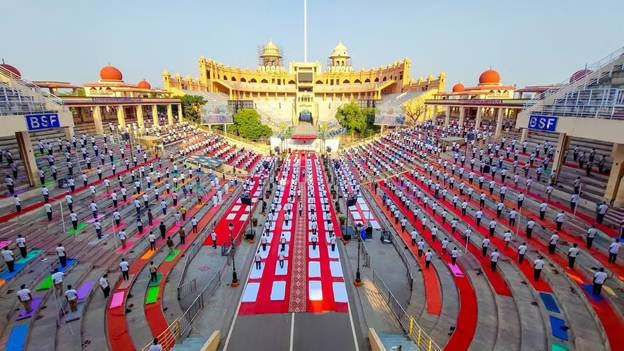
Data released by the Ministry of Ayush’s Yoga Sangam Portal tracked an unprecedented wave of mobilization: over 3.07 crore (30.7 million) individuals and 7.64 lakh (764,000) organizations registered to participate. From mass demonstrations of 35,000 people at the historic Red Road in Kolkata to high-altitude sessions conducted by the Indo-Tibetan Border Police at 14,000 feet near Pangong Tso, Ladakh, the 2026 event highlighted yoga’s growing integration into preventative medicine and senior wellness strategies.
The Public Health Pivot: Why “Healthy Ageing” Matters
According to the World Health Organization (WHO), the global population of people aged 60 and older will double to 2.1 billion by 2050. This demographic shift presents severe challenges to healthcare infrastructure, primarily due to chronic age-related conditions like osteoarthritis, cognitive decline, and cardiovascular disease.
The 2026 IDY theme directly targets this crisis by framing yoga not merely as physical exercise, but as a low-cost, accessible therapeutic intervention.
To demonstrate this utility, the Ministry of Social Justice and Empowerment hosted the “Vayo Yoga Sangam” at Bharat Mandapam in New Delhi, gathering 1,300 senior citizens to perform tailored, low-impact regimens.
Medical experts unaffiliated with the event note that the timing of this public health push matches current clinical literature.
“We are seeing a major shift in how we view geriatric care,” says Dr. Aris Thorne, a geriatric medicine specialist based in London. “Mainstream medicine is realizing that pharmaceutical interventions for the elderly must be paired with movement therapies that preserve musculoskeletal integrity and cognitive function. Yoga fits this requirement remarkably well.”
What the Science Says: Evidence-Based Benefits of Yoga for Seniors
While public enthusiasm for yoga is high, clinical researchers have spent years measuring its actual biological impact on aging bodies.
                          YOGA FOR HEALTHY AGEING
                                     │
         ┌───────────────────────────┼───────────────────────────┐
         ▼                           ▼                           ▼
  Musculoskeletal                Neurological               Cardiovascular
  • Balance control              • Cortisol reduction       • Vagal tone enhancement
  • Joint flexibility            • Gray matter retention    • Blood pressure reduction
1. Fall Prevention and Musculoskeletal Health
Falls remain the leading cause of injury-related death among adults aged 65 and older. A comprehensive systematic review published in the Journal of Cachexia, Sarcopenia and Muscle (2023) demonstrated that progressive yoga interventions significantly improve balance, lower-body strength, and mobility in older adults. By strengthening stabilizing muscles and improving proprioception (the body’s ability to sense its location in space), consistent practice directly decreases fall risk.
2. Cognitive Preservation and Stress Reduction
Aging is frequently accompanied by a gradual decline in neural plasticity. Neuroimaging studies published in Frontiers in Human Neuroscience reveal that regular yoga and meditation practitioners show less age-related gray matter decline in the hippocampus and prefrontal cortex—areas critical for memory and executive function. Furthermore, yoga downregulates the hypothalamic-pituitary-adrenal (HPA) axis, reducing chronic circulating cortisol (the primary stress hormone), which is known to accelerate cellular aging.
3. Cardiovascular and Metabolic Regulation
Research from the European Journal of Preventive Cardiology indicates that yoga provides metabolic and cardiovascular benefits comparable to moderate aerobic exercise. The practice enhances vagal tone—the activity of the vagus nerve, which dictates heart rate variability—helping to lower resting blood pressure and improve lipid profiles in hypertensive seniors.
From “Gangotri to Gangasagar”: Uniting Geography and Health
The 2026 celebrations featured highly synchronized logistics to maximize public engagement. A premier initiative was the “Gangotri to Gangasagar” campaign, executed by the Morarji Desai National Institute of Yoga (MDNIY). The campaign mapped out Common Yoga Protocol (CYP) sessions across a 2,525-kilometer stretch along the Ganga basin, engaging communities in Rishikesh, Haridwar, Prayagraj, Varanasi, and Patna.
[Gangotri] ──► [Rishikesh] ──► [Haridwar] ──► [Prayagraj] ──► [Varanasi] ──► [Gangasagar]
                    │                                             │
                    └────────── 2,525 km Common Protocol ─────────┘
Concurrently, a massive digital outreach strategy drove public interaction. The Ministry of Ayush secured a Guinness World Record during the lead-up to the event, logging 4,35,831 concurrent viewers for a single YouTube Live streaming yoga session.
A Balanced View: Clinical Limitations and Injury Risks
Despite the clear benefits showcased during IDY 2026, medical professionals urge caution. Yoga is not a flawless cure-all, and a sudden surge in unsupervised practice among senior citizens presents real clinical risks.
| Parameter | Clinical Benefit | Potential Medical Risk / Limitation |
| Balance & Mobility | Decreases fall risk by improving stabilizing muscles. | Acute balance loss during advanced poses can cause immediate fractures. |
| Flexibility | Lubricates joints and counteracts age-related stiffness. | Hyperextension can worsen pre-existing spinal stenosis or herniated discs. |
| Cardiovascular | Lowers resting blood pressure via parasympathetic activation. | Inverted poses (e.g., down-dog) can dangerously elevate intraocular pressure in glaucoma patients. |
“We must be objective,” cautions Dr. Thorne. “An older individual with severe osteoporosis or advanced osteoarthritis cannot simply jump into a standard yoga class. Without modification, certain poses can cause spinal compression fractures or ligament tears. The key to ‘Yoga for Healthy Ageing’ is strict customization and professional supervision.”
Epidemiological data on yoga-related injuries indicate that the lower back, shoulders, and knees are highly vulnerable in older demographics. Public health officials emphasize that seniors should seek clearance from their primary care physicians before starting a regimen, and should strictly focus on chair yoga or prop-supported variations.
Changing Daily Health Decisions
As IDY 2026 concludes, its success will be measured by whether these mass gatherings translate into permanent lifestyle changes. For the general public, the primary takeaway is that preventative health adjustments do not require high-intensity workouts. Incorporating 15 to 30 minutes of gentle, structured movement and controlled breathing daily can fundamentally alter an individual’s aging trajectory.
For global healthcare systems managing aging populations, yoga represents an extraordinarily cost-effective, scalable tool to promote independent living and mitigate chronic disease burdens worldwide.
Reference Section
-
Event Metrics & Analytics: Press Information Bureau (PIB) Delhi, Ministry of Ayush, Government of India. Yoga Sangam Portal Registry Data (Released June 23, 2026).
Medical Disclaimer: This article is for informational purposes only and should not be considered medical advice. Always consult with qualified healthcare professionals before making any health-related decisions or changes to your treatment plan. The information presented here is based on current research and expert opinions, which may evolve as new evidence emerges.