 0
0
 0
0
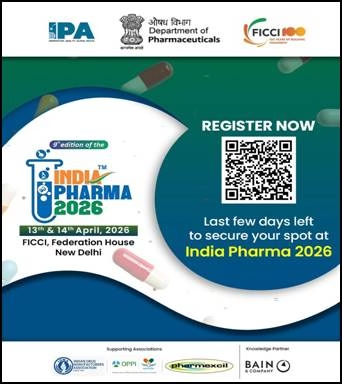
NEW DELHI – In a move signaling a tectonic shift in the global healthcare landscape, the Department of Pharmaceuticals, Ministry of Chemicals & Fertilizers, has announced the 9th Edition of India Pharma 2026. Scheduled for April 13-14 at Federation House, the summit aims to pivot the world’s “pharmacy to the world” from a manufacturing-heavy model to a high-value, innovation-led ecosystem.
Organized in collaboration with the Federation of Indian Chambers of Commerce and Industry (FICCI) and the Indian Pharmaceutical Alliance (IPA), the conference arrives at a critical juncture for global health security. Under the theme “Discover in India: Leapfrogging Life-Sciences Innovation,” the event will gather policymakers, researchers, and global CEOs to chart a course for India’s transition into a premier hub for drug discovery and complex biologics.
Beyond Generics: The Innovation Leap
For decades, India has been the global leader in volume, providing over 20% of the world’s generic drug supply and approximately 60% of global vaccine demand. However, the 2026 summit marks a formal commitment to “Value-at-Volume.”
The primary focus of this year’s agenda is the “Leapfrog” strategy. This involves moving beyond simple molecular copies toward complex generics, biosimilars, and New Chemical Entities (NCEs).
“The era of India being just a backup manufacturer is over,” says Dr. Aruna Sharma, a senior health policy analyst (not affiliated with the event organizers). “The focus now is on ‘Discover in India.’ This means creating original intellectual property that addresses unmet medical needs, particularly in oncology, rare diseases, and antimicrobial resistance.”
Key Themes of India Pharma 2026:
-
Drug Discovery & R&D: Streamlining clinical trial regulations to foster homegrown innovation.
-
Digital Transformation: Integrating Artificial Intelligence (AI) and Machine Learning (ML) in drug development to reduce time-to-market.
-
Sustainability: Developing “Green Chemistry” to reduce the environmental footprint of Active Pharmaceutical Ingredient (API) manufacturing.
-
Global Supply Chain Resilience: Strengthening the “Atmanirbhar Bharat” (Self-Reliant India) initiative to reduce dependence on external raw materials.
The Economic and Public Health Impact
The Indian pharmaceutical industry is currently valued at approximately $50 billion, with projections suggesting it could reach $130 billion by 2030. This growth isn’t just a matter of economics; it has profound implications for global patient access.
By shifting toward innovation, India aims to make expensive treatments—such as monoclonal antibodies for cancer and autoimmune disorders—more affordable through biosimilar development.
“When India innovates, the world benefits from the price correction,” notes a recent report from the Indian Pharmaceutical Alliance (IPA). “The goal is to provide ‘high-tech’ medicine at ‘low-tech’ prices.”
Infrastructure and Policy: The “Viksit Bharat 2047” Vision
The Department of Pharmaceuticals has highlighted that this summit is a cornerstone of the Viksit Bharat 2047 vision—a roadmap to make India a developed nation by its centenary of independence.
To support this, the government has introduced several Production Linked Incentive (PLI) schemes. According to government data, these schemes have already attracted billions in investment, specifically targeting the manufacturing of critical key starting materials (KSMs) and high-value medical devices.
The conference will also emphasize industry-academia partnerships. By bridging the gap between university research and commercial production, the government hopes to create a “seamless pipeline” for new therapies.
Challenges and Counter-Perspectives
Despite the optimism, the road to becoming an innovation powerhouse is fraught with hurdles. Critics and industry observers point to three main challenges:
-
R&D Spending: While global pharmaceutical giants often spend 15-20% of their revenue on R&D, the average Indian firm currently spends closer to 7-8%.
-
Regulatory Stringency: To be a global hub, India’s Central Drugs Standard Control Organisation (CDSCO) must continue to align with international standards like those of the USFDA and EMA to ensure data integrity and quality.
-
Intellectual Property (IP) Concerns: Balancing affordable access to medicine with the stringent IP protections required to incentivize innovation remains a delicate tightrope for Indian regulators.
“Transitioning to an innovation-led model requires more than just intent; it requires a massive influx of venture capital and a high tolerance for the high failure rates associated with new drug discovery,” says Michael Reynolds, a global supply chain consultant.
What This Means for Patients and Consumers
For the average consumer, India Pharma 2026 signals a future where cutting-edge treatments are no longer exclusive to Western markets.
-
Faster Access: Localized innovation means new drugs may be approved and available in India simultaneously with global launches.
-
Affordability: Increased competition in the biosimilar space is expected to drive down the cost of chronic disease management.
-
Quality Assurance: The push for global leadership necessitates higher manufacturing standards, ensuring safer medications for the end-user.
As the delegates prepare to meet in New Delhi this April, the message is clear: India is no longer content with being the world’s pharmacy—it wants to be the world’s laboratory.
Medical Disclaimer
Medical Disclaimer: This article is for informational purposes only and should not be considered medical advice. Always consult with qualified healthcare professionals before making any health-related decisions or changes to your treatment plan. The information presented here is based on current research and expert opinions, which may evolve as new evidence emerges.
References
Institutional Sources:
-
Press Information Bureau (PIB) Delhi. (2026, March 30). 9th India Pharma Conference 2026 to be Held in New Delhi on April 13-14. [Source ID: 21033001].