 0
0
 0
0
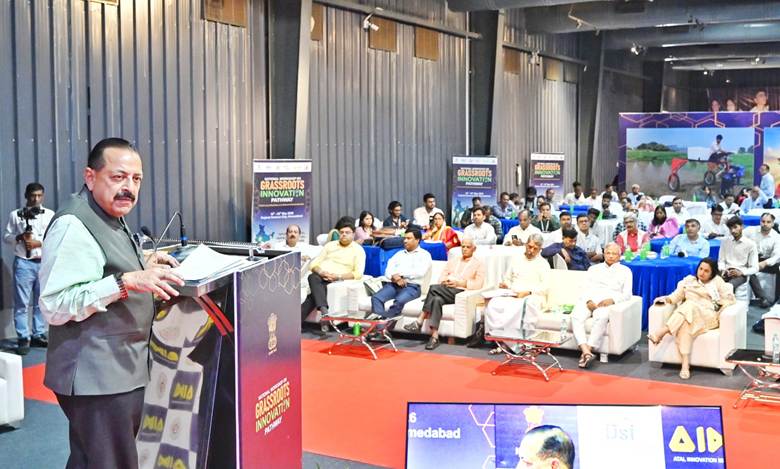
AHMEDABAD, INDIA — In an effort to correct stark regional imbalances and build a resilient health and economic framework from the ground up, Union Minister Dr. Jitendra Singh announced on May 19, 2026, a comprehensive plan to formally integrate India’s “grassroots innovators” into the mainstream scientific ecosystem. Speaking at the national workshop “Grassroots Innovation Pathways: From Local Resilience to National Advancements” at Science City, Ahmedabad, Dr. Singh emphasized that merging traditional rural practices with cutting-edge technologies like Artificial Intelligence (AI) and modern food processing is a critical public health and economic priority.
The two-day national workshop, organized by NITI Aayog in collaboration with the National Innovation Foundation (NIF) and the Gujarat Council of Science & Technology (GUJCOST), brought together leading policymakers, scientists, and local visionaries to create a uniform, community-led framework capable of converting local ideas into scalable national health and livelihood solutions.
Unlocking the Rural Innovation Ecosystem
For generations, rural communities across India have relied on indigenous resources to solve everyday challenges. Dr. Jitendra Singh labeled these local problem-solvers as India’s “silent nation builders.” He noted that while these innovators often lack formal academic credentials, they possess deep practical wisdom that remains untapped by elite metropolitan research laboratories.
          [ Traditional Rural Knowledge ]
                         │
                         ▼
        [ Validation & Scientific Screening ]
              (NIF Herbal Laboratories)
                         │
                         ▼
        [ Advanced Integration (AI & Biotech) ]
                         │
                         ▼
     [ Scalable Public Health & Food Solutions ]
A primary focus of this new national push is food security and preventive health through nutritional optimization. The Ministry highlights that by reinforcing traditional agricultural and dietary practices with modern manufacturing standards, local communities can achieve self-sufficiency while combatting chronic health issues.
“Innovation must not remain confined to metropolitan centers or elite institutions,” Dr. Singh stated. “Combining traditional knowledge systems with modern technologies can significantly increase the value and market potential of local products, directly improving commercialization and income opportunities for local communities.”
Nutritional Security as Preventive Healthcare
A key example of this strategy is the scientific upgrading of millet-based products and traditional regional foods. Public health experts have long advocated for the revival of millets due to their superior nutritional profile compared to highly processed grains.
According to the World Health Organization (WHO), non-communicable diseases (NCDs) like cardiovascular disease and type 2 diabetes are rising sharply in developing nations, driven heavily by rapid dietary shifts toward processed foods. Millets offer a highly effective, low-glycemic, and nutrient-dense alternative.
| Nutrient Component | Pearl Millet (Bajra) | Finger Millet (Ragi) | Refined Wheat Flour (Maida) |
| Dietary Fiber | High (~8.5g/100g) | Very High (~11.5g/100g) | Low (~2.7g/100g) |
| Glycemic Index (GI) | Low to Medium (~55) | Low (~50) | High (~70+) |
| Micronutrients | Rich in Iron & Zinc | Exceptionally High Calcium | Stripped during milling |
By applying modern food processing technologies to these ancient grains, grassroots innovators are extending the shelf-life and accessibility of these crops, turning localized climate-resilient farming into a scalable shield for preventive healthcare.
Validating Local Medicine and Herbal Safety
Beyond nutrition, the integration of traditional knowledge extends directly into community health and local botanical treatments. Rural areas often rely on herbal preparations for primary care. However, the lack of standardized testing can introduce significant risks regarding dosage, purity, and hepatotoxicity (chemical-driven liver damage).
To safely bridge this gap, the National Innovation Foundation (NIF) has established dedicated Herbal Analytical Laboratories. These facilities put local remedies through rigorous scientific screening, validation, and value-addition processes.
[Local Remedy Discovery] ➔ [Herbal Analytical Lab Isolation] ➔ [Toxicity & Efficacy Evaluation] ➔ [Standardized Bioactive Compound]
This screening filters out ineffective or hazardous preparations while preserving and patenting legitimate medical breakthroughs. According to NIF data, the organization has cataloged over 375,000 technological ideas and traditional knowledge practices across 730 districts. This systemic mapping has yielded more than 725 granted Indian patents, proving that rural ingenuity can withstand rigorous scientific scrutiny.
Public Health Implications and Structural Hurdles
From a public health perspective, establishing a robust, decentralized economic and healthcare model directly targets the root causes of regional health disparities. Socioeconomic instability is one of the most prominent social determinants of health; poverty and lack of local employment frequently restrict access to proper medical care, exacerbate maternal and child malnutrition, and fuel forced migration to overpopulated urban centers.
By supporting community entrepreneurship through programs like PM Vishwakarma, the government aims to establish local financial stability. Stable local economies translate into better healthcare choices, cleaner living conditions, and improved health literacy.
Navigating the Limitations
Despite the optimism surrounding community-led ecosystems, independent medical and public health authorities emphasize that several challenges must be addressed:
-
The Scalability Bottleneck: Transforming a localized solution into a commercially viable product that meets strict safety guidelines requires substantial capital and specialized manufacturing infrastructure that tier-2 and tier-3 areas currently lack.
-
Scientific Disconnect: Many government-backed scientific initiatives fail to reach local innovators because program requirements remain disconnected from ground realities.
-
Safety Rigor: Experts warn that traditional and herbal solutions must not bypass necessary clinical trial phases. Traditional use does not automatically guarantee safety when a compound is concentrated, packaged, and distributed at scale.
A Healthier, More Balanced Future
The National Workshop in Ahmedabad represents a deliberate step toward aligning India’s informal innovators with the nation’s broader scientific and economic goals under the Viksit Bharat @2047 vision.
By building formal, heavily monitored pathways from local resilience to national advancement, the initiative aims to create a more balanced ecosystem. If successful, this integration will protect and validate valuable traditional knowledge, shield rural areas from economic volatility, and deliver safer, locally-sourced healthcare alternatives to the public.
References
Policy and Institutional Authorities
-
Ministry of Science & Technology, Government of India. Press Information Bureau (PIB) Delhi. Headline: Promoting ‘Grassroots Innovators’ can Strengthen Rural Economy, reduce regional imbalance: Dr. Jitendra Singh. Published: May 19, 2026.
Medical Disclaimer: This article is for informational purposes only and should not be considered medical advice. Always consult with qualified healthcare professionals before making any health-related decisions or changes to your treatment plan. The information presented here is based on current research and expert opinions, which may evolve as new evidence emerges.