 0
0
 0
0
DELHI — Malnutrition has long been one of the most stubborn public health challenges in developing economies. For decades, tracking the nutritional status of millions of children scattered across remote villages relied on a slow, paper-heavy trail. Field workers spent hours filling out bulky, ink-stained ledgers, meaning that by the time data reached public health decision-makers, it was often months out of date.
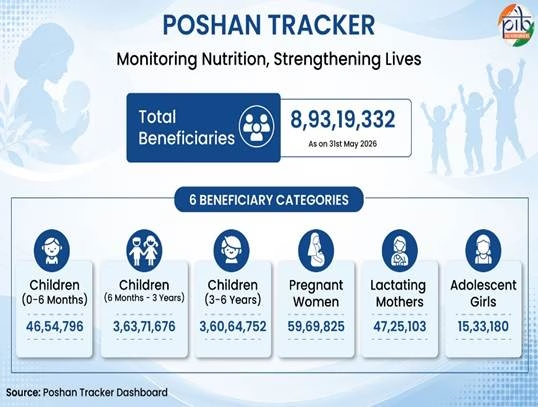
To bridge this critical gap, India has turned to technology. Statistics released by the Ministry of Women and Child Development (MoWCD) reveal that the country’s real-time nutrition surveillance system, the Poshan Tracker, has achieved nationwide scale. As of mid-2026, the mobile-based governance platform has expanded across all 28 States and 8 Union Territories, pulling in data for more than 8.93 crore (89.3 million) registered beneficiaries.
By replacing pen-and-paper tracking with real-time digital dashboards, the platform has fundamentally shifted nutrition management from a standard welfare initiative into a highly structured, data-driven public health strategy.
Moving Beyond the 11 Manual Registers
Before the rollout of the Poshan Tracker, frontline health workers—known locally as Anganwadi Workers (AWWs)—had to manually update 11 separate paper registers. These logs tracked everything from local infrastructure to daily food delivery and basic growth metrics. The sheer weight of this administrative burden often created significant data delays, making it difficult to spot acute nutritional crises until long after they had begun.
“In public health, data that is even a few months old limits your ability to act effectively,” explains Dr. Anita Sen, an independent maternal and child health researcher based in New Delhi. “By the time a paper report indicates a localized spike in childhood wasting, those children may have already suffered preventable health setbacks. Real-time data changes the dynamic entirely.”
The transition to a cloud-based infrastructure has streamlined this workflow. Frontend workers use smartphones loaded with the platform to log field observations immediately. To ensure that resources go exactly where they are needed, the system features Aadhaar-based verification (a secure national identity link) alongside a Facial Recognition System (FRS). This digital framework verifies beneficiary identities, eliminates duplicate or “ghost” entries, and ensures that nutritional supplements reach eligible individuals directly.
Smart Automation on the Frontlines
The platform does more than just aggregate statistics; it serves as an active assistant for field staff through several key features:
-
The Poshan Calculator: Frontline workers no longer have to manually calculate growth percentiles. By inputting a child’s age, gender, height, and weight, the system automatically cross-references the numbers with World Health Organization (WHO) Child Growth Standards. It then instantly classifies the child’s status across vital metrics, identifying whether they are underweight, stunting (too short for their age), or experiencing wasting (too thin for their height).
-
Automated Home Visit Scheduler: Inconsistent follow-ups have historically weakened community health programs. The tracker solves this by auto-scheduling 23 structured home visits over a child’s early development cycle, providing workers with specific, age-appropriate counseling prompts for mothers.
-
Early Childhood Content Delivery: Beyond physical nourishment, cognitive growth is supported through integrated early childhood care material. The platform delivers hundreds of instructional videos, voice notes, and activity guides based on Aadharshila—India’s national play-based preschool curriculum.
Measuring Scale and Impact
According to data from May 2026, the sheer volume of information handled by the tracker makes it one of the largest continuous nutrition surveillance ecosystems globally. The platform actively monitors six key life-cycle stages, spanning from pregnancy and lactation through early childhood and adolescence.
| Metric / Program Component | Current Scale & Reach (As of mid-2026) |
| Total Registered Beneficiaries | Over 8.93 crore (89.3 million) individuals nationwide |
| Children Actively Monitored | Live monthly tracking for 7.7 crore (77 million) children |
| Growth Assessment Coverage | Over 6.3 crore children aged 0–5 years (94% of those registered) |
| Supplementary Nutrition Programme (SNP) | 5.5+ crore received food for ≥15 days; 5.17 crore for ≥21 days |
This massive flow of data feeds directly into centralized dashboards and heat maps, allowing district and national health administrators to identify emerging nutritional deficits quickly and allocate resources to vulnerable regions.
Global Recognition and Structural Criticisms
The platform’s technological scale has drawn international notice. The World Health Organization (WHO) has highlighted it as an exemplary model for nutrition data ecosystems, while UNICEF has praised its simple interface and robust approach to tracking vulnerable groups. The platform was also showcased at the G20 Ministerial Conference on Women Empowerment and received the Prime Minister’s Award for Excellence in Public Administration.
However, independent public health analysts emphasize that software alone cannot solve malnutrition. A digital tracker is only as reliable as the physical infrastructure supporting it.
Studies evaluating real-time monitoring tools frequently highlight a handful of structural limitations:
Grassroots Challenges: In remote regions, poor internet connectivity can delay data syncing, occasionally causing local data discrepancies. Furthermore, minor mismatches in name spellings on identity cards have sometimes caused temporary registration delays for pregnant women.
Additionally, a study published in the PubMed Central (PMC) repository noted that real-time monitoring tools like the Poshan Tracker occasionally report lower overall undernutrition percentages compared to retrospective, household-level population surveys like the National Family Health Survey (NFHS-5). Experts suggest this variation underlines why real-time tools should be viewed as a complement to, rather than a total replacement for, traditional demographic health surveys. Real-time tools provide an immediate operational snapshot, while long-term surveys offer a broader baseline.
The Public Health Outlook
For the average consumer and healthcare provider, India’s pivot toward real-time monitoring represents a broader shift toward preventive medicine. By catching acute malnutrition early—such as identifying Severe Acute Malnutrition (SAM) or Moderate Acute Malnutrition (MAM) through automated alerts—frontline workers can step in with targeted therapeutic foods and medical counseling before a child requires emergency hospitalization.
As the system matures, the integration of upgraded physical centers—equipped with water purifiers, smart learning tools, and Poshan Vatikas (local nutrition gardens)—aims to turn raw data into better health outcomes on the ground. For global public health, the platform stands as a compelling case study in how cloud computing and mobile applications can be deployed to safeguard the health of a nation’s next generation.
Medical Disclaimer
This article is for informational purposes only and should not be considered medical advice. Always consult with qualified healthcare professionals before making any health-related decisions or changes to your treatment plan. The information presented here is based on current research and expert opinions, which may evolve as new evidence emerges.
References
-
Ministry of Women and Child Development (MoWCD): Press Information Bureau (PIB) Delhi, Official Releases on Nutrition Governance and Saksham Anganwadi Targets (2024–2026). [PRID: 2226343, 2282421]