 0
0
 0
0
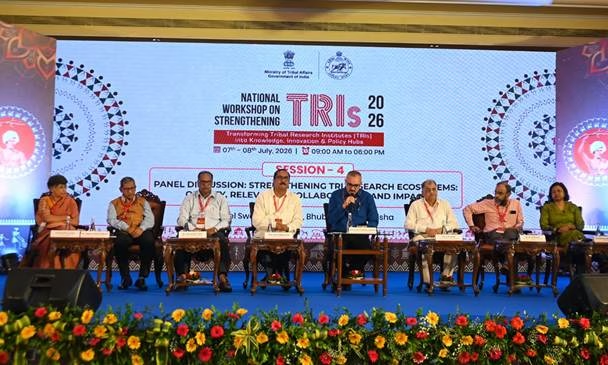
BHUBANESWAR, INDIA — In a major step toward addressing long-standing healthcare disparities and preserving indigenous knowledge, the Ministry of Tribal Affairs, in collaboration with the Government of Odisha, officially adopted the Bhubaneswar Declaration on July 8, 2026. Concluding a intensive two-day National Workshop, nearly 200 policymakers, public health experts, technologists, and tribal community representatives finalized a comprehensive national roadmap. The framework is designed to modernize India’s Tribal Research Institutes (TRIs), transforming them into technology-enabled centers of excellence capable of driving evidence-based health policymaking, tracking epidemiological trends, and safeguarding traditional medicinal systems for the country’s marginalized tribal populations.
A New Era for Evidence-Based Tribal Health
For decades, India’s tribal communities—comprising over 104 million people according to census data—have faced disproportionate health challenges, including high rates of malnutrition, genetic blood disorders like sickle cell anemia, and limited access to primary healthcare. The newly adopted Bhubaneswar Declaration seeks to systematically eliminate these inequities by shifting the national tribal research paradigm from passive documentation to active, data-driven public health intervention.
A primary pillar of the declaration is the finalization of the Model TRI Framework 2030. This framework establishes standardized benchmarks for institutional governance, staffing, and research quality. Crucially, it mandates that TRIs conduct community-level needs analyses to ensure that regional healthcare interventions are shaped by actual ground-level requirements.
To track progress and hold institutions accountable, the Ministry announced a new Result and Ranking Framework managed via the National Tribal Research Portal (NTRP). This framework will use data metrics to foster performance-based growth and encourage healthy, inter-state competition to improve health delivery models.
Integrating Advanced Technology and Traditional Medicine
A significant development from the workshop is the focus on technology integration to solve complex public health delivery challenges in remote areas. Under a newly proposed Shared-Service Model, TRIs will leverage advanced tools such as Artificial Intelligence (AI) and Geographic Information Systems (GIS) to map healthcare accessibility, trace disease outbreaks, and manage a robust centralized repository for tribal health and demographic data.
Furthermore, the declaration outlines a dual-purpose strategy to document and preserve vanishing indigenous knowledge systems. This includes traditional tribal medicine and ethnobotanical practices, which have frequently been overlooked by mainstream medical systems.
“Tribal Research Institutes are the voices of tribal communities,” stated Smt. Ranjana Chopra, Secretary of the Ministry of Tribal Affairs, during her address. “They must evolve into globally recognized centers of excellence built on high-quality research and rooted in community realities… Most importantly, they must bridge the gap between research, policy, and the people they serve.”
Expert Perspectives on Public Health Implications
Public health experts not directly involved in the workshop have welcomed the initiative, highlighting that centralized, high-quality data collection is vital for reducing health disparities.
Dr. Alok Sen, a community medicine specialist and independent health equity researcher, noted the practical implications of the announcement:
“Historically, public health strategies for tribal regions have suffered from a lack of granular, localized data. By transforming TRIs into data-driven hubs, we can better design targeted interventions for endemic issues like micronutrient deficiencies and maternal mortality. Furthermore, integrating GIS mapping allows health authorities to identify exactly where healthcare infrastructure falls short.”
The initiative also earned praise for its focus on youth engagement and institutional capacity-building. To sustain this ecosystem, the Ministry presented Certificates of Appreciation to seven top-performing TRIs for their outstanding contributions to documentation and research quality:
-
Tribal Research and Training Institute, Chhattisgarh
-
Scheduled Castes and Scheduled Tribes Research and Training Institute, Odisha
-
Tribal Research and Cultural Institute, Tripura
-
Tribal Research & Training Institute, Maharashtra
-
Kerala Institute for Research, Training & Development Studies of Scheduled Castes and Scheduled Tribes (KIRTADS), Kerala
-
Tribal Cultural Research and Training Institute, Telangana
-
Dr. Ramdayal Munda Tribal Welfare Research Institute, Jharkhand
Addressing Strategic Challenges and Limitations
While the roadmap presents a progressive vision, independent analysts point out several systemic challenges that must be overcome to achieve true institutional excellence.
A primary concern is human resource sustainability. The declaration acknowledges the need to “attract, retain, and continuously build the capacities of specialized researchers,” but executing this across remote regions remains difficult. Attracting highly trained epidemiologists, data scientists, and medical anthropologists into public sector tribal research requires competitive compensation and long-term institutional stability.
Additionally, experts emphasize that a Research Dissemination and Utilisation Strategy—while excellent on paper—will fail if state-level welfare and health departments do not actively integrate TRI recommendations into their annual budgetary planning. Translating complex research into accessible dashboards and policy briefs is only the first step; bureaucratic accountability is required to ensure these insights change clinical practices on the ground.
Practical Meanings for Communities and Next Steps
For health-conscious citizens and tribal communities, the Bhubaneswar Declaration signals a shift toward more inclusive, respectful, and effective healthcare delivery. It means future health policies will look at individuals through a person-first lens, honoring their cultural heritage while providing modern medical support.
The workshop concluded with a clear commitment to action. As Shri Anant Prakash Pandey, Joint Secretary of the Ministry of Tribal Affairs, summarized in his closing remarks:
“The recommendations emerging from the workshop and the Bhubaneswar Declaration provide a clear roadmap for enhancing institutional capacities, promoting research excellence, embracing technology, and fostering greater collaboration. The Ministry remains committed to working with State Governments, Tribal Research Institutes, and all stakeholders to translate these recommendations into meaningful outcomes.”
With the National TRI Research Agenda (2027–2032) set to guide priorities over the next five years, the declaration serves as a foundational blueprint to ensure that the vision of a developed India benefits its most vulnerable populations.
Medical Disclaimer
Medical Disclaimer: This article is for informational purposes only and should not be considered medical advice. Always consult with qualified healthcare professionals before making any health-related decisions or changes to your treatment plan. The information presented here is based on current research and expert opinions, which may evolve as new evidence emerges.
References
Institutional and Governmental Sources
-
Ministry of Tribal Affairs, Government of India. (Official Press Release, July 8, 2026). Bhubaneswar Declaration adopted as National Workshop on Strengthening Tribal Research Institutes concludes. PIB Delhi.