 0
0
 0
0
AUSTIN, Texas — Federal and state agricultural officials are intensifying surveillance and expanding emergency containment measures following the confirmation of two additional cases of New World screwworm (NWS) in livestock and a domestic pet in Texas and New Mexico. The United States Department of Agriculture (USDA) confirmed the infestations, bringing the U.S. tally to four identified cases in a single week. The rapid succession of detections has reignited deep concern among agricultural authorities and public health experts over the potential re-establishment of a destructive, flesh-eating parasite that was officially eradicated from the mainland United States decades ago.
The newly confirmed cases include a calf in La Salle County, Texas, and a domestic dog physically located in Lea County, New Mexico, which was linked to a Texas-based veterinarian. These detections follow closely on the heels of an initial livestock case involving a calf in Zavala County, Texas.
The geographic clustering indicates that the parasite is actively moving northward from an ongoing, severe outbreak that has plagued Central America and Mexico over the last few years. While the primary threat is economic and veterinary, public health agencies are monitoring the situation closely due to the parasite’s ability to infect any warm-blooded animal, including, in rare instances, humans.
Understanding the “Screwworm”: A Voracious Parasite
Unlike most common blowflies or maggots that feed exclusively on dead or decaying tissue, the New World screwworm (Cochliomyia hominivorax) is a obligate parasite of living flesh.
[Adult Fly Lays Eggs in Open Wound]
               │
               ▼ (12–24 Hours)
[Larvae Hatch & Burrow into Living Tissue] ◄─── (Causes Severe Myiasis)
               │
               ▼ (5–7 Days of Feeding)
[Larvae Drop to Ground & Pupate in Soil]
               │
               ▼ (6–8 Days)
[Adult Fly Emerges to Repeat Cycle]
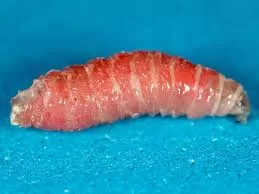
The name “screwworm” originates from the physical shape of the larvae and the structural ridges on their bodies, which resemble the threads of a screw. Using sharp, curved mouth hooks, the larvae burrow deep into the living muscular tissue of the host, progressively expanding the wound as they feed. This creates an agonizing, foul-smelling condition known as myiasis. If left untreated, the extensive tissue destruction and secondary bacterial infections can lead to systemic toxicity and death.
The life cycle of the fly is extraordinarily rapid under the warm, humid conditions typical of the southern United States. Adult female flies—distinguished by their metallic blue or green bodies and striking orange eyes—are drawn to the scent of open wounds, fresh surgical sites, or newborn umbilical areas. A single female can deposit up to 400 eggs at the edge of a wound. Within 12 to 24 hours, the larvae hatch and begin feeding, completing their development in less than a week before dropping to the soil to pupate into adult flies.
A Massive Sterile-Fly Response Activated
In response to the sudden cluster of border-state detections, the USDA’s Animal and Plant Health Inspection Service (APHIS) immediately activated its New World Screwworm Response Playbook. Officials have established strict 20-kilometer (approximately 12-mile) quarantine zones centered around each detection site. These zones restrict the movement of livestock and potentially infested animals out of the target areas without rigorous veterinary inspection.
The primary weapon being deployed against the infestation is the Sterile Insect Technique (SIT), the same biological control strategy that successfully eliminated the pest from the U.S. in 1966.
“Over the past week, USDA has identified and expeditiously confronted four confirmed detections of New World screwworm,” stated Dudley Hoskins, USDA Under Secretary for Marketing and Regulatory Programs. “This second detection is within the established movement control zone and enhanced sterile insect dispersal area.”
The federal government has scaled up operations to release approximately 100 million sterile male flies per week along and just south of the U.S.–Mexico border. Because female screwworm flies mate only once in their lifetime, mating with a continuous influx of laboratory-sterilized males results in unhatched eggs, causing the wild population to collapse.
       [ Wild Female Fly ]
                │
        ┌───────┴───────┐
        ▼               ▼
 [ Wild Male ]   [ Sterile Male (SIT) ]
        │               │
        ▼               ▼
 [ Viable Eggs ] [ 0% Hatch Rate ] ──► [ Population Collapses ]
Veterinary and Human Health Risks
The economic stakes for the American agricultural sector are massive. The U.S. livestock industry supports tens of billions of dollars in annual food production. In Central America and Mexico, the ongoing outbreak has caused devastating losses, with regional authorities documenting more than 170,000 animal cases since 2023. Livestock producers are urged to watch animals for lethargy, marked discomfort, and unusually foul-smelling or enlarging wounds.
Fortunately, officials emphasize that the U.S. food supply remains entirely secure, as any affected commercial livestock would be identified during routine anti-mortem inspections and legally barred from entering the supply chain.
While the primary risk rests with livestock, wildlife, and domestic pets, humans are biologically susceptible hosts. According to the Centers for Disease Control and Prevention (CDC), human cases remain exceedingly rare in developed nations.
The CDC recently monitored a single U.S. case involving an individual who developed NWS myiasis after traveling to El Salvador. Human risk is highly localized, concentrated among individuals with exposed, untreated wounds who spend significant time outdoors in rural or agricultural settings where active fly populations exist.
Public Health Implications and Operational Challenges
Independent experts note that while the public should remain calm, the situation requires aggressive regional management.
“At the population level, the primary impact is on animals and the agricultural economy,” explained Dr. Elena Torres, a veterinary parasitologist and infectious disease epidemiologist at the University of Texas at El Paso, who is not involved in the federal response. “But every animal case is a warning sign that people in the same environment should be vigilant about wound care and reporting.”
Controlling the biological front line presents unique logistical challenges. Screwworm flies are strong fliers, capable of traveling 10 to 15 miles independently under normal conditions, and up to 120 miles if assisted by strong wind currents or transported on infested animals and vehicles.
Furthermore, historical data published in parasitology literature indicates that the long-term success of sterile-fly programs can occasionally be hindered by subtle genetic or mating incompatibilities that develop between wild populations and mass-reared laboratory strains, or by operational gaps in coverage across international borders.
“We are currently in an aggressive monitoring phase rather than a crisis phase,” noted Dr. Michael Chen, a parasitologist affiliated with public health surveillance efforts. “But that status could change rapidly if the parasite manages to establish a self-sustaining foothold in local wildlife populations or stray animal communities on the U.S. side of the border.”
Guidance for Pet Owners, Livestock Producers, and Residents
For the vast majority of Americans, the direct health risk posed by the New World screwworm is negligible. However, for livestock operators, veterinarians, and pet owners living across Texas, New Mexico, Arizona, and California, federal health authorities recommend a series of preventive practices:
-
Examine Animals Daily: Closely inspect livestock, horses, and outdoor pets for any signs of skin injury, cuts, tick bites, or raw surgical sites. Look for rapidly enlarging wounds or visible masses of small maggots.
-
Practice Strict Wound Hygiene: Keep all human and animal wounds clean, treated, and appropriately bandaged to block fly access.
-
Do Not Attempt Home Extraction: If a screwworm infestation is suspected, seek immediate professional medical or veterinary care. Safe removal requires thorough clinical or surgical debridement to ensure all burrowed larvae are completely cleared from deep tissue layers.
-
Report Suspected Cases Immediately: Veterinary professionals and producers must immediately report any highly suspicious, rapidly worsening myiasis cases to state animal health authorities or the USDA APHIS hotline.
Reference Section
- https://www.reuters.com/world/us/usda-confirms-two-additional-cases-new-world-screwworm-united-states-2026-06-08/
Medical Disclaimer
Medical Disclaimer: This article is for informational purposes only and should not be considered medical advice. Always consult with qualified healthcare professionals before making any health-related decisions or changes to your treatment plan. The information presented here is based on current research and expert opinions, which may evolve as new evidence emerges.