 0
0
 0
0
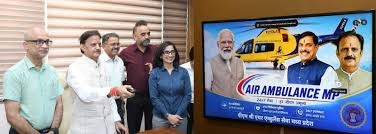
BHOPAL — In a major technological leap for emergency medicine, the Madhya Pradesh government has launched the “Air Ambulance MP” mobile app and web portal. The initiative is designed to dramatically reduce response times for emergency medical air transfers across the state’s 52 districts.
Unveiled by Deputy Chief Minister Rajendra Shukla at the Mantralaya in Bhopal, the digital platform transforms what was previously a cumbersome, paper-based request process into an agile, streamlined workflow. By triggering real-time alerts to pilots, specialized medical teams, and approval authorities simultaneously, the state aims to eliminate administrative bottlenecks and optimize the delivery of critical care when every second matters.
Key Findings: Digitizing the “Golden Hour”
The “Air Ambulance MP” platform directly addresses a critical vulnerability in emergency healthcare: the logistical delay between a local doctor’s referral and actual aircraft deployment. Under the newly implemented system, hospital authorities and district nodal officers can raise immediate digital requests through the app. Real-time fleet tracking further enables state officials to monitor aircraft availability and precise locations instantly.
State health department officials have stated that the primary objective is to bring down the interval between a medical referral and actual take-off to under one hour in most cases. This represents a substantial improvement over legacy procedures that required multiple layers of manual coordination and paperwork.
[Traditional System] Referral -> Manual Paperwork -> Multi-tier Approvals -> Crew Dispatch (Hours lost)
                                      vs.
[Digital Platform]   Referral -> Real-Time App Alert -> Automated Clearances -> Take-off (<60 Minutes)
The application features automated notifications to ensure crew and aircraft readiness before formal aviation clearances are issued. Meanwhile, a centralized command center in Bhopal maintains constant coordination with all peripheral health centers and district hospitals across the state.
Background: The PM Shri Air Ambulance Fleet
This digital upgrade serves as the technological backbone for the state’s existing “PM Shri Air Ambulance Service.” Initially launched in March 2024 by Chief Minister Mohan Yadav during the Regional Industry Conclave in Ujjain, the service was recently rebranded to align with national healthcare initiatives.
The air ambulance infrastructure features a dedicated fleet of intensive care unit (ICU)-equipped helicopters and fixed-wing converted flying ICU aircraft. Deployed to serve all districts, each aircraft is staffed with specialist doctors and paramedical teams trained to administer advanced life support (ALS) during transit.
The scale and operational impact of the service include the following milestones:
-
Total Missions Flown: 140 emergency medical evacuations completed statewide.
-
Geographic Reach: Active across all 52 districts of Madhya Pradesh, overcoming challenging terrains and remote tribal pockets.
-
Inter-State Capabilities: Facilitates seamless patient transfers to advanced tertiary care superspecialty hospitals in major medical hubs like Delhi, Mumbai, Chennai, and Hyderabad.
-
Operational Window: Available 24/7 for fixed-wing aircraft connecting established airstrips and airports.
The Clinical Imperative: Survival Metrics in Trauma Care
The launch of the digital portal highlights a foundational principle of emergency medicine: the “Golden Hour.” This term refers to the first 60 minutes immediately following a severe injury or acute medical event (such as a stroke or myocardial infarction) during which prompt, definitive medical intervention offers the highest likelihood of preventing mortality or long-term disability.
The public health stakes are particularly high in India, which ranks first globally in road traffic accident fatalities, accounting for approximately 16 deaths per 1 lakh (100,000) population annually. Delays in transporting victims from remote highways to specialized trauma centers remain a primary barrier to successful golden hour interventions.
Recent international data underscores the clinical efficacy of integrating aviation with emergency medicine. A comprehensive study published in the Emergency Medicine Journal analyzed 3,225 severe trauma patients treated by helicopter emergency medical services (HEMS) between 2013 and 2022. The peer-reviewed data revealed an 85% observed survival rate among patients transported via air ambulance, compared to an expected survival rate of 81% using standard ground metrics. This statistical difference translates to approximately five additional survivors per 100 cases, or up to 115 extra lives saved annually within that regional system.
“Time-sensitive medical response is the definitive boundary between life and death in trauma and critical cases,” Deputy Chief Minister Raj राजेंद्र Shukla stated during the launch event. “The digital integration of the PM Shri Air Ambulance Service symbolizes our commitment to ensuring that geographic isolation does not dictate survival outcomes.”
Expert Commentary and Clinical Applications
Medical experts not involved in the state’s initiative view the digitization of emergency workflows as a necessary evolution for rural healthcare delivery.
“In emergency medicine, administrative friction translates directly into tissue loss or mortality,” explained Dr. Anjali Sharma, a critical care specialist at AIIMS Bhopal. “The traditional referral system introduced systemic delays at multiple points—documentation, localized approval hierarchies, and aviation crew coordination. A unified digital workflow that alerts all stakeholders simultaneously eliminates these structural bottlenecks.”
Dr. Sharma further noted that the platform is especially relevant for Madhya Pradesh’s unique geography, which features vast forest covers, tribal belts, and regions with limited high-speed road connectivity.
| Patient Category | Primary Clinical Need |
| Critically Ill Newborns | Time-sensitive neonatal intensive care (NICU) access |
| Acute Cardiac Patients | Rapid transfer for primary percutaneous coronary intervention (angioplasty) |
| Ischemic Stroke Patients | Strict therapeutic window for thrombolysis (“clot-busting” medication) or mechanical thrombectomy |
| Severe Trauma/Accident Victims | Golden hour resuscitation and specialized surgical intervention |
| Organ Transplant Recipients | Time-critical transport of viable donor organs to preserve graft function |
Financial Accessibility and Equity
A cornerstone of the initiative’s public health framework is the removal of financial barriers to air medical transport, which is traditionally cost-prohibitive for the general public.
The service is provided completely free of charge to all Ayushman Bharat Pradhan Mantri Jan Arogya Yojana cardholders, as well as patients certified as belonging to economically weaker sections (EWS). For patients who do not fall under these categories, state health officials indicated that a clearly defined, tiered fee structure is being finalized based on the nature of the transfer (subsidy-eligible clinical emergencies versus commercial transfers).
Operational Limitations and Public Health Considerations
While the digital platform represents a significant step forward, public health analysts point out several operational realities and limitations that must be managed:
-
Aviation Constraints: While fixed-wing ICU aircraft operate 24/7 across functional airports, the helicopter fleet operates primarily during daylight hours due to visual flight rules (VFR) and limited night-landing infrastructure in rural sectors.
-
Meteorological Dependencies: Air ambulance deployments remain subject to weather conditions. Adverse weather, particularly during the monsoon season, can ground flights, necessitating reliable secondary ground transport protocols.
-
System Capacity: With current fleet resources distributed across a large geographic territory, localized demand could temporarily exceed available aircraft during mass casualty incidents or simultaneous remote emergencies.
-
Public Awareness: The technological platform relies heavily on institutional awareness. Ongoing campaigns are required to ensure that rural medical officers and district nodal authorities are proficient in navigating the app during high-stress scenarios.
According to senior health department officials, comprehensive training modules have already been conducted for nodal officers across all 52 districts. The Health and Aviation Departments are currently formalizing finalized Standard Operating Procedures (SOPs) alongside a dedicated public emergency helpline number to optimize utilization.
Public Health Implications
The transition to a digital air ambulance platform reflects a broader trend toward technology-enabled emergency medical infrastructure across developing healthcare ecosystems. By replacing fragmented manual communication with parallel digital alerts, Madhya Pradesh provides a scalable blueprint for critical care logistics. For healthcare professionals, it offers an integrated methodology to manage high-acuity transfers. For the public, particularly vulnerable rural populations, it marks a significant step toward making equitable, time-critical healthcare a geographic reality.
Medical Disclaimer
Medical Disclaimer: This article is for informational purposes only and should not be considered medical advice. Always consult with qualified healthcare professionals before making any health-related decisions or changes to your treatment plan. The information presented here is based on current research and expert opinions, which may evolve as new evidence emerges.
References
- https://www.thehansindia.com/news/national/mp-govt-launches-air-ambulance-app-to-reduce-critical-care-delays-1080044