 0
0
 0
0
Published: May 28, 2026
KINSHASA, DEMOCRATIC REPUBLIC OF CONGO — The World Health Organization (WHO) has declared a Public Health Emergency of International Concern (PHEIC) as the Democratic Republic of Congo (DRC) battles its 17th Ebola outbreak. Health officials warn that the epidemic is “only beginning” and could take four to six months to fully contain.
The outbreak, caused by the rare Bundibugyo strain of the Ebola virus, has infected at least 121 individuals with confirmed cases and left over 1,077 suspected cases across three provinces. As of May 26, 2026, the virus has resulted in 17 confirmed deaths and approximately 238 suspected fatalities in the DRC, alongside seven confirmed cases and one death in neighboring Uganda.
A Rare Strain with No Approved Vaccine
The current crisis is uniquely challenging because it is driven by the Bundibugyo virus species, a rare variant that has triggered only three documented global outbreaks since its discovery and has not been seen in over a decade. Unlike the more common Zaire strain—for which highly effective licensed vaccines and monoclonal antibody treatments exist—there is currently no approved vaccine or specific therapeutic regimen for the Bundibugyo strain.
Dr. Samuel Roger Kamba, Congo’s Health Minister, stated bluntly in a recent brief:
“We’re still at the beginning of the epidemic. The ministry has given itself between four and six months to contain the outbreak, depending entirely on the effectiveness of our response.”
Despite the lack of specialized tools, there is a minor silver lining regarding the pathogen’s baseline lethality.
“The Bundibugyo virus historically demonstrates a lower mortality rate, roughly 30% to 50%,” explains Dr. Lindsay Busch, MD, associate medical director of the Emory Serious Communicable Diseases Unit. This is notably lower than the Zaire strain, which can carry a terrifying case fatality rate of up to 90% if untreated. A recent meta-analysis in the Journal of Infectious Diseases pinned the pooled case fatality rate for Bundibugyo specifically at 32.8%.
Transmission and Symptoms: What You Need to Know
Public health officials emphasize that understanding how Ebola spreads is vital to preventing panic. Ebola is not airborne; it does not spread through casual contact, air, water, or food. Instead, it requires direct contact with the bodily fluids (such as blood, saliva, sweat, or vomit) of an infected person who is actively showing symptoms, or through surfaces contaminated by those fluids.
The incubation period—the time from infection to the onset of symptoms—ranges from 2 to 21 days, averaging about 8 to 10 days. Medical professionals categorize the progression into two distinct phases:
1. The Early “Dry” Phase
-
Sudden, high fever and severe headache
-
Profound weakness and muscle or joint aches
-
Sore throat and extreme fatigue
2. The Advanced “Wet” Phase (Typically appearing after 4–5 days)
-
Severe vomiting, abdominal pain, and diarrhea
-
Unexplained bruising or bleeding (such as from the gums or nose, or blood in stool/vomit)
-
Progressive multi-organ failure
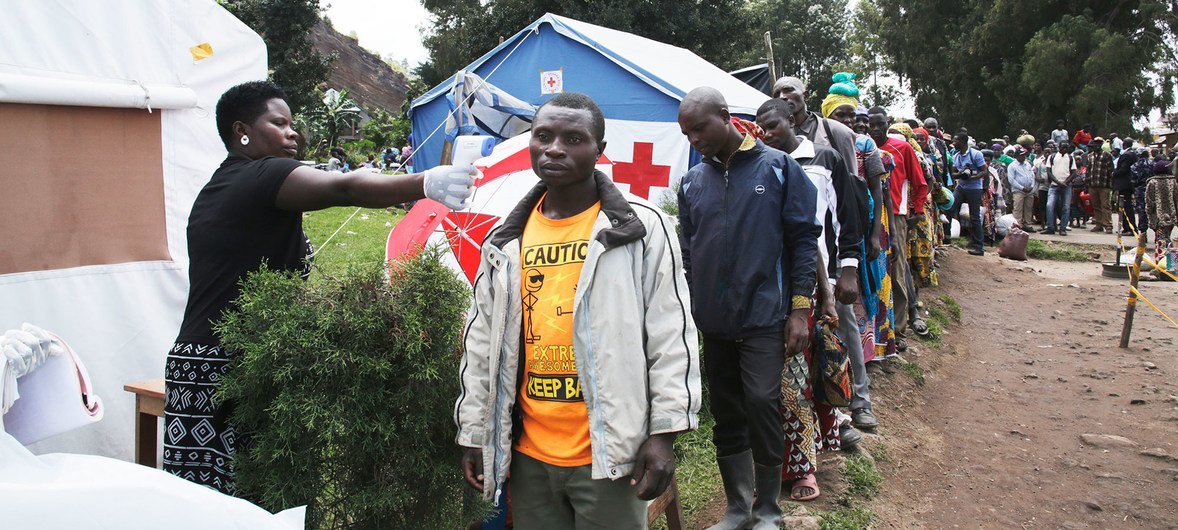
“The most common mode of transmission is direct contact with bodily fluids from symptomatic patients,” explains Dr. Russo, a U.S. physician currently working on the ground in the DRC. “Because of this, healthcare workers face an elevated risk and require strict infection control precautions, including full Personal Protective Equipment (PPE).”
A Perfect Storm: Conflict, Hunger, and Disease Collide
The WHO has warned that eastern DRC is experiencing a “catastrophic collision of disease and conflict.” The outbreak is centered in Ituri province but has successfully breached 11 health zones, including North Kivu (targeting major hubs like Butembo and Goma) and South Kivu. This region is already deeply destabilized by decades of armed violence, mass displacement, and acute food insecurity.
Security challenges are directly impeding medical teams. Recently, local police had to disperse angry, frightened crowds near Ebola treatment centers. Distrust, fueled by years of conflict, has made some communities resistant to outside medical intervention.
To combat this, the Africa CDC has structured a $319 million emergency response budget. However, funding is critically bottlenecked; only 10% has been secured so far, primarily funded by the affected nations of the DRC, Uganda, and South Sudan, alongside an initial $5 million commitment from South African President Cyril Ramaphosa.
Historical Context and Cross-Border Risks
This epidemic marks the DRC’s 17th battle with Ebola since the virus was first discovered in 1976 near the Ebola River in Yambuku. The country’s deadliest encounter occurred between 2018 and 2020, claiming more than 2,200 lives.
Alarmingly, a smaller outbreak just months ago in September 2025 went temporarily undetected. Authorities acknowledge that local diagnostics initially failed because standard assays were tuned for the Zaire strain and missed the rare Bundibugyo variant entirely.
The virus has also crossed borders. Uganda has confirmed seven cases, primarily among individuals who traveled from the DRC or cared for sick relatives, including two frontline health workers. The European Centre for Disease Prevention and Control (ECDC) and the WHO are actively supporting cross-border surveillance to prevent further regional spillover.
Strategic Challenges and Limitations
The path to containment faces steep hurdles, as outlined by international response teams:
| Critical Challenge | Direct Public Health Impact |
| Rare Bundibugyo Strain | Zero licensed vaccines or targeted antivirals are available. |
| Vaccine Timeline | WHO estimates it will take up to 9 months to deploy an experimental vaccine candidate. |
| Armed Conflict | Attacks on medical personnel and facilities halt active contact tracing. |
| Mass Displacement | Highly mobile populations make tracking exposed contacts nearly impossible. |
| Severe Underfunding | With only 10% of the $319M budget filled, supply chains are strained. |
“The previous outbreak in this macro-region required two years to fully suppress,” noted a WHO official who requested anonymity. “While we hope improved infrastructure will prevent that timeline, this will undoubtedly be a multi-month campaign.”
What This Means for Global Health Security
Despite the severity of the situation in Central Africa, international health agencies urge the global public not to panic. The ECDC currently assesses the risk of infection to residents of the EU and EEA as “very low.”
“People living in countries like the US or the UK are highly unlikely to encounter this virus,” reassures Dr. Russo. “Ebola is not COVID-19. It does not spread silently through asymptomatic breath.”
However, to protect international health security, governments are taking precautions. The U.S. Department of State has maintained a Level 4 travel warning (“Do Not Travel”) for eastern DRC due to the combination of civil unrest and the health crisis.
For health-conscious global citizens or those with essential travel to Central Africa, authorities advise strictly avoiding non-essential travel to Ituri, North Kivu, and South Kivu. Ultimately, health authorities reiterate that Ebola outbreaks are stopped from the ground up. Suppression relies on traditional public health pillars: rapid isolation, rigorous contact tracing, safe burials, and deep community engagement to build trust with those most affected.
Reference Section
- https://www.ndtv.com/health/ebola-outbreak-only-beginning-may-take-months-to-contain-congo-health-minister-11555037
Medical Disclaimer: This article is for informational purposes only and should not be considered medical advice. Always consult with qualified healthcare professionals before making any health-related decisions or changes to your treatment plan. The information presented here is based on current research and expert opinions, which may evolve as new evidence emerges.