 0
0
 0
0
Read Time:4 Minute, 59 Second
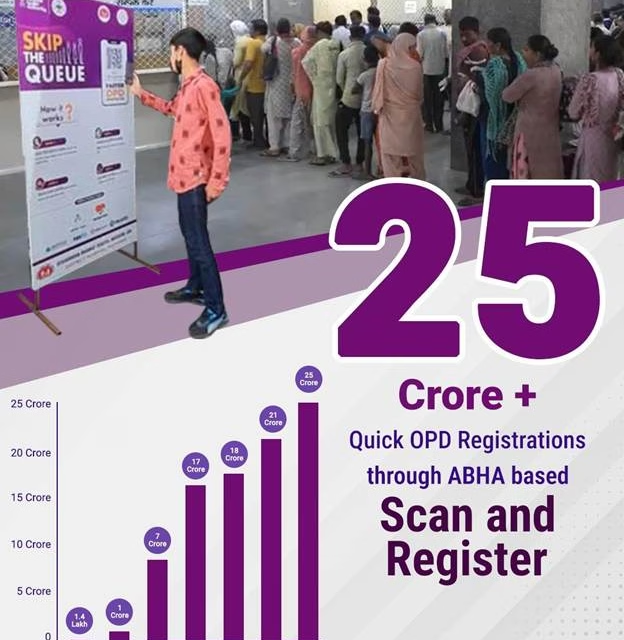
NEW DELHI — In a major development for global digital health architecture, India’s National Health Authority (NHA) has recorded over 25 crore (250 million) outpatient department (OPD) registrations completed via the “Scan and Register” service under the Ayushman Bharat Digital Mission (ABDM).
According to data released by the press authority, nearly 4 lakh citizens now utilize the QR-code-based registration system daily. Operative across 30,800 public and private health centers in 36 States and Union Territories, the initiative marks one of the largest deployments of tokenized, paperless patient intake systems in public health history.
By allowing patients to share demographic data instantly through Ayushman Bharat Health Account (ABHA) digital IDs, the system targets a long-standing structural bottleneck in healthcare delivery: prolonged hospital wait times and administrative overload at OPD counters.
The Technology: How QR-Based Registration Streamlines Care
The Scan and Register framework operates on an interoperable, open-protocol digital health architecture. When patients arrive at a participating hospital, they use an ABDM-enabled Personal Health Record (PHR) smartphone application to scan a unique QR code displayed at the facility.
Upon user consent, the application securely transfers basic profile details—such as name, age, gender, address, and unique ABHA identifier—directly to the hospital’s Health Management Information System (HMIS). A digital token or queue number is generated instantly on the user’s phone, replacing traditional paper forms and manual data entry.
+------------------+      Scans QR Code      +-----------------------+
| Patient PHR App  | ----------------------> | Hospital Facility QR  |
+------------------+                         +-----------------------+
         |                                               |
         | Grant Consent                                 | Secure Profile
         v                                               v Transfer
+--------------------------------------------------------------------+
|               Hospital Management Info System (HMIS)               |
+--------------------------------------------------------------------+
                                 |
                                 v
               Digital Token / OPD Pass Generated
“From an operational perspective, registration is often the first point of friction in acute and preventive care,” explains Dr. Ananya Mukherjee, a public health systems analyst not involved with the NHA. “By digitizing this touchpoint, facilities reduce administrative queue times significantly. More importantly, it creates a clean, standardized digital entry point for a patient’s longitudinal health records.”
Regional Adoption and Facility Leaders
Adoption metrics reveal broad integration across diverse geographical and socioeconomic regions.
Leading States and Union Territories
State-level data indicates strong uptake in both high-density northern states and southern healthcare networks:
-
Bihar: 7.30 crore registrations
-
Uttar Pradesh: 4.09 crore registrations
-
Andhra Pradesh: 3.38 crore registrations
-
Jammu & Kashmir: 1.39 crore registrations
Top Performing Healthcare Institutions
Tertiary care centers, which handle heavy daily outpatient footfalls, have shown high integration rates. The All India Institute of Medical Sciences (AIIMS), New Delhi, leads facility-level registrations nationwide:
| Healthcare Institution | Location | Digital OPD Registrations |
| AIIMS New Delhi | New Delhi | > 54.29 Lakh |
| AIIMS Bhopal | Madhya Pradesh | 29.10 Lakh |
| AIIMS Bhubaneswar | Odisha | 23.93 Lakh |
| AIIMS Patna | Bihar | 19.62 Lakh |
| AIIMS Raipur | Chhattisgarh | 18.63 Lakh |
Of the 30,800 operational facilities, 24,323 belong to the public health sector, while 6,481 are private clinics and hospitals. The network spans specialty institutes, medical colleges, district hospitals, community health centers, and specialized transport networks like railway and ESIC hospitals.
Speaking on the milestone, Dr. Sunil Kumar Barnwal, Chief Executive Officer of the National Health Authority, noted:
“Crossing the milestone of 25 crore OPD registrations through Scan and Register reflects the growing trust that citizens and healthcare providers have placed in India’s digital health ecosystem. By simplifying one of the most common touchpoints in healthcare… the service has significantly enhanced patient convenience while enabling healthcare facilities to improve efficiency.”
Public Health Implications: Reducing Friction for Vulnerable Populations
In large public hospitals across developing nations, overcrowding at administrative counters can delay clinical consultation by several hours. Prolonged wait times disproportionately impact vulnerable demographics—including expectant mothers, elderly patients, individuals with chronic mobility issues, and low-wage daily laborers who lose income spent waiting in line.
By streamlining data transfer, the Scan and Register workflow cuts intake processing to seconds. Beyond administrative speed, the process links every registration to the patient’s ABHA identity. This foundational step allows diagnostic reports, prescriptions, and discharge summaries to be stored digitally and accessed seamlessly during future consultations across different health centers.
Systems Limitations, Challenges, and Data Privacy
While the numerical milestone demonstrates rapid scaling, public health experts emphasize several ongoing challenges and technical constraints:
1. Digital Literacy and Device Equity
The system relies primarily on smartphones and internet connectivity. Patients without digital devices, those with low digital literacy, or populations in rural zones with intermittent cellular coverage must still rely on assisted digital kiosks or traditional paper lines.
2. Data Privacy and Informed Consent
With millions of health records linked to centralized systems, data protection remains a critical consideration. Independent bioethics advocates stress that explicit patient consent mechanisms must remain transparent within PHR apps to prevent unauthorized sharing of health metrics.
3. Interoperability Across Private Providers
While public sector adoption is robust, integrating thousands of fragmented private clinics—which use non-standardized electronic health record systems—requires continuous technical harmonization.
Practical Information for Patients
Citizens wishing to use the QR-based registration system during hospital visits can follow these steps:
-
Create an ABHA ID: Register via the official Ayushman Bharat Digital Mission portal or any verified partner app using an Aadhaar card or driver’s license.
-
Download an ABDM-Compliant App: Install any recognized Personal Health Record (PHR) application (such as the ABHA app, Aarogya Setu, or partner health apps).
-
Scan at Facility: Locate the official ABDM QR code displayed at the hospital’s OPD registration counter.
-
Approve Consent: Scan the code via the app, review the demographic data prompt, and approve the transfer to receive a digital queue token on your screen.
References and Sources
-
Primary Source Data: National Health Authority (NHA) Press Release, Issued via Press Information Bureau (PIB) Delhi, August 7, 2026.
Medical Disclaimer: This article is for informational purposes only and should not be considered medical advice. Always consult with qualified healthcare professionals before making any health-related decisions or changes to your treatment plan. The information presented here is based on current research and expert opinions, which may evolve as new evidence emerges.


Happy
0 %

Sad
0 %

Excited
0 %

Sleepy
0 %

Angry
0 %

Surprise
0 %