 0
0
 0
0
April 2, 2026
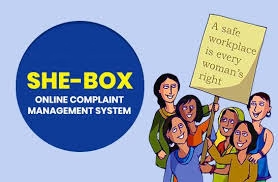
NEW DELHI — In a major milestone for workplace safety and mental health, the Ministry of Women and Child Development (MWCD) announced this week that over 161,000 public and private sector organizations have been onboarded onto the Sexual Harassment Electronic Box (SHe-Box) portal. The digital initiative, designed to enforce the Sexual Harassment of Women at Workplace (PoSH) Act of 2013, represents a critical shift in viewing workplace safety not just as a legal requirement, but as a fundamental pillar of occupational health and psychological well-being.
As of late March 2026, the portal has registered more than 68,460 Internal Committees (ICs) and 777 district-level Local Committees (LCs). This massive data integration follows a series of Supreme Court mandates aimed at closing the gap between legislative intent and ground-level reality.
A Digital Remedy for a Systemic Issue
The SHe-Box portal, revitalized in late 2024, serves as a centralized platform where women—regardless of their employment status—can register complaints and monitor the progress of inquiries. By digitizing the redressal process, the government aims to eliminate the “bureaucratic friction” that often discourages survivors from reporting misconduct.
“Sexual harassment is a significant psychosocial hazard,” says Dr. Aruna Singh, a workplace psychologist not involved in the government initiative. “When a workplace lacks a clear, transparent mechanism for justice, the resulting chronic stress can lead to clinical anxiety, depression, and even physical manifestations like hypertension. A portal like SHe-Box isn’t just a legal tool; it’s a preventive health measure.”
Key Statistics at a Glance
-
Total Workplaces Onboarded: 161,000+
-
Internal Committees (ICs) Registered: 68,460
-
Local Committees (LCs) Documented: 777
-
Language Support: 23 languages (including major regional dialects)
-
Accessibility: Integrated into the Mission Shakti app (iOS/Android)
Legal Teeth and Healthcare Integration
The momentum behind the portal is largely driven by the Supreme Court’s directives in Aureliano Fernandes vs. State of Goa. The Court mandated that Chief Secretaries and District Officers conduct rigorous surveys of both public and private organizations to ensure ICs are properly constituted.
The impact is particularly notable in the healthcare and education sectors. The MWCD has engaged directly with the National Medical Commission (NMC) and the All India Council for Technical Education (AICTE) to ensure that hospitals and universities—environments where power imbalances can be pronounced—are in full compliance.
For the healthcare sector, this is vital. Research published in The Lancet has previously highlighted that healthcare workers, particularly nurses and female residents, face disproportionately high rates of workplace harassment. By mandating that hospitals register their ICs on the SHe-Box portal, the initiative provides a layer of external accountability that was previously lacking.
Expanding Reach to the Informal Sector
One of the most significant challenges of the 2013 PoSH Act has been protecting women in the unorganized sector—domestic workers, daily wage laborers, and small-scale farm workers. Under the Act, Local Committees (LCs) must be established in every district to handle complaints from these sectors.
The MWCD has now integrated SHe-Box into the Mission Shakti mobile application and provided multilingual support in 23 languages. This ensures that a woman in a remote village can access the same reporting tools as a corporate executive in Bengaluru.
“Accessibility is the first step toward equity,” notes Rajeshwari Iyer, a public health advocate. “In rural areas, the stigma of entering a police station or a government office is a huge barrier. A mobile-first, multilingual approach allows for a level of privacy and ease that can literally save lives.”
Challenges and the Path Ahead
While the onboarding of 161,000 workplaces is a logistical triumph, experts caution that digital registration is only half the battle.
“The presence of an Internal Committee on a portal does not automatically guarantee a fair trial,” says Adv. Meera Deshpande, a legal consultant specializing in workplace safety. “The quality of the training these committees receive and their independence from management remain the primary hurdles. We must ensure that ‘onboarded’ translates to ’empowered.'”
Furthermore, while the portal hosts a repository of Information, Education, and Communication (IEC) materials—including FAQs and training manuals—the digital divide remains a factor. Success will depend on the continued efforts of District Officers to reach women who may not own smartphones or have consistent internet access.
Practical Implications for Employees and Employers
For the general public, the growth of the SHe-Box portal means that the “black box” of workplace harassment is opening.
-
For Employees: You can now verify if your workplace is registered and who sits on your Internal Committee.
-
For Employers: Compliance is no longer optional. With the Supreme Court overseeing data collection through Labour Commissioners, failure to constitute an IC can lead to significant legal penalties and reputational damage.
The MWCD continues to hold hybrid training sessions to address queries from both government departments and private establishments, signaling a long-term commitment to making the PoSH Act a living reality rather than a dormant statute.
Medical Disclaimer
This article is for informational purposes only and should not be considered medical advice. Always consult with qualified healthcare professionals before making any health-related decisions or changes to your treatment plan. The information presented here is based on current research and expert opinions, which may evolve as new evidence emerges.
References
Government & Statistical Sources:
-
Ministry of Women and Child Development (MWCD). (2026, April 1). SHe-Box Portal: A Digital Governance Initiative. PIB Delhi.
-
SHe-Box Official Portal: https://shebox.wcd.gov.in/