 0
0
 0
0
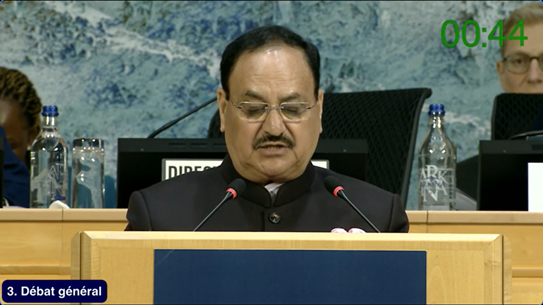
GENEVA, SWITZERLAND — In a major address aimed at reshaping the landscape of global public health, India’s Union Minister of Health and Family Welfare, Shri Jagat Prakash Nadda, championed universal health coverage, digital data infrastructure, and ethical artificial intelligence during the plenary session of the 79th World Health Assembly (WHA) on May 19, 2026. Speaking to delegates, health ministers, and global policymakers on the assembly’s central theme, “Reshaping Global Health: A Shared Responsibility,” Nadda outlined India’s domestic healthcare transformations as a scalable blueprint for developing nations striving to achieve equitable, people-centric care.
The address comes at a pivotal moment for global health governance, as international bodies continue to re-evaluate pandemic preparedness, health equity, and the rapid integration of artificial intelligence (AI) into clinical settings. By detailing the massive scale of India’s state-sponsored digital and insurance programs, the Health Minister positioned the nation as a central driver of global health solidarity and a critical manufacturing hub for affordable medicine.
Expanding Primary Infrastructure and Financial Protection
A cornerstone of India’s presentation to the World Health Assembly was its dual-track approach to physical infrastructure and financial health shielding. Minister Nadda reported that India has successfully operationalized more than 185,000 Ayushman Arogya Mandirs (Health and Wellness Centers) across urban and rural sectors. These decentralized hubs are engineered to transition the country’s healthcare model from reactive, episodic treatment to proactive, comprehensive primary care delivered directly within local communities.
Parallel to this primary infrastructure is the Ayushman Bharat Pradhan Mantri Jan Arogya Yojana (AB-PMJAY). Officially recognized as the world’s largest publicly funded health assurance scheme, the program provides secondary and tertiary hospitalization cover to nearly 600 million beneficiaries. By targeting the most economically vulnerable segments of the population, the initiative seeks to eliminate catastrophic out-of-pocket health expenditures, which global health authorities have long identified as a primary driver of systemic poverty in middle- and low-income nations.
Independent public health observers note that the sheer scale of the program offers valuable data on managing high-volume public insurance frameworks.
“Covering hundreds of millions of individuals under a singular public assurance umbrella is an unprecedented logistical undertaking,” says Dr. Elena Rostova, a global health systems analyst based in Geneva, who is not affiliated with the Indian delegation. “The primary challenge moving forward will be ensuring uniform clinical quality across participating private and public hospitals, alongside managing the long-term fiscal sustainability of such expansive subvention models.”
The Digital Architecture: 880 Million Health Identities
Beyond financial protection, India emphasized its aggressive pivot toward digital health infrastructure. The Ayushman Bharat Digital Mission (ABDM) has now generated over 880 million unique digital health IDs for citizens. This digital backbone is designed to create secure, interconnected longitudinal health records—meaning an individual’s medical history can follow them seamlessly across different hospitals, states, and medical specialists.
          [ 880 Million Unique Digital Health IDs ]
                            │
         ┌──────────────────┴──────────────────┐
         ▼                                     ▼
[Seamless Portability of              [Longitudinal Records for
 Longitudinal Records]                Data-Driven Public Health]
This massive synthesis of data arrives alongside the formal introduction of India’s new Strategy for Artificial Intelligence in Healthcare. As machine learning tools are increasingly deployed to diagnose diseases, optimize hospital workflows, and predict epidemiological outbreaks, Nadda issued a clear caution to the assembly regarding rapid technological adoption.
“The future of AI depends on our collective ability to build ethical and human-centric systems,” Nadda stated, underscoring the necessity of data privacy, algorithmic fairness, and human oversight in automated clinical decision-making.
Balancing Innovation with Algorithmic Safety
The deployment of AI at such an immense scale introduces sophisticated public health debates. While automated tools can drastically reduce the burden on overworked radiologists and general practitioners in rural outposts, they also carry inherent risks of data breaches and algorithmic bias.
Public health experts emphasize that if an AI model is trained primarily on data from specific urban demographics, its diagnostic accuracy may degrade when applied to diverse rural populations.
Furthermore, integrating AI with a database of 880 million digital health IDs requires rigorous, uncompromising cybersecurity frameworks. Health data remains a prime target for malicious cyber activities globally. To maintain public trust, the rollout of these digital systems must run parallel with ironclad data protection laws that give patients complete sovereignty over who views, handles, and analyzes their medical information.
Global Solidarity and the “Pharmacy of the World”
Addressing international delegates, the Health Minister closed by connecting domestic health security to global health solidarity. He recalled India’s Vaccine Maitri (Vaccine Friendship) initiative during the height of the COVID-19 crisis, during which the nation exported nearly 300 million vaccine doses to approximately 100 countries.
Reiterating India’s standing as the “Pharmacy of the World,” Nadda affirmed that the country remains dedicated to manufacturing and supplying affordable, high-quality generic medications and vaccines to nations that would otherwise be priced out of essential pharmaceutical markets.
As the 79th World Health Assembly continues its committee sessions this week, India’s model of combining vast digital infrastructure with expansive public insurance schemes will likely serve as a core reference point for international panels charting the roadmap toward the United Nations Sustainable Development Goal of health and well-being for all by 2030.
Reference Section
Government & Institutional Declarations
-
Source Document: Press Information Bureau (PIB) Delhi, Ministry of Health and Family Welfare, Government of India. Union Health Minister Shri Jagat Prakash Nadda Addresses 79th World Health Assembly in Geneva. Published May 19, 2026.
Medical Disclaimer: This article is for informational purposes only and should not be considered medical advice. Always consult with qualified healthcare professionals before making any health-related decisions or changes to your treatment plan. The information presented here is based on current research and expert opinions, which may evolve as new evidence emerges.