 0
0
 0
0
NEW YORK/JHANSI — June 6, 2026 — A sobering new projection released by U.S. health authorities warns that the current Ebola outbreak in Central Africa could rapidly escalate to 20,000 cases or more within three months if containment measures and patient isolation protocols are not aggressively scaled up. The computer modeling, published Friday by the Centers for Disease Control and Prevention (CDC), underscores a closing window of opportunity to halt transmission in a region heavily restricted by active conflict and restricted humanitarian access.
A Dangerous Trajectory: The CDC’s Worst-Case Modeling
The CDC’s mathematical analysis paints a stark picture based on varying rates of patient isolation—the primary tool used to break transmission chains. In a worst-case scenario where only 20% of infected individuals are successfully isolated, the virus could spread exponentially. Assuming approximately 50 deaths had occurred by late May, the model estimates that total infections could surge to at least 20,000, resulting in roughly 4,000 deaths.
An outbreak of this magnitude would approach the catastrophic scale of the 2014–2016 West Africa epidemic, which ultimately saw more than 28,000 cases and 11,000 deaths.
Fortunately, the trajectory drops sharply if intervention efficiency improves. Increasing patient isolation to 50% or 70% would slash the projected caseload closer to 10,000. Currently, the Africa Centres for Disease Control and Prevention (Africa CDC) officially registers around 400 confirmed cases and 63 deaths distributed across the Democratic Republic of Congo (DRC) and Uganda. However, field epidemiologists warn that limited diagnostic testing means many more infections remain uncounted.
Conflict and Closures: The Hurdles to Containment
“Without robust public health measures, our modeling indicates that an outbreak of this magnitude is feasible,” stated Dr. Satish Pillai, the CDC’s incident manager for Ebola response, during a Friday press briefing.
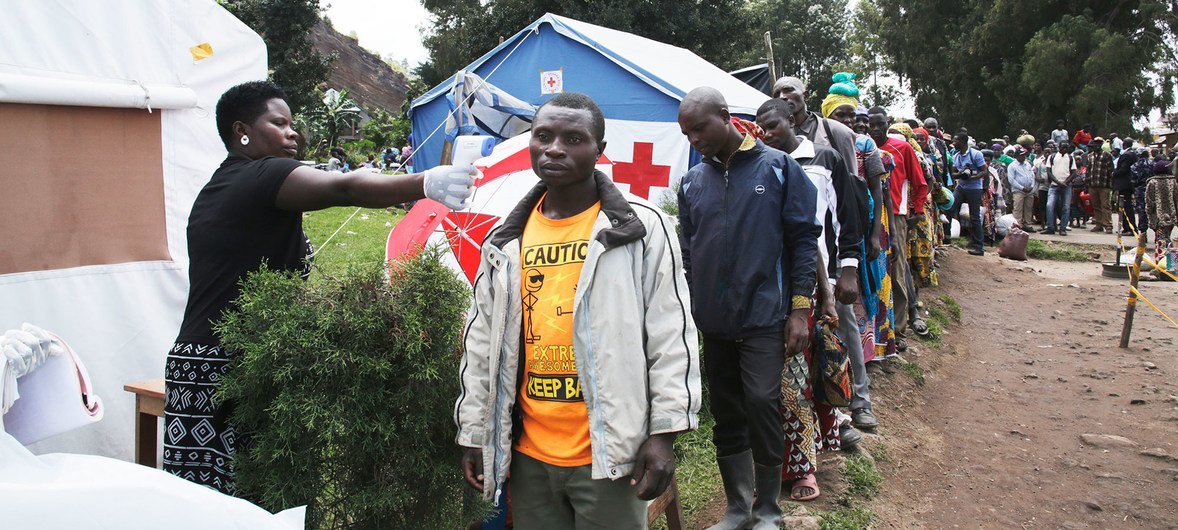
The logistical reality on the ground makes achieving high isolation rates incredibly difficult. The epicenter of the outbreak is heavily concentrated in the eastern DRC, a region severely destabilized by violent clashes between the Congolese government and the Rwanda-backed M23 rebel group, alongside attacks from the Allied Democratic Forces (ADF). This widespread insecurity has displaced hundreds of thousands of people, making rigorous contact tracing—the process of identifying and monitoring people exposed to the virus—nearly impossible.
Dr. Alan Gonzalez, deputy director of operations for Médecins Sans Frontières (MSF), expressed deep alarm at how quickly the situation is moving.
“Never before has an Ebola outbreak recorded so many cases so soon after its declaration,” Gonzalez noted, two weeks following the World Health Organization’s (WHO) May 17 emergency declaration. “The reality today is that nobody knows the true scale and severity of this outbreak. New suspected cases are being reported daily, yet hundreds of samples remain untested due to border and airport closures.”
The Bundibugyo Strain: Rare, Lethal, and Unvaccinated
Adding to the gravity of the crisis is the specific pathogen responsible. This outbreak is driven by the Bundibugyo virus, one of the rarer strains of the Orthoebolavirus genus.
Unlike the more common Zaire strain—which can be curbed using highly effective vaccines like Ervebo—there are currently no approved vaccines or targeted therapeutic treatments for the Bundibugyo strain. A historical meta-analysis evaluating Ebola outbreaks from 1976 to 2022 published in the Journal of Infection and Public Health found that the Bundibugyo virus carries a pooled case fatality rate of 32.8%.
The virus propagates via direct contact with the bodily fluids (such as blood, vomit, saliva, or semen) of an infected person or through contaminated surfaces. It manifests with rapid-onset symptoms, including:
-
High fever and severe headache
-
Intense muscle pain and profound weakness
-
Persistent vomiting and diarrhea
-
Severe internal and external hemorrhaging (bleeding)
-
Multi-organ failure
Without specific antiviral drugs, survival depends entirely on aggressive supportive care—intravenous hydration, electrolyte stabilization, and symptom management—delivered early in the course of the infection.
Current Geographic Distribution
As of June 3, 2026, epidemiological data shows a heavily localized but highly volatile footprint across two countries:
| Region / Country | Confirmed Cases | Confirmed Deaths | Key Impact Zones |
| DR Congo (Ituri Province) | 359 | 64 | Accounts for 93.1% of all cases; spread across 15 health zones. |
| DR Congo (North & South Kivu) | 22 | 0 | Emerging clusters linked to regional transit corridors. |
| Uganda | 19 | 2 | 7 cases linked to local transmission; 5 have direct travel links to DRC. |
| International (Germany) | 1 | 0 | One American healthcare worker evacuated from DRC; currently stable in isolation. |
While the WHO officially designated the outbreak a Public Health Emergency of International Concern (PHEIC) on May 17, officials emphasize that it remains a regional emergency and does not meet the criteria for a global pandemic.
Reading Between the Numbers: Modeling Uncertainties
Public health experts urge the public not to view the 20,000-case projection as an inevitability. Modeling is a tool designed to show what could happen under static conditions, rather than a definitive prophecy.
“I wouldn’t read too much into the specific numbers. It’s really hard to make an accurate projection when you have limited data,” cautioned Jennifer Nuzzo, director of Brown University’s Pandemic Center. Nuzzo pointed out that during the 2014 West Africa crisis, early CDC models warned of a worst-case scenario involving up to 1.4 million infections—a figure that turned out to be 50 times higher than the final tally because human behavior changed and international aid scaled up.
Nonetheless, Nuzzo added, the current model “affirms what we have worried about since the beginning: This outbreak is following a dangerous trajectory.”
Public Health Implications and Global Safeguards
For individuals living outside of Central Africa, the immediate health risk remains exceedingly low. The virus does not spread through the air like influenza or SARS-CoV-2; it requires direct, physical contact with infectious fluids.
To prevent international seeding, strict border controls have been activated. The U.S. government has temporarily restricted entry for non-U.S. passport holders who have traveled through the DRC, Uganda, or South Sudan within the preceding 21 days. Returning U.S. citizens who visited these areas are being routed through four designated hub airports for mandatory health screenings. Public health agencies advise travelers to avoid all non-essential travel to the affected provinces.
Looking toward long-term solutions, Africa CDC head Jean Kaseya announced that an accelerated clinical trial framework is underway, with a candidate Bundibugyo-specific vaccine tentatively anticipated by the end of 2026. Until then, containment relies entirely on traditional, fundamental public health measures: rapid testing, safe burials, and securing safe zones where medical teams can isolate and treat patients without the threat of violence.
Medical Disclaimer
This article is for informational purposes only and should not be considered medical advice. Always consult with qualified healthcare professionals before making any health-related decisions or changes to your treatment plan. The information presented here is based on current research and expert opinions, which may evolve as new evidence emerges.
References
- https://health.economictimes.indiatimes.com/news/industry/ebola-outbreak-in-central-africa-could-reach-20000-cases-without-strong-public-health-measures/131543056?utm_source=latest_news&utm_medium=homepage