 0
0
 0
0
PARBHANI, India — For millions living in Tier-2 and Tier-3 districts across India, emergency medical care has long involved a perilous trade-off: travel hours to a metro city or face limited care locally. Today, a 70-bed medical facility in Parbhani, Maharashtra, is offering a third way, demonstrating how public equity investment can expand critical care access in traditionally underserved communities.
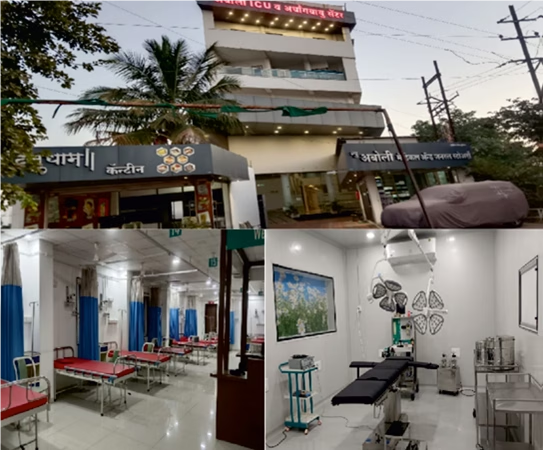
Aboli Hospital Private Limited, founded by Dr. Anil Sadashivrao Kamble, has expanded its operations into a full-scale multi-specialty institution. The transformation was made possible through a ₹5 crore ($600,000 USD) investment from the Venture Capital Fund for Scheduled Castes (VCF-SC), an initiative under the Ministry of Social Justice and Empowerment.
The expansion addresses a chronic healthcare deficit in non-metropolitan regions: the absence of high-tier Intensive Care Units (ICUs) capable of handling acute emergencies like stroke-induced paralysis, cardiac events, and multi-organ failure locally.
The Rural Critical Care Vacuum
In medical emergency management, the concept of the “golden hour”—the period immediately following a traumatic injury or acute medical event—is central to patient survival and long-term recovery.
For stroke patients, rapid administration of thrombolytic therapy (clot-busting medication) or transfer to an advanced ICU within three to four hours significantly reduces mortality and permanent disability.
“When a patient suffers an acute ischemic stroke or severe trauma in a semi-urban district, every minute spent in transit to a major city diminishes their neurological recovery window,” says Dr. Meera Sharma, a public health policy specialist based in New Delhi who was not involved in the project. “Establishing advanced critical care units in places like Parbhani is not just an infrastructure improvement; it is a direct intervention in mortality and long-term disability rates.”
Prior to the expansion, residents of Parbhani and surrounding districts in the Marathwada region often had to travel over 150 kilometers to cities like Aurangabad or Nanded for tertiary care.
Financial Restructuring and Infrastructure Scaling
The expansion was anchored by the VCF-SC, which provides equity and optionally convertible debentures to first-generation social entrepreneurs.
In 2023, the fund extended ₹5 crore to Aboli Hospital. According to official reports from the Press Information Bureau (PIB), this non-predatory capital structure allowed the institution to bypass high-interest commercial bank loans, freeing up capital for medical technology and infrastructure.
       Financial Expansion at Aboli Hospital
       -------------------------------------
       Net Worth:  [₹61.75 Lakh] ===> [₹6.93 Crore]
       Asset Base: [Created ₹2.78 Crore in assets]
       Capacity:   [70 Beds + Advanced ICU & Pharmacy]
Key Technical Upgrades
-
Advanced ICU Beds: Equipped with multi-para monitors, mechanical ventilators, and central oxygen delivery systems to manage complex respiratory and organ failure cases.
-
Specialized Stroke & Paralysis Care: Integrated diagnostic support to enable rapid intervention for neurological emergencies.
-
On-Site Pharmacy & Diagnostics: Reduces delays in treatment administration during emergency admissions.
Beyond physical assets, the facility has integrated with public health networks, enrolling as an empanelled provider under government insurance schemes like Ayushman Bharat (Pradhan Mantri Jan Arogya Yojana). This enables low-income households to access critical care treatments without out-of-pocket expenses.
Socio-Economic Impact and Employment
Health equity is closely linked to regional economic stability. The development of healthcare infrastructure acts as an anchor for local employment, attracting skilled medical professionals back to non-metro areas.
To date, the expansion of Aboli Hospital has generated 65 direct, permanent jobs, including nursing staff, ICU technicians, pharmacists, and administrative personnel. Of these, 27 positions are held by workers from Scheduled Caste communities, aligning with the VCF-SC’s dual mandate of health access and economic empowerment.
“The support received under the Venture Capital Fund for Scheduled Castes strengthened our mission of delivering quality and affordable healthcare services to underserved communities,” stated Dr. Anil Sadashivrao Kamble, Managing Director of Aboli Hospital. “Today, the hospital stands as a trusted critical care institution across the region.”
Public Health Context and Industry Challenges
While the success of Aboli Hospital presents a promising framework for rural health development, health policy analysts note that scaling such models across rural India faces systemic hurdles:
-
Specialist Recruitment and Retention: Attaining high-end diagnostic machinery is often easier than retaining qualified intensivists, cardiologists, and neurologists in semi-urban regions long-term.
-
Operational Overhead: Advanced ICUs require continuous, uninterrupted power supplies, sophisticated biomedical maintenance, and strict infection control protocols, which carry high ongoing operational costs.
-
Insurance Reimbursement Rates: Private facilities operating under public insurance frameworks frequently navigate tight margins due to standardized government package rates.
“Capital investment solves the initial barrier of entry,” notes Dr. Sharma. “The long-term test for semi-urban multi-specialty centers lies in maintaining high quality standards, securing uninterrupted supply chains for pharmaceuticals, and keeping skilled clinical teams intact.”
Looking Ahead
The operational growth of Aboli Hospital—from a initial net worth of ₹61.75 lakh to ₹6.93 crore—offers a case study in how targeted public venture financing can address both social equity and healthcare infrastructure gaps.
For the communities of Parbhani, the presence of a functional 70-bed critical care facility means that life-saving emergency care is no longer distant, but available within the local community.
References & Data Sources
-
Government Source: Press Information Bureau (PIB) Delhi. “Expanding Access to Affordable Healthcare: How VCF-SC Enabled Aboli Hospital to Build a Modern Multi-Speciality Healthcare Facility.” Published August 3, 2026.
Medical Disclaimer: This article is for informational purposes only and should not be considered medical advice. Always consult with qualified healthcare professionals before making any health-related decisions or changes to your treatment plan. The information presented here is based on current research and expert opinions, which may evolve as new evidence emerges.