 0
0
 0
0
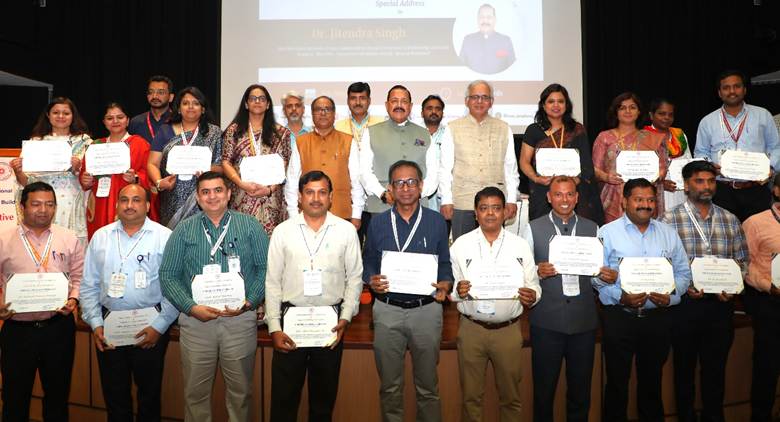
NEW DELHI — In a move to fortify the leadership of India’s premier scientific and medical research bodies, the Union Government has launched a pioneering training initiative designed to transform elite researchers into effective administrative leaders. On Wednesday, Union Minister Dr. Jitendra Singh presided over the valedictory ceremony for the inaugural batch of the INSA–CBC Administrative Training Programme, a three-day intensive course aimed at equipping scientists with the governance, financial, and administrative tools necessary to lead modern institutions.
The programme, jointly organized by the Indian National Science Academy (INSA) and the Capacity Building Commission (CBC) under the government’s flagship Mission Karmayogi, signals a strategic shift in how India manages its vast scientific ecosystem. By providing formal training in public administration to senior scientists, the initiative seeks to ensure that institutions like the Indian Council of Medical Research (ICMR) and the Council of Scientific and Industrial Research (CSIR) are led not only by brilliant minds but by capable administrators.
Beyond the Microscope: Why Governance Matters in Science
For decades, the career trajectory for India’s top scientists has followed a traditional path: excellence in research leads to senior appointments, which eventually culminate in institutional leadership. However, as Dr. Jitendra Singh noted during his address, scientific excellence alone is no longer sufficient to navigate the complexities of 21st-century institutional management.
“Scientific excellence alone is not sufficient to lead modern institutions,” Dr. Singh emphasized. “Scientists moving into leadership roles must also be equipped with governance, administrative, and financial management capabilities.”
The Minister highlighted a persistent “gap” between scientific expertise and administrative preparedness. When a top-tier virologist or physicist becomes a Director-General, they are suddenly responsible for multi-million dollar budgets, parliamentary inquiries, procurement rules, and human resource management—areas rarely covered in a laboratory setting.
Key Learning Pillars of the Programme
The first batch consisted of 23 senior scientists representing a cross-section of India’s scientific backbone, including:
-
Indian Council of Medical Research (ICMR)
-
Council of Scientific and Industrial Research (CSIR)
-
Defence Research and Development Organisation (DRDO)
-
Department of Science and Technology (DST)
The curriculum moved beyond theoretical lectures, utilizing case studies and simulations to cover:
-
Administrative Vigilance: Understanding the legal and ethical frameworks of public service.
-
Financial Management: Navigating the intricacies of government budgeting and the “GeM” (Government e-Marketplace) procurement systems.
-
Strategic Decision-Making: Balancing long-term scientific goals with immediate public policy needs.
-
Public Service Values: Ensuring transparency and accountability in the use of public funds.
Strengthening the Health Ecosystem
The inclusion of scientists from the ICMR is particularly significant for the public health sector. As the apex body for the formulation, coordination, and promotion of biomedical research in India, the ICMR’s efficiency directly impacts the nation’s ability to respond to health crises, manage vaccine rollouts, and address the rising burden of non-communicable diseases.
Effective administration in health research translates to faster approval processes for clinical trials, more transparent funding for university labs, and better integration of research findings into national health policy. By training health scientists in “role-based” rather than “rule-based” governance, the programme aims to reduce the bureaucratic friction that can often delay life-saving innovations.
Expert Perspectives: A Necessary Evolution
Independent experts in science policy have largely welcomed the move. Prof. Shekhar Mande, President of INSA and former Director-General of CSIR, noted that the programme was conceptualized to address a long-standing need for institutional capacity building.
“We are familiarizing scientists with the rules and accountability structures necessary for effective leadership,” Prof. Mande stated. This sentiment is echoed by many in the academic community who argue that “accidental administrators”—scientists forced into management without training—can lead to institutional stagnation.
Dr. Brajesh Pandey, Executive Director of INSA, linked the initiative to the broader “Viksit Bharat 2047” vision, suggesting that India’s goal of becoming a developed nation depends on the efficiency of its scientific and digital governance systems.
Limitations and the Road Ahead
While the initiative marks a positive step, some critics suggest that a three-day programme may only scratch the surface of complex Indian administrative laws. There are also concerns regarding whether a standardized training module can address the unique needs of diverse fields—ranging from deep-sea exploration to infectious disease control.
To address this, Dr. Singh called for the institutionalization of the programme. He suggested integrating these modules with the iGOT Karmayogi platform, a digital portal designed to provide continuous, on-demand learning for millions of government officials across India.
What This Means for the Public
For the average citizen and health-conscious consumer, the professionalization of science administration may seem distant, but its effects are tangible. Improved governance in institutions like the ICMR or the Department of Biotechnology means:
-
Enhanced Accountability: Greater transparency in how taxpayer money is spent on research.
-
Faster Innovation: Streamlined administrative processes can lead to quicker transitions from the laboratory to the pharmacy shelf.
-
Better Policy: Leaders who understand both the science and the “machinery of government” are better equipped to advise on public health mandates.
As India continues to make global strides in space exploration and medical technology, the shift toward “competence-driven public service” ensures that the country’s scientific future is built on a foundation of professional management as much as intellectual brilliance.
Reference Section
Citations & Sources:
-
Primary Source: Press Information Bureau (PIB) Delhi, “Union Minister Dr Jitendra Singh presents certificates… to first batch of Scientists,” Posted 06 May 2026.
Medical Disclaimer: This article is for informational purposes only and should not be considered medical advice. Always consult with qualified healthcare professionals before making any health-related decisions or changes to your treatment plan. The information presented here is based on current research and expert opinions, which may evolve as new evidence emerges.