 0
0
 0
0
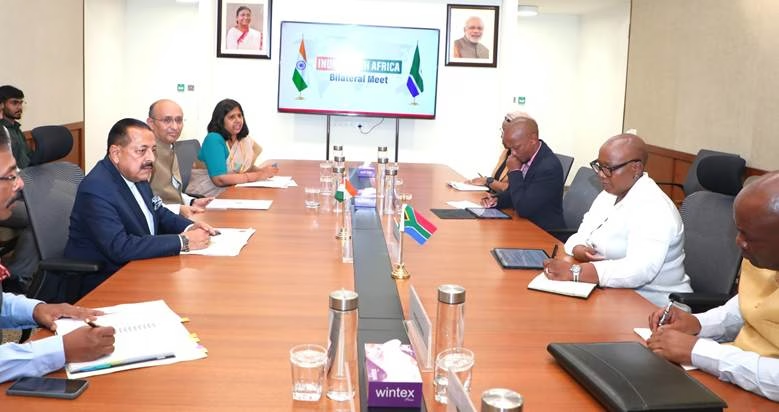
NEW DELHI — In a move set to reshape the landscape of healthcare, biotechnology, and digital public infrastructure across the developing world, India and South Africa have agreed to a major escalation of their bilateral scientific partnership. Emerging from a high-level ministerial meeting held yesterday at Kartavya Bhawan, the two nations announced a strategic pivot away from traditional academic research toward high-impact, commercialized innovations. The newly expanded alliance places artificial intelligence (AI), vaccine manufacturing, and advanced genomics at the absolute forefront of its agenda, aiming to deliver affordable and inclusive medical solutions across the Global South.
The agreement was solidified during bilateral talks between Dr. Jitendra Singh, India’s Union Minister of State for Science and Technology, and Dr. Nomalungelo Gina, South Africa’s Deputy Minister of Science, Technology, and Innovation. Supported by delegations including Dr. Rajesh S. Gokhale, Secretary of India’s Department of Biotechnology (DBT), the leaders committed to transforming over three decades of diplomatic scientific ties into an active industrial pipeline.
Expanding the Medical and Biotech Frontier
While the bilateral agreement encompasses broad technological sectors like quantum computing and hydrogen energy, the most immediate public health implications lie in its dedicated focus on life sciences. The partnership explicitly outlines a joint roadmap for deep collaboration in:
-
Biotechnology and Genomics: Leveraging population-scale genetic insights to advance precision medicine.
-
Vaccine Development and Manufacturing: Enhancing local manufacturing capabilities to secure biological sovereignty for African and Asian nations.
-
Pandemic Preparedness: Creating synchronized surveillance systems and shared research infrastructure to identify and mitigate future infectious disease threats.
“Science must increasingly translate into solutions that improve lives, generate employment, and strengthen economies,” Dr. Jitendra Singh stated during the summit. He emphasized that India’s established infrastructure in affordable healthcare innovation and mass vaccine production offers an immediate blueprint for collaboration with South African research institutions.
The AI and Digital Health Revolution
A pillar of the new agreement is the deployment of Artificial Intelligence and Digital Public Infrastructure (DPI) within public health frameworks. Healthcare systems throughout the Global South frequently battle severe structural resource constraints, including critical shortages of specialized medical personnel in rural areas.
Independent medical experts suggest that integrating AI into diagnostics and leveraging India’s robust digital infrastructure models could fundamentally alter patient care delivery in both countries.
“AI-driven diagnostic tools can bridge the massive gap between urban medical centers and underserved rural clinics,” says Dr. Aristha Naidoo, an independent public health policy analyst specializing in sub-Saharan medical infrastructure, who was not involved in the bilateral talks. “By deploying machine learning algorithms for automated chest X-ray screenings or retinal scans, we can screen for tuberculosis, pneumonia, and diabetic retinopathy at a fraction of the current cost and time. This isn’t just about high-tech research; it’s about basic survival and diagnostic access.”
Furthermore, the integration of advanced materials and advanced manufacturing is slated to drive down the production costs of essential medical devices, prosthetics, and drug delivery systems, making them more accessible to low-income populations.
Context: A Foundation Built on Historical Cooperation
The relationship between New Delhi and Pretoria is not new. The foundational Science and Technology Agreement between the two countries was inked in 1995. Since then, the partnership has co-funded nearly 150 scientific projects spanning diverse disciplines.
                                  [1995]
                     Bilateral S&T Agreement Signed
                                     │
                                     ▼
                     [Over Decades of Collaboration]
                ~150 Co-Funded Projects Across Disciplines
                                     │
                                     ▼
                                  [2026]
              Strategic Pivot to Scale Up Future Tech &
                   Health Innovation at Industry Scale
Historically, flagship collaborations have leaned heavily into astronomy, highlighted by both nations’ critical involvement in the Square Kilometre Array (SKA) project—the world’s largest and most sensitive radio telescope ecosystem. The new agreement seeks to apply the same level of cross-border institutional rigor to urgent, human-centric biological challenges.
To concrete these initiatives, Dr. Jitendra Singh extended an invitation to South Africa to actively participate in the upcoming BRICS Science, Technology, and Innovation Ministerial Meeting, scheduled to take place in Chennai in August 2026. Conversely, the South African delegation invited Indian scientists to participate in the Science Forum South Africa later this year to ensure steady momentum.
Balancing Expectations: Potential Bottlenecks and Limitations
Despite the optimistic projections of both ministries, international public health experts urge a realistic view of the hurdles ahead. Translating high-level diplomatic goodwill into tangible, shelf-ready medical solutions presents significant operational difficulties.
-
Regulatory Disparities: Aligning the clinical trial protocols and approval mechanisms of India’s Central Drugs Standard Control Organisation (CDSCO) with South Africa’s Health Products Regulatory Authority (SAHPRA) can take years, potentially delaying the rollout of co-developed therapeutics or vaccines.
-
The “Brain Drain” and Capacity Retention: While both countries possess world-class scientists, maintaining the specialized technical workforce required for advanced genomics and AI infrastructure within the public healthcare sector remains an ongoing battle against private-sector migration.
-
Intellectual Property (IP) Hurdles: Moving from academic research to commercialized industry collaboration requires navigating complex IP sharing agreements between international universities, private corporations, and state-funded bodies. If not managed equitably, the goal of “affordable” solutions could be compromised by commercial interests.
What This Means for Global Health and Consumers
For the everyday citizen in India and South Africa, this partnership signals a long-term shift toward medical self-reliance. By co-developing vaccines and therapeutics tailored specifically to the genetic profiles and disease burdens prevalent in the Global South (such as tuberculosis, HIV, and emerging zoonotic diseases), both countries reduce their vulnerability to Western supply chain disruptions—a vulnerability exposed during global health crises in the early 2020s.
In the long run, as digital public infrastructure models expand, patients can expect more streamlined digital health tracking, more accurate localized disease forecasting, and enhanced access to point-of-care diagnostics right in their local communities.
Reference Section
Government and Official Communiqués
-
Source Document: National Press Release, Government of India. Dr Jitendra Singh Calls for Next-Generation India–South Africa Technology Partnership Focused on Emerging Technologies. Issued: June 3, 2026. New Delhi, India.
Medical Disclaimer
Medical Disclaimer: This article is for informational purposes only and should not be considered medical advice. Always consult with qualified healthcare professionals before making any health-related decisions or changes to your treatment plan. The information presented here is based on current research and expert opinions, which may evolve as new evidence emerges.