 0
0
 0
0
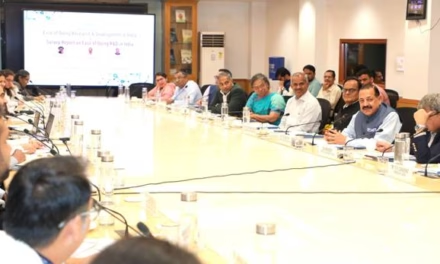
NEW DELHI — In a major move to transform medical education, India’s apex medical education regulator and its premier health research body are teaming up to overhaul how future doctors learn science. The National Medical Commission (NMC) and the Indian Council of Medical Research (ICMR) are jointly drafting a comprehensive national framework to integrate clinical research training as a core component of both undergraduate (MBBS) and postgraduate (PG) medical curricula across the country.
The expert committee’s draft work, which came to light in May 2026, aims to transition research from an optional, often overlooked extra into a foundational pillar of medical training. While the plan has received in-principle approval, officials emphasize that it remains at the proposal stage as the joint committee iron out the operational details.
If successfully implemented, the initiative could reshape the day-to-day training of hundreds of thousands of medical students, ultimately shifting how healthcare is delivered to patients throughout India.
Inside the Proposed Framework: What is Changing?
For decades, the primary focus of Indian medical education has been clinical care—diagnosing and treating patients. While vital, this approach has often left a critical gap in teaching doctors how to generate new medical evidence, analyze data, or critically evaluate emerging scientific literature.
The new NMC-ICMR proposal seeks to change that by embedding structured research competencies directly into the routine medical curriculum. According to early reports of the draft framework, the core components will include:
-
Foundational Research Methodology: Early exposure for MBBS students to study design, basic biostatistics, and data collection.
-
Clinical Trials Literacy: Comprehensive training on how clinical trials are designed, run, and regulated.
-
Scientific Writing and Thesis Standards: Standardized guidelines to improve the quality, structure, and publishability of postgraduate theses.
-
Modern Data Analytics and AI: Training on utilizing Artificial Intelligence (AI) tools for data analysis and predictive modeling, paired with robust ethical safeguards.
-
Research Ethics: Enhanced education on patient consent, institutional review boards (IRBs), and the responsible conduct of human research.
Rather than introducing an entirely new burden from scratch, the framework is expected to scale up and adapt existing models. Chief among these is the online Basic Course in Biomedical Research, currently managed by the ICMR’s National Institute of Epidemiology (NIE), which is already mandatory for certain postgraduate students and medical faculty.
Why It Matters: Building India’s Local Evidence Base
The implications of this shift extend far beyond classroom walls. Historically, much of the medical data guiding global treatment algorithms has originated from Western populations. However, genetic backgrounds, environmental factors, lifestyle habits, and healthcare infrastructure in India differ significantly.
By training a generation of “physician-scientists,” public health experts believe India can build a more robust, indigenous evidence base. This will allow researchers to translate local clinical findings into treatment protocols specifically optimized for Indian patient populations. Furthermore, a research-focused curriculum is seen as a vital step toward accelerating domestic innovation in health technology, pharmaceuticals, and public health policy.
Independent Experts Weigh In: Optimism vs. Operational Realities
Independent medical educators and public health experts have expressed cautious optimism about the proposal, noting that execution will be the ultimate test of its success.
“Integrating structured research training into the medical curriculum can bridge the long-standing divide between clinical care and evidence generation,” says Dr. Anita Rao, a professor of clinical epidemiology who is not involved with the NMC/ICMR drafting committee. However, she notes that a curriculum paper alone is not enough. “Sustained, high-quality mentorship and protected research time for both students and faculty are absolutely crucial for this to work.”
Other senior medical educators caution that mandating research without a parallel upgrade in institutional infrastructure could backfire. The primary concern is the risk of “tokenism”—where students treat research as a mandatory box-checking exercise.
Without robust oversight, well-funded Institutional Review Boards (IRBs), and adequate statistical support, critics warn that a blanket mandate risks flooding medical journals and institutional repositories with poorly conducted studies and rushed publications that lack scientific merit.
Additionally, the inclusion of AI tools has sparked debate. While AI can drastically accelerate data parsing, experts stress that medical students must be taught to recognize the inherent biases, limitations, and “hallucinations” associated with AI models in clinical datasets before relying on them for research.
What This Means for Future Doctors and Patients
For medical learners, the framework promises a more modernized education. Undergraduate students will learn how to critically appraise medical literature, making them more discerning practitioners who can separate high-quality scientific evidence from marketing hype or weak data. Postgraduates, who are already required to write a thesis, will receive more standardized, structured institutional support, increasing their chances of publishing their work in reputable, peer-reviewed medical journals.
For the everyday patient, the transition to a research-driven medical culture creates a higher standard of care.
The Translation Pipeline: Consider a postgraduate resident working under this strengthened framework. Instead of treating their mandatory thesis as a bureaucratic hurdle, the student receives formal training in trial design, ethical approvals, and manuscript writing. Their research into a local outbreak or a specific drug response could be successfully published, directly altering and improving the local hospital’s treatment algorithms within a few years.
Next Steps: What to Watch For
As the joint committee continues its work, medical professionals, students, and healthcare stakeholders should keep an eye out for the following milestones:
-
The Public Draft Release: The official publication of the framework by the NMC and ICMR for public review.
-
Stakeholder Consultations: Feedback windows where medical colleges, faculty associations, and student bodies can voice operational challenges.
-
Faculty Development Initiatives: Announcements regarding funding and training programs aimed at upskilling existing faculty to serve as research mentors.
-
Implementation Timelines: Clarification on whether the rollout will happen in phases or as a nationwide mandate for upcoming academic cohorts.
Ultimately, turning India’s medical colleges into vibrant hubs of scientific inquiry will require substantial capital, structural reform, and a cultural shift. If the NMC and ICMR can back their ambitious blueprint with the necessary resources and faculty support, it could mark the beginning of a highly sophisticated, evidence-based era for Indian medicine.
Medical Disclaimer
Medical Disclaimer: This article is for informational purposes only and should not be considered medical advice. Always consult with qualified healthcare professionals before making any health-related decisions or changes to your treatment plan. The information presented here is based on current research and expert opinions, which may evolve as new evidence emerges.
References
- https://medicaldialogues.in/news/education/nmc-icmr-drafting-framework-to-integrate-clinical-research-into-mbbs-pg-training-report-171320