 0
0
 0
0
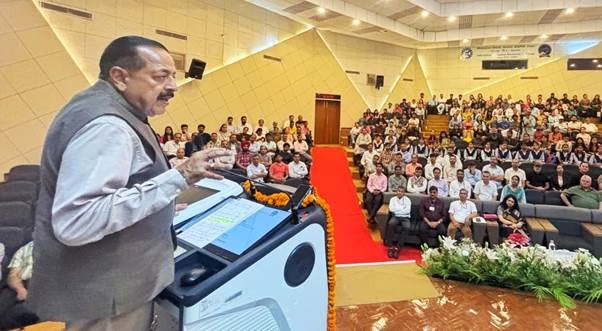
PALAMPUR, Himachal Pradesh — In a major push toward indigenous scientific development, the central government has announced that the long-underexplored Himalayan bioregion will serve as a foundational pillar for India’s long-term economic expansion. Speaking at the National Technology Day event held at the Council of Scientific and Industrial Research – Institute of Himalayan Bioresource Technology (CSIR-IHBT), Union Minister Dr. Jitendra Singh revealed that specialized agricultural and technological frameworks are rapidly turning the region’s vast natural biodiversity into highly lucrative, scientifically verified pipelines for the healthcare, nutraceutical, and pharmaceutical industries.
This strategic shift represents a transition from treating the Himalayas solely as an environmental preservation zone to utilizing it as an active engine for high-value bioresource creation, aiming to propel the nation toward its Viksit Bharat 2047 milestones.
The Shift to High-Value Bioresources
For decades, the challenging terrain of the Himalayan region limited its economic contributions primarily to conventional farming, forestry, and seasonal tourism. However, recent infrastructure and targeted scientific oversight have initiated a shift toward precision bio-farming. Under central initiatives like the Aroma Mission and the Floriculture Mission, local agricultural communities are transitioning from subsistence crops to high-value botanical varieties.
The economic implications are substantial. According to data from CSIR-IHBT, the implementation of standardized agro-technologies has allowed regional farmers to cultivate Tagetes minuta (wild marigold), generating up to 200 quintals of biomass per hectare. This biomass yields high-grade essential oils that command net returns of ₹1.5 lakh to ₹2 lakh per hectare from flavor, perfume, and pharmaceutical manufacturers.
A notable cultural and scientific benchmark of this program was highlighted during the presentation: the premium tulip bulbs cultivated by local farmers under the guidance of CSIR-IHBT were selected for the ceremonial offerings made by Prime Minister Narendra Modi during the Pran Pratishtha prayers in Ayodhya. Beyond their symbolic value, these commercial floriculture initiatives have established flourishing agri-tourism hubs, with Himachal Pradesh’s local Tulip Gardens drawing over 1.5 lakh visitors this year alone.
From Import Substitution to Medical Innovation
A central focus of the Himalayan development strategy is reducing India’s dependence on imported medicinal and culinary resources—a core tenet of the Atmanirbhar Bharat (self-reliant India) vision.
The successful cultivation, flowering, and seed production of Heeng (asafoetida) in the high-altitude, cold-desert conditions of Lahaul and Spiti marks a notable agricultural milestone, as India has historically imported the entirety of its raw asafoetida supply. Parallel cultivation programs are currently expanding domestic yields of high-value saffron, true cinnamon, and monk fruit.
       [Raw Himalayan Bioresources]
                    │
                    ▼ (AI, Genomics & Deep Tech)
        [CSIR-IHBT Extraction & Validation]
                    │
         ┌──────────┴──────────┐
         ▼                     ▼
[Phytopharmaceuticals]   [Fortified Nutraceuticals]
 (Therapeutic Agents)     (POSHAN Abhiyaan Supplies)
From a medical standpoint, these raw materials are being routed into modern pharmaceutical research. The Western Himalayas serve as a natural repository for complex botanical compounds that are increasingly being validated through modern clinical frameworks.
-
Phytopharmaceuticals: Scientists are studying native species like Valeriana jatamansi (locally known as Muskbala). Long utilized in traditional Ayurvedic structures for its sedative properties, current pharmacological evaluations are investigating the specific mechanisms of its active valepotriates, which exhibit therapeutic potential in oncology and neurological research.
-
Preventative Health and Nutraceuticals: In alignment with the national POSHAN Abhiyaan (National Nutrition Mission), researchers are utilizing native crops to engineer fortified nutritional products designed to address childhood malnourishment. Simultaneously, clinically validated plant-based formulations are being developed to target metabolic and lifestyle disorders, such as Type 2 diabetes and hypertension.
Integration of Deep Technology
To preserve the delicate ecological equilibrium of the mountain ecosystems while maximizing output, agricultural practices are incorporating deep-technology tools. CSIR-IHBT has integrated Artificial Intelligence (AI) and machine learning algorithms to model crop disease outbreaks and monitor local biodiversity health.
Researchers are utilizing genomic sequencing to identify and propagate climate-resilient strains of indigenous flora. On the ground, drone-based precision agriculture allows farmers to apply inputs with exact accuracy, minimizing chemical runoff into pristine mountain watersheds. These systems are supported by localized green chemistry initiatives, bioplastic development, and “waste-to-wealth” protocols that transform agricultural processing byproducts into functional industrial materials.
Public Health Implications and Nutritional Trends
For the general consumer, the commercialization of Himalayan bioresources is expected to expand the availability of clean, rigorously verified, and highly bioavailable wellness products. As consumers increasingly prioritize preventative healthcare, the transition of traditional botanical remedies into standardized, peer-reviewed nutraceuticals provides a reliable alternative to unverified supplements.
“The rigorous scientific validation of native Himalayan flora bridges the gap between traditional heritage and modern evidence-based medicine,” notes Dr. Sandeep Varma, an independent clinical pharmacologist not involved in the institute’s operations. “When an institution like CSIR isolates a compound, maps its genome, and tests its safety profile, it elevates consumer safety. It moves public health away from speculative herbalism and toward predictable, therapeutic supplementation.”
Limitations, Market Realities, and Ecological Balancing Acts
Despite the optimistic economic outlook, experienced analysts urge a measured approach regarding scalability and ecological impact. The very characteristics that render Himalayan biomolecules potent—the extreme altitudes, UV exposure, and thermal stress under which the plants grow—make them exceptionally difficult to replicate or scale in traditional agricultural environments.
Furthermore, over-commercialization carries clear ecological risks:
-
Habitat Disruption: Mass cultivation risks fracturing fragile alpine soil structures, increasing susceptibility to landslides and erosion.
-
Monoculture Risks: Rapidly expanding high-profit crops like wild marigold or lavender could inadvertently discourage the cultivation of diverse, lesser-known indigenous flora, impacting localized biodiversity.
-
Supply Chain Volatility: High-altitude farming remains highly vulnerable to changing climate patterns, erratic monsoons, and flash floods, introducing potential instability into commercial pharmaceutical supply chains.
Independent environmental policy experts emphasize that strict, science-driven cultivation thresholds must be enforced to ensure that the economic pursuit of Viksit Bharat 2047 does not compromise the foundational ecology of the Himalayan range.
Bridging the Gap to Tomorrow’s Health
The integration of scientific innovation with traditional resource management marks a definitive chapter in India’s bioeconomy. By validating local traditional knowledge through rigorous clinical technologies, institutions like CSIR-IHBT are establishing a framework where rural economic empowerment directly supports national healthcare advancements. For the consumer, this integration promises a future where wellness choices are backed by structural, evidence-based science.
Reference Section
- https://www.pib.gov.in/PressReleasePage.aspx?PRID=2266281®=3&lang=1
Medical Disclaimer: This article is for informational purposes only and should not be considered medical advice. Always consult with qualified healthcare professionals before making any health-related decisions or changes to your treatment plan. The information presented here is based on current research and expert opinions, which may evolve as new evidence emerges.