 0
0
 0
0
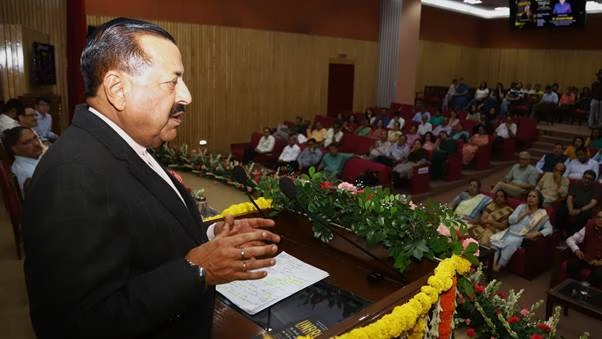
NEW DELHI — In a major public health intervention addressing India’s shifting health landscape, Union Minister Dr. Jitendra Singh called for a nationwide “Jan Andolan” (people’s movement) to combat the rising tide of non-communicable diseases (NCDs), including cancer, diabetes, and obesity.
Speaking in New Delhi on July 19, 2026, Dr. Singh emphasized that India’s strategy against these chronic illnesses must move beyond the walls of hospitals. Instead, it must transform into a community-led crusade anchored in early detection, qualified medical advice, and scientifically backed healthcare.
The Minister’s address came during the launch of UNBROKEN: My Battle with Cancer and the Will to Lead, a memoir by Dr. Akhilesh Gupta, a prominent scientist and former Senior Adviser to the Department of Science & Technology. Using Dr. Gupta’s successful battle against cancer as a testament to the power of modern medicine, Dr. Singh warned that India’s developmental goals are inextricably linked to the physical well-being of its citizens.
“The vision of Viksit Bharat (Developed India) cannot be realized without a healthy population,” Dr. Singh stated, adding that managing lifestyle diseases is a “shared national responsibility.”
The Dual Threat: Chronic Disease and Digital Misinformation
India is currently facing a dual epidemic: a steep rise in metabolic and oncological (cancer-related) disorders, alongside a rampant spread of digital health misinformation.
Dr. Singh cautioned that unverified dietary advice, internet fads, and pseudoscientific treatments frequently mislead the public. This misinformation often delays essential medical screenings, causing patients to miss critical early-intervention windows when diseases are most treatable.
Health Misinformation Cycle:
[Pseudoscience/Unverified Online Advice]
               ↓
[Delayed Routine Screening/Medical Care]
               ↓
[Diagnosis at an Advanced Disease Stage]
               ↓
[Higher Mortality & Complex Treatment]
Public health experts not involved in the announcement strongly endorse this focus on scientific literacy.
“Misinformation is arguably as dangerous as the diseases themselves,” says Dr. Arvinder Soin, Chairman of the Medanta Liver Institute (who was not present at the event). “We regularly see patients with advanced fatty liver disease or late-stage cancers who spent months trying unverified home remedies or internet diets. By the time they see a qualified oncologist or hepatologist, their therapeutic options are severely limited.”
The Hard Numbers: India’s Changing Disease Profile
The call for a public movement comes at a critical juncture. Data from the World Health Organization (WHO) and the Indian Council of Medical Research (ICMR) highlight a stark reality:
-
The Cancer Burden: According to ICMR projections, cancer cases in India are estimated to cross 1.57 million annually, with a notable rise in breast, cervical, and lung cancers.
-
The Metabolic Crisis: India is frequently referred to as the “diabetes capital of the world,” housing over 101 million individuals living with diabetes, and another 136 million classified as pre-diabetic, according to a landmark 2023 study published in The Lancet Diabetes & Endocrinology.
-
Obesity and Younger Demographics: The same Lancet study revealed that generalized obesity affects nearly 28.6% of the population. Strikingly, these metabolic disorders are no longer confined to older generations; they are increasingly diagnosed in young adults and urban children.
The Minister noted that many cancers are now highly curable or manageable, provided they are caught early. However, low screening rates remain a significant bottleneck in reducing mortality.
“Indian Data for Indian Solutions”
To make cutting-edge treatments both accessible and affordable, Dr. Singh highlighted the government’s push for indigenous scientific innovation. A primary example is the Genome India Project, an initiative aimed at sequencing thousands of Indian genomes to map the unique genetic variations of the local population.
Historically, most biomedical research and therapeutic frameworks were developed using Western cohorts. By collecting localized genomic data, Indian researchers can create targeted therapies, highly accurate diagnostic tools, and precise risk-prediction models specifically tailored to Indian biology. This initiative operates alongside affordable biotechnology innovations and the expansion of the Ayushman Bharat health insurance scheme, aiming to protect vulnerable families from catastrophic healthcare expenses.
Structural Hurdles and the Road Ahead
While a public movement focused on lifestyle modifications—such as balanced nutrition and regular physical activity—is vital, public health policy experts note that individual behavioral changes face structural challenges.
Public health analysts point out that lifestyle choices are heavily influenced by socioeconomic environments. In many expanding urban centers, access to safe spaces for physical exercise is limited, and highly processed, calorie-dense foods are often more affordable and accessible than fresh, nutrient-rich options.
Furthermore, while early screening tools are expanding under public initiatives, rural infrastructure still faces challenges regarding uniform access to comprehensive oncological care. Experts argue that for a “Jan Andolan” to succeed, public awareness campaigns must be paired with structural improvements, including subsidized screening camps, clear front-of-pack nutritional labeling on processed foods, and strict regulations against misleading health advertisements online.
Turning Awareness into Action
For the general public, translating the Minister’s address into daily health practices involves several practical steps:
-
Verify Before You Cultivate: Avoid adopting strict diets, heavy supplementation, or alternative disease therapies based solely on social media videos or forwarded messages. Cross-reference health information with qualified doctors or established bodies like the ICMR or WHO.
-
Prioritize Objective Screenings: Routine blood sugar tests, lipid profiles, and age-appropriate cancer screenings (such as mammograms or pap smears) should be treated as non-negotiable yearly checks, rather than reactive measures taken only when symptoms appear.
-
Focus on Sustainable Lifestyle Shifts: Rather than turning to extreme, unsustainable fitness regimes, focus on consistent modifications: 150 minutes of moderate physical activity per week, minimizing ultra-processed foods, and managing chronic stress.
Ultimately, the transition from hospital-centric management to community-led prevention requires a cultural shift. As Dr. Singh concluded, safeguarding public health cannot rely on doctors and policymakers alone; it requires individuals to actively choose evidence over internet trends.
Reference Section
-
Policy Statement Source: Press Information Bureau (PIB) Delhi, Government of India. Press release posted on July 19, 2026.
Medical Disclaimer: This article is for informational purposes only and should not be considered medical advice. Always consult with qualified healthcare professionals before making any health-related decisions or changes to your treatment plan. The information presented here is based on current research and expert opinions, which may evolve as new evidence emerges.