 0
0
 0
0
NEW DELHI — In the high-pressure corridors of urban policing, where 14-hour shifts and chronic sleep deprivation are the standard, a quiet revolution in mental health is taking place. The All India Institute of Ayurveda (AIIA) has announced the successful completion of its landmark Public Health Initiative (PHI), “Stress Management by Ayurveda Intervention for Police Personnel,” a project that has now reached over 35,700 individuals and provided a blueprint for integrating traditional medicine into modern occupational health.
The initiative, launched during the height of the COVID-19 pandemic, was designed to address the specific psychological toll placed on law enforcement—a demographic often overlooked in mainstream mental health discourse. By combining traditional Ayurvedic therapies with digital monitoring, the project has demonstrated that holistic intervention can offer a scalable solution for high-stress professions.
A System Under Pressure: The Scope of the Problem
Policing is widely recognized by public health experts as one of the most psychologically taxing occupations. According to a 2019 study by the Status of Policing in India Report (SPIR), police personnel work an average of 14 hours a day, with nearly 80% of officers reporting that the workload negatively impacts their physical and mental well-being.
“Mental health is the foundation of individual well-being and the effective functioning of society,” said Prof. (Vd.) Pradeep Kumar Prajapati, Director of the AIIA, during a dissemination workshop in late March 2026. “The World Health Organization (WHO) defines health not merely as the absence of disease, but as a state of complete physical, mental, and social well-being. For our police force, achieving this state requires more than just reactive care; it requires a proactive, preventive strategy.”
The Methodology: From Screening to Shirodhara
The PHI project, led by Principal Investigator Prof. (Dr.) Medha Kulkarni and Co-PI Prof. (Dr.) Meena Deogade, utilized a multi-tiered approach to reach the Delhi Police force. The team organized 206 specialized health camps across Delhi, facilitating the screening of 7,752 personnel for stress, hypertension, and comorbid conditions.
Of those screened, 1,843 individuals—roughly 24% of the screened group—received targeted Ayurvedic clinical interventions. These treatments were not limited to herbal supplements but included specialized “Sattvavajaya Chikitsa” (Ayurvedic psychotherapy) and physical therapies:
-
Internal Medications: Use of Medhya Rasayanas (nootropic herbs) such as Ashwagandha (Withania somnifera) and Brahmi (Bacopa monnieri), which are clinically noted for their adaptogenic properties.
-
Shirodhara: A rhythmic pouring of warm herbal oil over the forehead. Research published in the Journal of Evidence-Based Integrative Medicine suggests Shirodhara can significantly reduce anxiety and improve sleep quality by modulating the autonomic nervous system.
-
Smriti Meditation: A technique aimed at memory and emotional regulation, which was highlighted during the project’s final workshop by experts from the North Eastern Institute of Ayurveda & Folk Medicine Research.
To bridge the gap between ancient practice and modern lifestyle, the team also developed a dedicated stress management mobile application, allowing officers to track their symptoms and access wellness resources in real-time.
Validating the “Holistic” Claim
While Ayurveda is often categorized as “alternative medicine” in Western contexts, the AIIA project sought to ground its findings in measurable public health outcomes.
“Police personnel operate under intense psychological pressure, making them vulnerable to burnout and cardiovascular issues,” explained Prof. (Dr.) Meena Deogade. “The measurable outcomes we’ve seen reflect that when you treat the mind and body as an integrated unit, the recovery is more sustainable.”
Independent observers note the importance of this integration. Dr. Suneela Garg, a Public Health Consultant for the Ministry of AYUSH, emphasized that the project serves as a critical case study for occupational health. By addressing “occupational stress” through the lens of Ayurveda—which views health as a balance of Doshas (energies) and Manas (mind)—the initiative offers a personalized approach that standard “one-size-fits-all” stress management programs often lack.
Balancing the Perspective: Challenges and Limitations
Despite the project’s reported success, medical skeptics and evidence-based practitioners often point to the challenges of “standardizing” traditional medicine. Unlike synthetic pharmaceuticals, the efficacy of Ayurvedic treatments can vary based on the quality of raw materials and the practitioner’s expertise.
Furthermore, while the screening of 7,752 personnel provides a robust data set, longer-term longitudinal studies are required to determine if the stress-reduction effects of therapies like Shirodhara persist six to twelve months after the intervention ends. Public health officials also note that while Ayurveda can manage the symptoms of stress, systemic changes—such as better shift rotation and increased staffing within the police force—are necessary to address the root causes of occupational burnout.
Practical Implications for the Public
For the average citizen, the AIIA’s findings suggest a shift in how we might view stress management. The project highlights three key takeaways for daily health:
-
Early Screening: Just as the police were screened for hypertension alongside stress, individuals should recognize that mental strain often manifests as physical symptoms (headaches, high blood pressure).
-
The Adaptogen Factor: The use of Ayurvedic herbs under medical supervision may offer a non-habit-forming alternative for managing mild-to-moderate anxiety.
-
Digital Mindfulness: The project’s use of a mobile app underscores the growing role of “mHealth” (mobile health) in maintaining mental hygiene.
A Milestone for Integrated Medicine
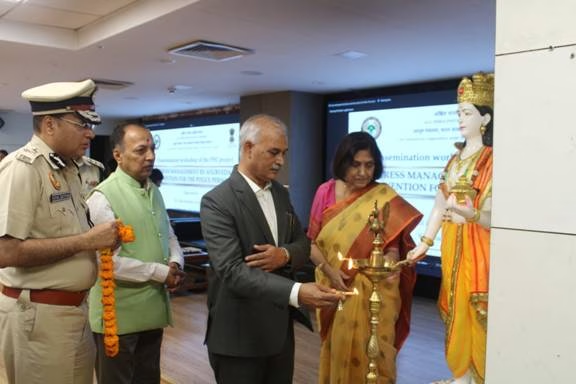
The dissemination workshop held on March 24, 2024, which included high-ranking officials like Mr. Atul Katiyar, IPS, and Dr. Koustubha Upadhyaya from the Ministry of AYUSH, signaled a growing institutional shift. The Delhi Police’s Welfare Division has already expressed deep appreciation for the initiative, noting that a healthy police force is essential for a safe community.
As the AIIA looks to scale this model to other high-risk professions, the PHI project stands as a testament to the potential of pluralistic healthcare. In the words of the AIIA leadership, the goal is not to replace modern medicine, but to enrich the public health toolkit with “timeless wisdom and holistic healing.”
References
Institutional Sources:
-
All India Institute of Ayurveda (AIIA). (2026). Report on Public Health Initiative: Stress Management by Ayurveda Intervention for Police Personnel. * Ministry of AYUSH, Government of India. (2026, April 1). Press Release: AIIA’s PHI Project on Stress Management.
Medical Disclaimer: This article is for informational purposes only and should not be considered medical advice. Always consult with qualified healthcare professionals before making any health-related decisions or changes to your treatment plan. The information presented here is based on current research and expert opinions, which may evolve as new evidence emerges.