 0
0
 0
0
BENGALURU, May 8, 2026 — In a move that signals a paradigm shift for India’s public health infrastructure, the National Health Authority (NHA) today inaugurated the first day of the AB PM-JAY Auto-Adjudication Hackathon Showcase 2026. The event, hosted at the Indian Institute of Science (IISc), Bengaluru, marks a national milestone in using Artificial Intelligence (AI) to automate and secure the claims process for the world’s largest government-funded healthcare program.
The showcase brought together an elite group of policymakers, AI startups, and clinical experts to demonstrate how machine learning can eliminate the bottlenecks that often delay hospital reimbursements and complicate patient care. By automating the “adjudication”—or the formal review and approval—of medical claims, the NHA aims to ensure that the 550 million eligible citizens under the Ayushman Bharat Pradhan Mantri Jan Arogya Yojana (AB PM-JAY) receive seamless, transparent, and fraud-free services.
A New Era of “Digital Public Goods”
The cornerstone of the day’s announcements was the introduction of BODH, an open benchmarking and data platform for Health AI. Developed in collaboration with IIT Kanpur, BODH is designed to be a “sandbox” where AI developers can test their algorithms against India-specific datasets.
“India is among the first countries in the Global South to establish such a platform,” stated Dr. Sunil Kumar Barnwal, CEO of the National Health Authority. “Innovation is distributed across society—spanning institutions, academia, and startups. Initiatives like this help harness collective potential to solve complex healthcare challenges.”
For the average citizen, this means the AI being used to process their hospital bill isn’t just a “black box” imported from the West; it is a system trained on local medical data, languages, and clinical realities, ensuring higher accuracy in a diverse demographic.
From Deepfakes to Diagnosis: Three Pillars of Innovation
The hackathon focused on three critical “problem statements” that have historically burdened the manual claims process. The winning teams demonstrated technologies that seem pulled from science fiction but have immediate practical applications:
1. Cracking the Code of Medical Paperwork
Processing claims often involves deciphering handwritten notes, multilingual forms, and blurry scans. The first group of innovators showcased AI equipped with multilingual Optical Character Recognition (OCR). These systems can automatically classify clinical documents, extract billing data, and—crucially—check if the treatment provided aligns with India’s Standard Treatment Guidelines (STGs).
2. AI as the Radiologist’s Assistant
One of the most complex areas of insurance is verifying radiological claims. Winning teams presented AI tools capable of “reading” X-rays, CT scans, and MRIs. These tools correlate imaging data with the hospital’s submitted reports to validate that the diagnosis matches the visual evidence. This prevents errors in disease staging and ensures that the treatment timeline is medically justified.
3. Safeguarding Against Modern Fraud
As digital systems evolve, so do the methods of fraud. The showcase highlighted AI-driven Deepfake and Forgery Detection. These systems can identify tampered discharge summaries, manipulated billing records, and even “ghost beneficiaries”—identities that don’t exist. By detecting synthetically altered medical reports, the NHA aims to protect the program’s integrity and ensure funds reach genuine patients.
Expert Perspectives: Efficiency vs. Empathy
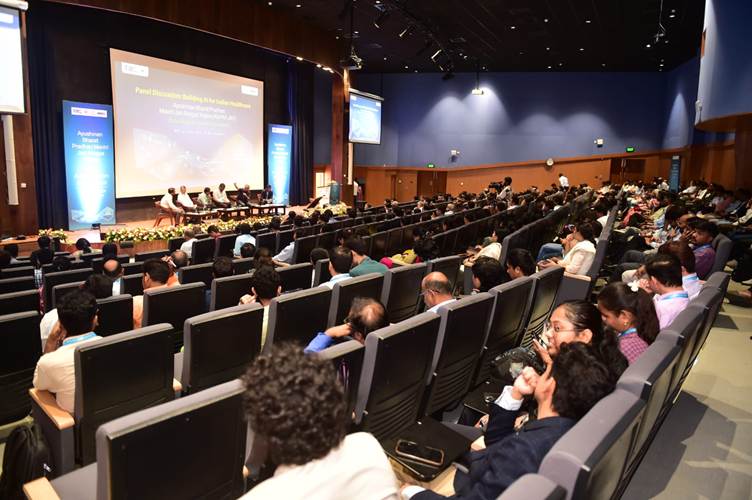
While the technology is promising, experts emphasize that AI should be viewed as a tool to assist, not replace, human judgment. Shri S. Krishnan, Secretary of the Ministry of Electronics and Information Technology (MeitY), led a panel discussion on “Building AI for Indian Healthcare,” noting the importance of Small Language Models (SLMs). Unlike massive global AI models, SLMs are more efficient for specific tasks and can run on lower-resource hardware in rural hospitals.
Independent experts not involved in the hackathon also see the potential. “The move toward auto-adjudication is vital for the sustainability of universal health coverage,” says Dr. Arvinder Singh, a digital health consultant. “Manual reviews are prone to fatigue and subjective bias. However, the challenge will be ‘explainability’—ensuring that if a claim is rejected by an AI, there is a clear, human-verifiable reason why.”
Public Health Implications: What This Means for You
For the millions of families relying on AB PM-JAY, these technical upgrades translate to several real-world benefits:
-
Faster Turnaround: Automated reviews mean hospitals get paid faster, reducing their financial strain and encouraging more private hospitals to join the scheme.
-
Reduced Errors: AI doesn’t get tired. It can cross-reference thousands of pages of guidelines in seconds, reducing the likelihood of a claim being wrongfully denied due to human clerical error.
-
Enhanced Trust: With robust fraud detection, the “leaks” in the system are plugged, ensuring that taxpayer money is used exclusively for patient care.
Challenges and Limitations
Despite the optimism, the transition to AI-driven adjudication is not without hurdles. Data privacy remains a paramount concern. The NHA has reiterated its commitment to “responsible AI,” incorporating privacy safeguards and validation frameworks into the rollout.
Furthermore, the “digital divide” in India means that while AI can process a claim in seconds, the initial data entry still relies on hospital staff in varying levels of digital readiness. The success of these AI innovations will depend heavily on their seamless integration with existing hospital management systems.
Looking Ahead
Day 2 of the showcase is expected to dive deeper into scalable implementation pathways. As India positions itself as a leader in “Digital Public Goods,” the world is watching to see if this AI-first approach can serve as a blueprint for other developing nations striving for universal healthcare.
As Dr. Barnwal noted, the ultimate goal is to build a “future-ready adjudication framework” that serves the entire ecosystem—from the largest city hospital to the smallest rural clinic.
Reference Section
-
Source Citation: National Health Authority (NHA). (May 8, 2026). National Health Authority convenes Day 1 of AB PM-JAY Auto-Adjudication Hackathon Showcase 2026. PIB Delhi.
Medical Disclaimer: This article is for informational purposes only and should not be considered medical advice. Always consult with qualified healthcare professionals before making any health-related decisions or changes to your treatment plan. The information presented here is based on current research and expert opinions, which may evolve as new evidence emerges.