 0
0
 0
0
March 31, 2026
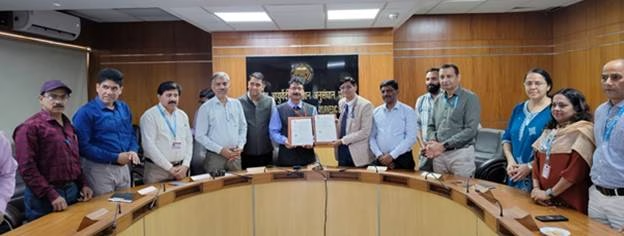
NEW DELHI — In a landmark move to democratize access to traditional medical knowledge, the Central Council for Research in Ayurvedic Sciences (CCRAS) officially partnered with the AI-driven translation platform Anuvadini AI yesterday. This collaboration, formalized through a Memorandum of Understanding (MoU), aims to dismantle linguistic barriers by translating vast repositories of evidence-based Ayurveda research into 13 Indian regional languages. By leveraging artificial intelligence to bridge the gap between English-dominated scientific publishing and local vernaculars, the initiative seeks to empower millions of citizens with credible, peer-reviewed health information.
From Lab to Local: Why Language Matters in Healthcare
For decades, the primary hurdle in the global acceptance of Ayurveda has been the “translation gap.” While the CCRAS—an autonomous body under the Ministry of Ayush—operates 30 institutes across 25 Indian states, much of its high-level scientific output has been published exclusively in English.
This linguistic bottleneck often leaves regional healthcare practitioners and rural populations reliant on anecdotal evidence or unverified digital claims. The new partnership with Anuvadini AI, a platform developed by the All India Council for Technical Education (AICTE), changes this dynamic.
“This is not just about translation; it is about health equity,” says Prof. Vaidya Rabinarayan Acharya, Director General of CCRAS. “Our commitment is to ensure that the outcomes of Ayurveda research benefit the academic community and the common citizen alike, in the language they speak and understand.”
The Technology: How Anuvadini AI Works
Anuvadini AI is not a standard translation tool. Unlike generic consumer AI, it was specifically engineered to handle technical, scientific, and governance-related terminology. In medical contexts, precision is paramount; a mistranslated dosage or botanical name could have serious health implications.
Key Features of the Initiative:
-
Scale: Initial translation into 13 regional languages, including Hindi, Tamil, Bengali, and Marathi.
-
Content Scope: Translation of the CCRAS Bulletin (a quarterly peer-reviewed journal), educational materials, and Information, Education, and Communication (IEC) resources.
-
Future Expansion: Plans to include foreign languages to support “Ayush Chairs” established globally by the Ministry of Ayush.
Combatting the “Infodemic” of Misinformation
The rise of digital health platforms has led to a surge in “WhatsApp medicine,” where traditional remedies are often stripped of their scientific context or exaggerated. Public health experts believe that providing a direct, translated pipeline of actual research can act as a “truth serum” for the public.
“When scientific evidence is locked behind a language barrier, misinformation rushes in to fill the vacuum,” explains Dr. Arati Verma, a public health consultant not involved in the MoU. “By making CCRAS research available in regional languages, the government is providing a ‘gold standard’ reference that local doctors and patients can use to verify claims about Ayurvedic treatments for chronic conditions like diabetes or arthritis.”
By the Numbers: The CCRAS Reach
| Metric | Detail |
| Research Institutes | 30 across India |
| Geographic Presence | 25 States |
| Initial Languages | 13 (including Hindi) |
| Publication Frequency | Quarterly (CCRAS Bulletin) |
Balancing Tradition with Modern Rigor
While the initiative is a leap forward for accessibility, the medical community maintains a cautious watch on the quality of evidence being translated. Modern Ayurveda research focuses on “reverse pharmacology”—taking traditional knowledge and testing it through randomized controlled trials (RCTs).
Dr. Buddha Chandrasekhar, CEO of Anuvadini AI, emphasizes that the platform is designed to maintain the integrity of these scientific nuances. “Technology is a tool for empowerment. By ensuring technical accuracy in translation, we are making traditional Indian medical knowledge both accessible and scientifically robust for a global audience.”
Potential Limitations
Critics and linguistic experts note that AI translation, while advanced, is not infallible.
-
Contextual Nuance: Traditional Ayurvedic terms (Sanskrit-based) often lack direct equivalents in modern scientific English or other regional dialects.
-
Human Oversight: Experts suggest that while AI can handle the bulk of the work, human “post-editing” by bilingual medical experts remains essential to ensure patient safety.
Practical Implications for Consumers
For the average health-conscious reader, this development means that the next time they read about an Ayurvedic supplement or lifestyle change, they may soon be able to access the original Indian government-backed study in their mother tongue.
What you should do:
-
Verify before you buy: Look for translated CCRAS materials when researching Ayurvedic formulations.
-
Consult your doctor: Use these translated papers as a talking point with your healthcare provider to see how traditional treatments might complement modern medicine.
-
Stay updated: Follow the official Ministry of Ayush portals as these translated resources begin to roll out over the coming months.
Looking Ahead: A Global Footprint
The MoU also hints at a broader horizon. As interest in holistic and integrative medicine grows in Europe and North America, the Ministry of Ayush plans to use Anuvadini AI to translate research into foreign languages. This could position India as a global leader in providing standardized, evidence-based traditional medicine data to the international scientific community.
By turning the “silent” archives of Ayurvedic research into a multilingual dialogue, India is not just preserving its heritage—it is modernizing it for the digital age.
References
Institutional Sources:
-
Press Information Bureau (PIB) Delhi. (2026, March 30). Ayurveda Research Accessible in 13 Languages: CCRAS Signs MoU with Anuvadini AI. [Release ID: 20260330].
Medical Disclaimer: This article is for informational purposes only and should not be considered medical advice. Always consult with qualified healthcare professionals before making any health-related decisions or changes to your treatment plan. The information presented here is based on current research and expert opinions, which may evolve as new evidence emerges.