 0
0
 0
0
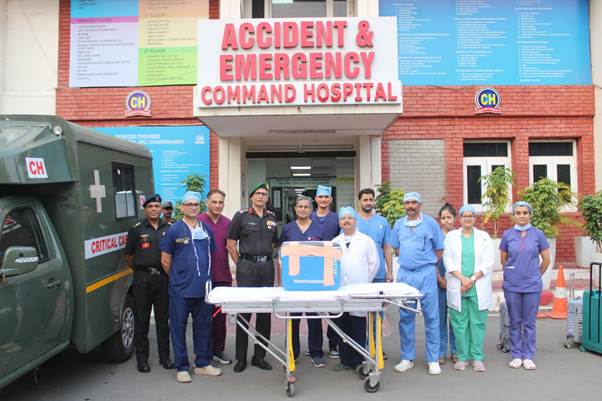
CHANDIMANDIR, HARYANA – In a profound intersection of personal tragedy and medical triumph, the family of a 41-year-old woman has transformed their grief into a lifeline for others. The donation of her organs at Command Hospital (Western Command), Chandimandir, on May 2, 2026, not only saved four critically ill patients but also marked a historic milestone: the first-ever heart retrieval performed at this premier military medical facility.
The donor, the wife of a serving Indian Army Colonel, was declared brain stem dead following a catastrophic brain hemorrhage. In a decision supported by her husband and two young daughters, the family consented to donate her heart, kidneys, liver, and pancreas. This act of altruism triggered a high-stakes, multi-agency operation that spanned three cities and involved the Indian Air Force, the National Organ and Tissue Transplant Organization (NOTTO), and civil aviation authorities.
The Logistics of Life: A Race Against the Clock
Organ transplantation is a battle against the “ischemic time”—the period an organ can remain viable outside the body. For a heart, that window is a mere four to six hours.
To facilitate this, a “Green Corridor” was established with the cooperation of traffic police in Haryana, Chandigarh, and Delhi. This ensured that ambulances could navigate normally congested urban routes without delay. Simultaneously, the Indian Air Force provided an aircraft to ferry the heart to the Army Hospital (Research and Referral) in Delhi, where a recipient was prepped and waiting.
The distribution of the organs was coordinated by NOTTO to ensure the best possible matches:
-
The Heart: Flown to Army Hospital (R&R), Delhi.
-
The Kidneys and Pancreas: Transported to the Postgraduate Institute of Medical Education and Research (PGIMER), Chandigarh.
-
The Liver: Sent to Indraprastha Apollo Hospital, Delhi.
Among the beneficiaries was a 14-year-old boy, whose life was saved by one of the donated organs, highlighting the transformative impact of pediatric and young-adult transplantation.
A Milestone for Military Medicine
The successful retrieval of a heart at Command Hospital, Chandimandir, represents a significant leap in the facility’s surgical capabilities. While kidney and eye donations are more common, heart retrieval requires specialized cardiothoracic expertise and sophisticated preservation infrastructure.
“This milestone signifies that our tertiary care military hospitals are now reaching the pinnacle of transplant medicine,” says Dr. Anirudh Deshpande, a veteran transplant coordinator not involved in this specific case. “Being able to retrieve a heart locally reduces the transit time significantly, which is the single most important factor in the success of a heart transplant.”
Understanding Brain Stem Death
For the general public, the concept of “brain stem death” can be difficult to navigate. Unlike a coma, where a patient may eventually regain consciousness, brain stem death is irreversible. It occurs when the brain stem—the part of the brain responsible for involuntary functions like breathing and heartbeat—ceases to function.
Under the Transplantation of Human Organs Act (THOA), a patient must be evaluated by a board of four medical experts twice, with a six-hour interval, before being declared brain stem dead. Once this occurs, the person is legally dead, even if a ventilator is temporarily keeping the heart beating and oxygenating the organs. This specific window is what allows for the retrieval of healthy organs for donation.
The National Landscape of Organ Donation
While this case is a success story, it highlights a persistent gap in India’s healthcare system. According to data from the Ministry of Health and Family Welfare, India has an organ donation rate of less than one donor per million population. In contrast, countries like Spain and the United States see rates between 30 and 50 per million.
The Ministry has reaffirmed its commitment to strengthening the National Organ Transplant Programme (NOTP). Key initiatives include:
-
One Nation, One Policy: Streamlining registration and allocation across state lines.
-
Digital Integration: Utilizing the NOTTO web portal for real-time tracking of available organs.
-
Abolishing Age Caps: Recent policy changes have removed the 65-year age limit for those seeking organs, recognizing that “biological age” is more important than “chronological age.”
The “Ripple Effect” of One Donor
A single deceased donor can save up to eight lives and improve the quality of life for over 50 others through tissue donation (such as corneas, skin, and bone).
“The decision made by the Colonel’s family is exemplary,” says Sarah Mehta, a patient advocate for organ awareness. “In the military community, we often talk about ‘service before self.’ There is no greater service than providing the gift of life to a stranger at your moment of greatest loss.”
Despite the progress, myths remain a barrier. Concerns about body disfigurement or religious prohibitions often deter families. However, medical professionals emphasize that organ retrieval is a surgical procedure performed with the same dignity and respect as any life-saving operation, and all major religions globally support organ donation as an act of charity.
Looking Forward: How to Become a Donor
The Union Ministry of Health and Family Welfare continues to urge citizens to pledge their organs. Pledging is a simple process that can be done online through the NOTTO website using an Aadhaar-linked mobile number.
However, medical experts stress that the most important step is informed consent within the family. In India, even if an individual has a donor card, the final decision rests with the next of kin. Discussing one’s wishes with family members ensures that in the event of an untimely tragedy, the decision to donate can be made with clarity and peace of mind.
As the 14-year-old boy and the three other recipients begin their recovery, the legacy of a 41-year-old woman lives on—not just in the hearts of her family, but in the very breath and pulse of the survivors she left behind.
Medical Disclaimer: This article is for informational purposes only and should not be considered medical advice. Always consult with qualified healthcare professionals before making any health-related decisions or changes to your treatment plan. The information presented here is based on current research and expert opinions, which may evolve as new evidence emerges.
References and Sources
Official Reports:
-
Press Information Bureau (PIB) Delhi. “Multi-Organ Donation at Command Hospital, Chandimandir Saves Multiple Lives.” Posted 06 May 2026.