 0
0
 0
0
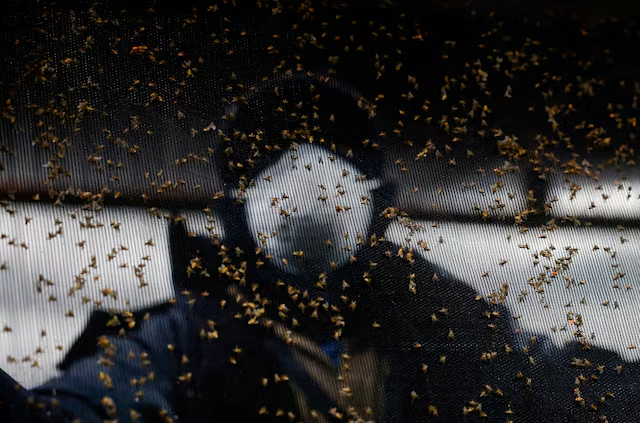
EDINBURG, TX — In a major escalation of biological defense, the U.S. Department of Agriculture (USDA) has announced the construction of a massive sterile-fly production plant in Edinburg, Texas. Slated for completion by late 2027, the $750 million facility aims to produce 300 million sterilized flies weekly to halt the northern migration of the New World screwworm (Cochliomyia hominivorax). The move comes as a response to a resurgence of the flesh-eating parasite in Mexico, which officials warn poses a multi-billion dollar threat to U.S. livestock, wildlife, and public health.
The Resurgence of a Biological Threat
The New World screwworm is not a typical housefly. It is an “obligate parasite,” meaning its larvae must feed on the living tissue of warm-blooded animals to survive. While the United States was declared free of the pest in the 1980s, recent spikes in wild populations across Mexico have put the USDA on high alert.
The Edinburg facility will be co-located with the recently completed dispersal center at Moore Air Base. By producing and releasing hundreds of millions of sterile flies, the USDA hopes to “starve” the wild population of reproductive opportunities—a strategy known as Sterile Insect Technique (SIT).
How the “Fly Factory” Works
The SIT process is a feat of biological engineering:
-
Rearing: Larvae are raised to adulthood in a controlled environment.
-
Sterilization: Male pupae are exposed to ionizing radiation, rendering them sterile but otherwise healthy.
-
Release: These sterile males are released via aircraft over target zones.
-
Suppression: Because female screwworms mate only once in their lifetime, mating with a sterile male results in non-viable eggs, causing the population to collapse.
“The beauty of sterile-insect technology is that it attacks the problem at the reproductive level without saturating pastures or border ecosystems with chemical pesticides,” says Dr. Matthew Finkler, a parasitologist not involved in the project. “It is a biologically elegant route to population suppression.”
A “Flesh-Eating” Reality: The Risk to Animals and Humans
The name “screwworm” originates from the larvae’s screw-like shape and the way they burrow deep into living flesh. Unlike other maggots that primarily consume dead tissue, screwworms target fresh wounds.
-
The Targets: Newborn livestock (navels), branded cattle, dehorned animals, or even pets with minor scratches.
-
The Damage: Within 12 to 24 hours of egg-laying, larvae hatch and begin eating. If left untreated, the infestation can lead to deep tissue destruction, secondary infections (sepsis), and death.
-
Human Risk: While rare in areas with modern sanitation, humans with open wounds are susceptible. Health authorities urge anyone in risk zones to clean and cover even minor injuries immediately.
The Economic Stakes
A full-scale re-infestation of the U.S. could be catastrophic. Beyond the animal welfare concerns, the USDA warns that an outbreak could disrupt the beef supply chain, potentially driving already record-high meat prices even higher due to increased inspection, treatment, and mortality costs.
A Five-Pronged Strategy
The Texas plant is the cornerstone of a broader 2025 USDA strategy. The agency is not relying solely on sterile flies; the initiative includes:
-
Movement Controls: Stricter checks at ports of entry for infested animals.
-
Enhanced Surveillance: Scent-lure traps to detect incursions early.
-
Research Grants: Funding for non-invasive treatments and improved lures.
-
Public Education: Digital tools like Screwworm.gov for rapid reporting.
Dr. Elena Reyes, a large-animal veterinarian in southern Texas, emphasizes that technology must be met with boots-on-the-ground vigilance. “For SIT to really pay off, we need outreach that teaches herders how to recognize the earliest signs,” she notes. “Otherwise, we’re chasing a problem that could have been caught days earlier at a fraction of the cost.”
Limitations and Trade-offs
Despite the high success rate of SIT, it is not a “silver bullet.”
-
Time Lag: The Edinburg plant won’t be fully operational until late 2027. Until then, the U.S. remains dependent on the COPEG facility in Panama.
-
Cost: Maintaining a sterile barrier requires continuous federal funding.
-
Biological Speed: As Dr. Finkler warns, if the wild population grows faster than sterile males can be released, the strategy can falter.
| Factor | Detail |
| Projected Cost | $750 Million |
| Weekly Production | 300 Million sterile flies |
| Target Completion | Late 2027 |
| Primary Method | Sterile Insect Technique (SIT) |
What This Means for You
For the average citizen, the risk remains low, but awareness is key—especially for those in border states or rural areas.
-
Monitor Pets and Livestock: Check animals daily for unusual wounds or maggot activity.
-
Practice Wound Care: Clean and cover all skin breaks on yourself and your animals.
-
Report Suspected Cases: If you see deep, malodorous wounds with burrowing larvae, contact the USDA-APHIS helpline or use the Screwworm.gov portal immediately.
The “Fly Factory” represents a massive investment in preventive medicine—a $750 million bet that biological engineering can keep one of nature’s most gruesome parasites at bay.
References
- https://www.reuters.com/business/healthcare-pharmaceuticals/usda-says-fly-production-plant-open-by-end-2027-fight-screwworm-2026-02-09/
Medical Disclaimer: This article is for informational purposes only and should not be considered medical advice. Always consult with qualified healthcare professionals before making any health-related decisions or changes to your treatment plan. The information presented here is based on current research and expert opinions, which may evolve as new evidence emerges.