 0
0
 0
0
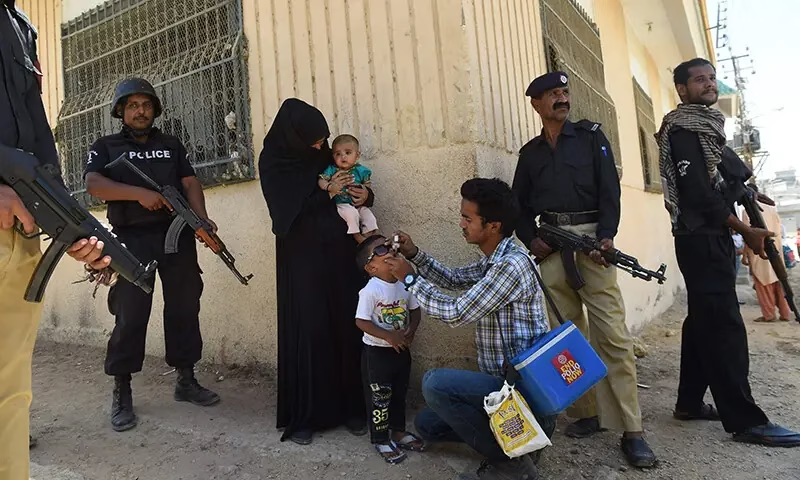
PESHAWAR, PAKISTAN — In a sobering reminder of the lethal crosscurrents complicating the final stages of global polio eradication, gunmen killed two police officers in separate targeted attacks in Pakistan’s northern Khyber Pakhtunkhwa province on May 17, 2026.
The officers were deployed to protect frontline healthcare workers on the opening day of a crucial four-day synchronized immunization campaign. The incident, which took place in the Salarzai area of the volatile Bajaur district near the Afghan border, underscores the profound security crises threatening the health of millions of children in one of the world’s final reservoirs for wild poliovirus.
According to local security briefs, one officer was killed instantly at the scene of the ambush, while the second succumbed to severe injuries shortly thereafter at a regional medical facility. Law enforcement agencies have since launched sweeping search operations across the district. Pakistan’s Interior Minister, Mohsin Naqvi, issued a swift condemnation, characterizing the ambush as a cowardly assault on personnel whose sole mission is safeguarding the health and future of the nation’s youth.
The Resilient Threat of Polio
Poliomyelitis, commonly known as polio, is a highly infectious viral disease that primarily invades the nervous system. In its most severe manifestations, the virus can cause irreversible paralysis—often in the legs—within a matter of hours. Because there is no cure for polio once a person is infected, public health infrastructure relies entirely on preventative immunization.
       Global Polio Endemic Status (2026)
       ┌─────────────────────────────────┐
       │      PAKISTAN  &  AFGHANISTAN    │
       └─────────────────────────────────┘
        Only two remaining nations where
        wild poliovirus transmission has
        never been completely interrupted.
The virus spreads through person-to-person contact, typically via the fecal-oral route, making densely populated areas with compromised sanitation and suboptimal vaccination coverage highly vulnerable. To build adequate herd immunity, children must receive multiple doses of the oral polio vaccine (OPV), which requires health workers to return to neighborhoods repeatedly.
Pakistan has made staggering progress toward total eradication over the past three decades. Driven by coordinated efforts with global bodies, local case numbers plummeted by 99.8% from an estimated 20,000 annual cases in the early 1990s to just 31 documented cases in 2025. Yet, as global health strategists frequently note, the final fraction of a percent is proving to be the most elusive and dangerous to eliminate. The mid-May campaign aimed to mobilize roughly 400,000 frontline workers to vaccinate 45 million children across the country.
Disinformation and the Security Dilemma
The targeted killings in Bajaur are not isolated incidents but part of a decades-long pattern of violence by militant groups operating in Pakistan’s border regions. Frontline vaccinators, who are predominantly local women, alongside their armed police escorts, have frequently found themselves in the crosshairs of extremist factions.
Public health researchers note that this violence is fueled by deeply entrenched misinformation. Peer-reviewed literature analyzing the program’s history reveals that militant groups regularly disseminate false narratives on social media and through local channels. These counter-narratives frequently assert that the vaccine is an elaborate foreign plot aimed at sterilization or surveillance.
“The primary obstacle to eradication in these border zones is no longer a lack of vaccines or infrastructure,” notes an independent global health analyst specializing in South Asian infectious disease dynamics. “It is a complex web of geopolitical suspicion and calculated propaganda that turns a routine health intervention into a high-risk security operation.”
When a security incident occurs, it triggers an immediate freeze of campaign activities in the affected sector. This leaves pockets of children entirely missed during critical immunization windows, creating localized immunity gaps where the virus can quietly incubate and mutate.
Public Health Consequences and Systemic Attrition
From a clinical and epidemiological standpoint, a single missed pocket of children compromises the safety of an entire region. As long as a single child remains infected, poliovirus can easily cross borders and reinfect populations in countries that have been polio-free for decades.
        VACCINATION ENVIROMENTAL DYNAMICS

   [ Security Failure ] ──> [ Suspended Campaigns ]
                                    │
                                    ▼
   [ Weakened Public ] <── [ Unvaccinated Pockets ]
     Health Trust              (Immunity Gaps)
Beyond the immediate epidemiological danger, these continuous threats exert a psychological toll on communities. When the act of receiving or administering a basic health measure carries a threat of lethal violence, the foundational trust between the civilian population and public health frameworks begins to erode. This makes it increasingly difficult to deploy subsequent routine health interventions, such as maternal health initiatives or other childhood immunizations.
Contextualizing the Progress
While the security realities in Khyber Pakhtunkhwa are severe, international health authorities emphasize that these regional challenges should not obscure the program’s overarching success. The vast majority of Pakistan routinely and safely participates in these vaccination campaigns, and the geometric reduction of the disease over thirty years proves the physiological efficacy of the vaccine.
The crisis is fundamentally one of logistics, safety, and delivery rather than medical science. The oral polio vaccine remains one of the most thoroughly vetted and safest public health tools in medical history, with no credible scientific data linking it to long-term adverse health outcomes or validating the conspiratorial claims driving regional hostilities.
The Road Ahead
For families worldwide, the fundamental takeaway remains unchanged: adhering to established childhood immunization schedules is the single most effective shield against preventable paralysis. For international health systems, the tragedy in Bajaur serves as an unambiguous reminder that total disease eradication requires far more than biological tools. It demands stabilized security, aggressive counter-misinformation strategies, and sustained institutional support for the frontline workers and security personnel who risk their lives to close the final gaps in global immunity.
References
-
Dawn News. “Two policemen deployed with polio teams martyred in KP’s Bajaur.” Published May 17, 2026.
Medical Disclaimer: This article is for informational purposes only and should not be considered medical advice. Always consult with qualified healthcare professionals before making any health-related decisions or changes to your treatment plan. The information presented here is based on current research and expert opinions, which may evolve as new evidence emerges.