 0
0
 0
0
By SHOBHA SHUKLA – CNS
Published: March 22, 2026
CHONBURI, Thailand — With only 56 months remaining to meet the global goal of ending tuberculosis (TB) by 2030, Thailand is turning to silicon and software to bridge a critical diagnostic gap. In hospitals across the “Land of Smiles,” artificial intelligence (AI) is now working alongside radiologists to detect TB and 26 other lung pathologies, identifying cases that previously slipped through the cracks of traditional screening methods.
The initiative comes at a pivotal moment. According to the World Health Organization (WHO) Global TB Report 2025, Thailand failed to diagnose over 22,000 people with TB in 2024—nearly one in five of the estimated 104,000 cases in the country. By deploying AI-powered computer-aided detection (CAD) software, Thai health authorities aim to eliminate human error and bypass the acute shortage of specialist radiologists in rural provinces.
From Microscopy to Molecules: A Diagnostic Revolution
For decades, the “gold standard” for TB screening in resource-limited settings was sputum smear microscopy—a century-old technique that misses more than 50% of active cases. Recognizing this failure, Thailand has aggressively moved toward molecular testing and digital X-ray screening.
In 2024, Thailand’s use of upfront molecular testing reached 69%, significantly outpacing the global average of 54%. However, the challenge remains: who should receive these expensive molecular tests? This is where AI-driven “triaging” becomes a game-changer.
The Power of “Genki”
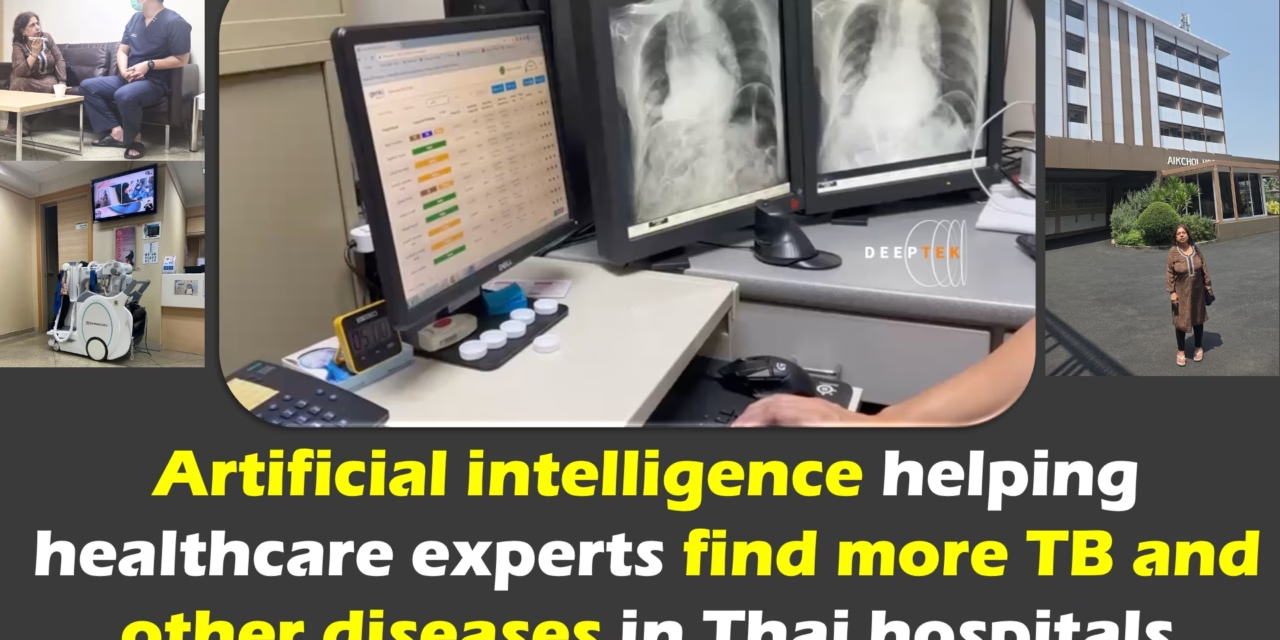
In 2022, the Thailand FDA approved Genki AI, an automated interpretation software developed by DeepTek. Integrated into digital X-ray machines—including mobile units that travel to remote villages—the AI scans chest images in seconds. It looks for signatures of TB, pneumonia, lung masses, and fibrosis with a sensitivity that often exceeds the human eye.
“Genki AI is crucial. I think it is very helpful,” says Dr. Grisit Prueksaritanond, a veteran radiologist at Aikchol Hospital in Chonburi. Over the past year, Dr. Grisit has used the software to screen over 1,000 patients. In that time, the AI flagged three specific cases with lesions that he admits he might have missed due to the subtlety of the findings.
Addressing the Specialist Shortage
The implications for public health are profound, particularly in low- and middle-income countries (LMICs) where the ratio of radiologists to the population is low.
“I think it is quite useful for the country that has few radiologists,” Dr. Grisit explains. “And it is also quite helpful even where you have a radiologist because AI can double-check that they are not missing any finding.”
By “ruling out” healthy patients quickly, the AI allows medical staff to focus their limited time and resources on high-risk individuals. This “All-Inclusive” approach ensures that even asymptomatic carriers—those who feel fine but are still capable of spreading the bacteria—are identified and linked to care.
Key Benefits of AI in TB Screening:
-
High Sensitivity: Detects early-stage lesions often invisible to human readers.
-
Speed: Provides instant results, reducing the “diagnostic delay” that leads to community transmission.
-
Multi-Disease Detection: Identifies 27 different conditions, including lung cancer (nodules) and pneumonia.
-
Cost-Effectiveness: Reduces the need for unnecessary, expensive molecular tests by accurately triaging patients.
A Balanced Perspective: AI as a Tool, Not a Replacement
While the enthusiasm for AI is high, experts urge a balanced perspective. AI is a screening tool, not a standalone diagnostic. A positive AI flag must be followed by a confirmatory molecular test (such as GeneXpert) and a clinical assessment by a physician.
Furthermore, there are inherent limitations. AI performance can vary based on the quality of the digital X-ray hardware and the “training data” used to develop the algorithm. However, since the WHO integrated CAD software into its official guidelines in July 2021, multiple peer-reviewed studies have confirmed that these tools are “at-par” with human experts in population-based screening.
The Road to 2030
As Thailand works to lower its TB burden—currently declining at a rate of 2% annually—the integration of AI represents a “technological leapfrog.” The goal is not just to find TB, but to find it early enough to prevent the catastrophic costs and physical toll of advanced disease.
“As long as it can detect something in the lung, I can evaluate further,” says Dr. Grisit. “It is more sensitive than my eyes. So that’s better!”
With 56 months left on the clock, the success of Thailand’s AI integration may serve as a blueprint for the rest of the world in the race to make TB a disease of the past.
Medical Disclaimer
Medical Disclaimer: This article is for informational purposes only and should not be considered medical advice. Always consult with qualified healthcare professionals before making any health-related decisions or changes to your treatment plan. The information presented here is based on current research and expert opinions, which may evolve as new evidence emerges.