 0
0
 0
0
JAIPUR, Rajasthan — In a major development for India’s healthcare infrastructure, Rajasthan has cemented its position as a national leader in digital health transformation. The state has secured the second-highest number of Ayushman Bharat Health Account (ABHA) IDs in the country, surpassing 7.19 crore registered accounts.
This milestone arrives as the National Health Authority (NHA) announced that total national ABHA registrations under the Ayushman Bharat Digital Mission (ABDM) have crossed the 90-crore mark in 2026. The massive surge reflects an unprecedented shift toward a connected, citizen-centric digital healthcare ecosystem designed to eliminate paper-based medical tracking across the country.
Unprecedented Growth and State Leadership
The expansion of India’s digital health identity system highlights a rapid upward trajectory over the last five years. According to data from the Press Information Bureau (PIB) and the NHA, national ABHA creation has grown exponentially:
-
2021: 14.7 crore registrations
-
2022: 30.4 crore registrations
-
2023: 50.6 crore registrations
-
2024: 72.2 crore registrations
-
2025: 84.5 crore registrations
-
2026: Over 90 crore registrations
In the competitive landscape of state-level implementation, Rajasthan has emerged as a top performer. It trails only Uttar Pradesh in absolute numbers while showcasing an exceptional population saturation rate.
Top 5 States by ABHA Account Volume (2026)
| National Rank | State / Union Territory | ABHA Accounts Created | Population Saturation Rate |
| 1 | Uttar Pradesh | 15.3 crore | Not reported |
| 2 | Rajasthan | 7.19 crore | 89.7% |
| 3 | Maharashtra | 7.1 crore | Not reported |
| 4 | Bihar | 6.3 crore | Not reported |
| 5 | West Bengal | 5.9 crore | Not reported |
Among India’s larger states, Rajasthan’s 89.7% saturation rate places it fourth nationwide, trailing only Andhra Pradesh (98.5%), Odisha (91.9%), and Chandigarh (90.8%). Neighboring Himachal Pradesh follows closely behind with an 88.9% saturation rate.
What is ABHA and Why Does It Matter?
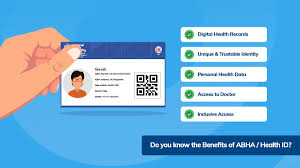
The ABHA ID is a unique 14-digit digital health identity that allows citizens to securely link, store, and share their medical histories. Historically, patient health data in India has been fragmented, scattered across isolated hospital filing cabinets, independent laboratories, and local clinics. ABHA resolves this by establishing a longitudinal health record—essentially a chronological digital timeline of an individual’s medical journey—accessible directly via mobile devices.
For the everyday patient, this infrastructure provides several practical benefits:
-
Reduced Physical Bureaucracy: Eliminates the logistical burden of carrying thick folders of paper prescriptions, discharge summaries, and diagnostic reports to medical appointments.
-
Enhanced Continuity of Care: Grants attending physicians instant access to a patient’s comprehensive medical history, facilitating faster, more accurate diagnoses.
-
Granular Data Privacy: Operates on an explicit-consent model, meaning patients retain absolute control over who views their data, for what purpose, and for how long.
-
Streamlined Insurance Processing: Integrates directly with the Ayushman Bharat Pradhan Mantri Jan Arogya Yojana (AB-PMJAY), paving the way for paperless and cashless healthcare delivery.
“ABHA is an important step towards empowering citizens with secure, consent-based access to their own health information,” stated Dr. Sunil Kumar Barnwal, CEO of the National Health Authority. “As ABDM adoption deepens, ABHA will enable continuity of care, reduce dependence on physical records, and support a more seamless, transparent, and citizen-centric healthcare delivery system.”
An encouraging demographic trend within this digital expansion is the inclusive participation of women. Females currently constitute 49.75% of all ABHA holders nationwide. Public health authorities emphasize that achieving near-perfect gender parity is crucial for improving maternal healthcare, streamline tracking for childhood immunization schedules, and enhancing essential community health delivery, where women frequently act as the primary healthcare managers for their families.
The Usage Gap: Registration vs. Active Adoption
Despite the impressive registration metrics, independent health systems research reveals a significant disconnect between owning a digital ID and actively utilizing it within clinical settings.
A peer-reviewed study published in BMC Health Services Research examined ABDM implementation across three tertiary care hospitals. Led by Dr. Ayushi Ranjan, the analytical cross-sectional study evaluated 425 outpatient department (OPD) attendees and highlighted notable operational friction.
The study revealed a monthly average ABHA adoption rate of just 23.96% among the surveyed outpatient population. Furthermore, despite visiting medical facilities actively participating in the digital mission, 58.6% of patients reported a fundamental lack of adequate knowledge regarding how the system functioned.
[Patient Awareness & Literacy Gaps]
 ├── Lacked adequate ABDM knowledge: 58.6%
 ├── Required on-site training/support: 88.0%
 └── Comfortable with digital data privacy: 55.0%
“While ABDM demonstrates operational efficiency and moderate patient user satisfaction, adoption of ABHA registration remains limited in comparison to conventional OPD registrations,” Dr. Ranjan noted in the study conclusions. She emphasized that the system faces stubborn structural barriers “related to digital literacy, awareness, economic constraints, and privacy concerns.”
Primary Obstacles to Sustained Digital Health Use
The research identified five distinct bottlenecks preventing patients from shifting entirely to digital health tools:
-
Cultural Preference: 85.6% of participants expressed a strong preference for traditional, in-person healthcare interactions over digital navigation.
-
Economic Constraints: 81.9% cited high mobile data plan costs as a barrier to managing digital health profiles.
-
Usability Issues: 65.6% reported technical difficulties when attempting to navigate mobile health applications.
-
Language Barriers: 64.0% struggled with interfaces that did not adequately cater to local languages or dialects.
-
Security Hesitancy: 60.0% displayed hesitation or fear regarding sharing One-Time Passwords (OTPs), which are required to authenticate and link digital health records.
The study also highlighted a distinct digital health literacy divide. Digital health literacy scores showed statistically significant disparities favoring male participants over female participants ($U = 15,922, p < .001$). Educational attainment emerged as the single strongest predictor of digital literacy ($\rho = 0.480, p < .001$).
Interestingly, while patients demonstrated acceptable basic operational skills (scoring $2.38 \pm 0.64$ on the Digital Health Literacy Index), they scored poorly in critical higher-level competencies, such as evaluating the reliability of online health information ($2.18 \pm 0.66$) and protecting personal data privacy ($2.22 \pm 0.65$).
Private Sector Integration Lags Behind
For the digital mission to succeed universally, it must bridge the gap between public and private healthcare facilities. Data indicates that private sector integration remains a steep hurdle; out of approximately 1.3 lakh ABDM-enabled health facilities, only about 17,000 belong to the private sector.
Industry leaders point out that while corporate hospital chains possess the resources to adapt, smaller, standalone medical institutions face distinct financial hurdles.
“The private sector is open to digitization if it addresses patient needs,” explained Viren Shetty, Executive Vice Chairman of Narayana Health. However, he noted that smaller nursing homes and local clinics frequently struggle to justify the upfront software integration and administrative overhead costs required to comply with full ABDM standards.
Public policy experts echo this sentiment, stressing that mandates alone cannot solve the infrastructure gap. “The government can enforce adoption in public facilities, but integrating the private sector is essential for ABDM’s overall success, especially given its growing footprint in tier II and III cities,” observed CK Mishra, Former Union Secretary of the Ministry of Health and Family Welfare.
Real-World Takeaways for Citizens and Providers
The transition toward a fully digital ecosystem alters how healthcare is navigated on the ground.
For Health-Conscious Citizens
Creating an ABHA ID is entirely voluntary and free of cost. It can be generated within minutes using an Aadhaar number or a mobile number linked to self-authentication systems. Once established, it serves as a lifelong tool that allows you to consolidate medical records from entirely different hospital systems into one secure folder. You remain the sole gatekeeper of this data; no doctor or facility can view your history without a digital consent request approved by you.
For Healthcare Professionals
The rollout aims to substantially lower clinical administrative burdens. With 6,79,692 doctors and nurses currently enrolled in the Healthcare Professionals Registry (HPR), the network allows for seamless peer-to-peer sharing of verified patient data. This instant access minimizes diagnostic redundancies—such as ordering duplicate blood tests or X-rays simply because a past paper record was misplaced.
For Public Health Advocates
Rajasthan’s 89.7% saturation rate proves that rapid population-wide onboarding is entirely possible when backed by coordinated state enforcement. However, to prevent a growing digital divide from isolating vulnerable groups—such as elderly patients, individuals with lower formal education, and rural communities—future campaigns must pivot toward grassroots digital literacy training, simplified multilingual interfaces, and heavily subsidized data access.
Looking Ahead: From Registration to Utilization
To shift India’s digital health infrastructure from a massive repository of identification numbers into an active clinical utility, the NHA is deploying specialized digital public infrastructure components. These include the Health Facility Registry (HFR), the Health Information Exchange and Consent Manager (HIE-CM), the Unified Health Interface (UHI), and the National Health Claims Exchange (NHCX), which simplifies insurance claim processing.
Rajasthan’s rapid ascent demonstrates that systemic implementation can yield massive enrollment. Under joint state and central health initiatives, the region has successfully maximized reach. However, as the broader national campaign moves past its 90-crore milestone, the true test of India’s digital health revolution will not be how many accounts are created, but how seamlessly those accounts are used to improve everyday patient care.
Medical Disclaimer
Medical Disclaimer: This article is for informational purposes only and should not be considered medical advice. Always consult with qualified healthcare professionals before making any health-related decisions or changes to your treatment plan. The information presented here is based on current research and expert opinions, which may evolve as new evidence emerges.
References
-
Press Information Bureau (PIB), Ministry of Health and Family Welfare, Government of India. “Ayushman Bharat Digital Mission Crosses Landmark Milestone of 90 Crore ABHA Accounts.” Released May 30, 2026. Release ID: 2266979.