 1
1
 0
0
ISLAMABAD — A devastating resurgence of measles has claimed the lives of at least 71 children across Pakistan in the first four months of 2026, health officials confirmed this week. The outbreak, which has seen more than 4,500 confirmed cases nationwide, has exposed critical vulnerabilities in the country’s primary healthcare infrastructure and reignited a domestic debate over stalled vaccination coverage.
While the southern province of Sindh remains the epicenter of the crisis, the virus is circulating rapidly through Punjab, Khyber Pakhtunkhwa, and Balochistan. Public health experts warn that the surge is a “preventable tragedy” occurring during World Immunization Week—a period intended to celebrate vaccine progress, but which instead finds Pakistan grappling with a widening immunity gap among its most vulnerable citizens.
A Crisis in Numbers: Mapping the Spread
According to data released by Pakistan’s Ministry of Health and local health directorates, the virus has moved with aggressive speed through both dense urban centers and underserved rural districts. Between January 1 and mid-April 2026, the toll has mounted as follows:
-
Sindh: The hardest-hit region, recording 40 deaths and 1,183 cases. Districts like Karachi and Hyderabad are currently under high-alert status.
-
Khyber Pakhtunkhwa: Reported the highest volume of infections with 1,712 confirmed cases and 12 deaths.
-
Punjab: Documented 1,198 cases and 12 deaths, with significant clusters emerging in Lahore and Faisalabad.
-
Balochistan: Recorded four deaths, with officials warning that remote geography may be masking the true scale of the transmission.
Public health analysts note that while the official case count sits at 4,541, the actual number of infections is likely significantly higher due to under-reporting in conflict-affected regions and rural areas where laboratory confirmation is difficult to obtain.
The “Five-Year Lapse”: Why Now?
Measles is one of the world’s most contagious viral diseases. To achieve “herd immunity” and block sustained transmission, a population requires a vaccination coverage rate of at least 95%. Pakistan has historically struggled to maintain these levels, with its first-dose measles-containing vaccine (MCV1) coverage often falling well below the target.
Health Minister officials have pointed to a “five-year lapse” in effective vaccination programming as a primary driver of the 2026 crisis. While a massive 2021 campaign reached millions, the momentum was reportedly lost to a combination of chronic under-funding, logistical barriers in hard-to-reach areas, and a lingering distrust of vaccination drives in certain communities.
“Measles does not discriminate on its own; it exploits gaps in vaccination, nutrition, and basic healthcare,” says Dr. Khalid Ahmed, a public health specialist who has monitored regional immunization trends. “Those gaps are still very visible in Pakistan. This isn’t just an emergency; it’s a systemic failure to protect children from a disease we have known how to prevent for decades.”
Understanding the Pathogen
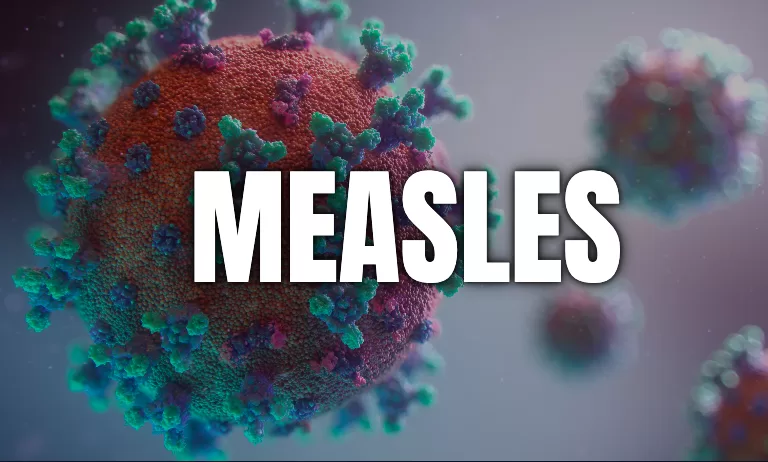
The measles virus is spread via respiratory droplets. For an unvaccinated individual, the risk is extreme: one infected person can transmit the virus to 90% of their close contacts.
Symptoms and Complications
The illness typically begins with a high fever, cough, and runny nose. However, the virus’s danger lies in its complications, which are particularly lethal in malnourished children:
-
Pneumonia: The leading cause of measles-related death in children.
-
Encephalitis: Swelling of the brain that can lead to permanent disability.
-
Severe Dehydration: Caused by diarrhea, which can quickly turn fatal in low-resource settings.
-
Blindness: A long-term consequence of vitamin A deficiency exacerbated by the virus.
According to the World Health Organization (WHO), case-fatality rates in vulnerable settings can exceed 3–5% when supportive care, such as oxygen and professional nursing, is unavailable.
National and Global Response
In an attempt to blunt the current trajectory, the Federal Directorate for Immunization, supported by WHO, UNICEF, and Gavi, has intensified a nationwide measles-rubella (MR) campaign. The initiative aims to reach 34.6 million children aged 6 months to 59 months.
Health leaders emphasize that while these “catch-up” campaigns are essential to stop the immediate bleeding, they are not a substitute for routine care. “Children should not have to wait for an emergency drive to receive life-saving vaccines,” a UNICEF representative noted in a recent brief. The focus is now shifting toward integrating vaccination into every routine clinical visit and improving real-time surveillance to catch future clusters before they become province-wide outbreaks.
Guidance for Parents and Caregivers
For families living in or traveling through affected regions, medical experts provide the following recommendations:
-
Verify Vaccination Status: Ensure children have received both recommended doses (typically administered at 9 months and 15–18 months).
-
Monitor Symptoms: Seek immediate medical attention if a child develops a high fever accompanied by a spreading, blotchy red rash.
-
Supportive Nutrition: For children with measles, maintaining hydration and administering Vitamin A (as prescribed by a doctor) is critical for reducing the severity of complications.
The Road Ahead: Challenges and Limitations
Despite the influx of emergency resources, the path to elimination remains steep. Experts cite several ongoing hurdles:
-
Vaccine Hesitancy: Misinformation continues to hamper door-to-door efforts in specific districts.
-
Climate and Displacement: Frequent flooding and internal displacement in Pakistan disrupt the “cold chain” (the refrigerated transport of vaccines) and make tracking mobile populations difficult.
-
Economic Inequality: The 2026 data shows a clear trend: deaths are disproportionately concentrated among the poorest families, making measles as much a marker of social inequality as it is a viral threat.
As Pakistan moves through the remainder of 2026, the success of its health system will be measured not just by how many vaccines are delivered in a campaign, but by whether it can build a permanent shield of immunity for every child, regardless of their zip code.
Medical Disclaimer
This article is for informational purposes only and should not be considered medical advice. Always consult with qualified healthcare professionals before making any health-related decisions or changes to your treatment plan. The information presented here is based on current research and expert opinions, which may evolve as new evidence emerges.
Reference
-
Gulf News (April 25, 2026). “Pakistan reports 71 measles deaths in 4 months.”