 0
0
 0
0
ISLAMABAD — Pakistan’s long-standing effort to eliminate poliovirus has encountered a sobering reality check this year. Health officials reported two additional cases of wild poliovirus type 1 (WPV1) this week, signaling that the “final mile” of eradication remains fraught with operational hurdles and security challenges.
The new detections, confirmed by the Pakistan Polio Eradication Programme, bring the total count for 2025 to 31 cases. While this is a staggering 99.8% reduction from the 20,000 annual cases recorded in the early 1990s, the persistence of the virus in high-risk “reservoirs” underscores the fragility of global eradication efforts. As one of only two countries where the virus remains endemic—alongside neighboring Afghanistan—Pakistan’s struggle is a critical focal point for international health security.
The Geography of Persistence
The recent cases were identified in regions long considered “hotspots” for transmission: South Khyber Pakhtunkhwa and the densely populated urban center of Karachi. According to the World Health Organization (WHO) Polio IHR Emergency Committee, these areas are plagued by a combination of factors that allow the virus to survive despite frequent vaccination drives.
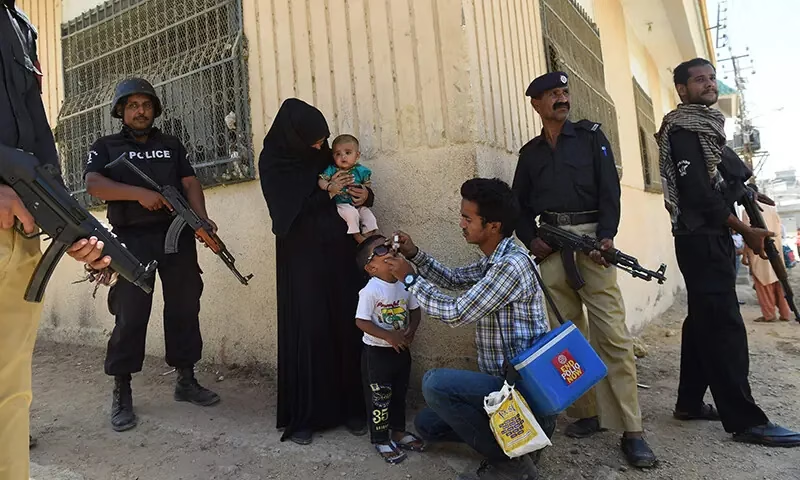
“The core challenge in Pakistan is not a lack of vaccine science; it is reach and coverage,” the Committee noted in its March 2026 review. In some high-risk districts, more than 250,000 children remain unreached by health workers. These “missed children” are often the result of insecurity, mobile populations moving across the border, and local resistance fueled by misinformation.
Why the Virus Won’t Quit
Polio is a highly infectious disease caused by a virus that invades the nervous system. It spreads primarily through the fecal-oral route—often via contaminated water or food. Once inside the body, the virus multiplies in the intestines and can eventually cause total paralysis in a matter of hours.
Public health experts use a powerful analogy to describe the current state of the outbreak: If the polio landscape is a forest, years of vaccination have cleared most of the trees. However, a few smoldering embers remain in these hard-to-reach pockets. If those embers are not extinguished through 100% vaccination coverage, they can reignite a massive fire that threatens not just Pakistan, but the rest of the world.
Evidence of this global vulnerability surfaced in 2025 when polio fragments were detected in Germany’s wastewater. While no clinical cases occurred there, the detection served as a stark reminder that as long as polio exists anywhere, every country remains at risk.
Expert Perspectives: Protection vs. Failure
Experts emphasize that the recent rise in cases should be viewed as a gap in immunity, not a failure of the vaccine.
“The vaccines we use are among the most successful interventions in medical history,” says Dr. Arshad Rafiq, a public health consultant who has monitored immunization programs in South Asia for over a decade. “The data from the CDC is clear: two doses of the Inactivated Poliovirus Vaccine (IPV) provide at least 90% protection, and three doses offer 99% protection against severe disease.”
In Pakistan, the program utilizes both the injectable (IPV) and the oral polio vaccine (OPV). The OPV is particularly vital because it is easy to administer—requiring only two drops—and it creates a unique type of “gut immunity” that prevents a person from spreading the virus to others. While the newer generation nOPV2 vaccine has been introduced to minimize the extremely rare risk of vaccine-derived outbreaks, the priority remains the consistent delivery of the standard doses.
The Public Health Stakes
The Pakistani government has responded to the 2025 surge by launching its first massive nationwide campaign of 2026. The goal is to reach 45 million children under the age of five across 159 districts.
For the average citizen, the message from health authorities is urgent:
-
Routine Immunization: Parents must ensure children receive all scheduled vaccinations at local clinics.
-
Campaign Participation: Accepting the “polio drops” during door-to-door campaigns is essential, even if a child has been vaccinated previously. Repeated doses boost the immune system to the highest possible level.
-
Hygiene: Improving handwashing and sanitation helps slow the environmental spread of the virus.
Limitations and the Path Forward
It is important to interpret the 2025 case numbers with nuance. A rise in reported cases does not always mean the virus is “winning”; sometimes, it reflects better surveillance and more aggressive testing of environmental samples. However, the WHO has warned that some testing in Pakistan has been delayed or disrupted by logistical issues, meaning the true number of infections could be higher than reported.
The 2026 strategy focuses on “translating political commitment into reliable access.” This means providing better security for frontline workers—many of whom are women—and improving the accuracy of data in cities like Karachi, where audits suggest some children may be missed by routine reporting.
As long as Pakistan and Afghanistan function as a single “epidemiological bloc” with constant cross-border movement, the fight remains a regional and global priority. The current setback is a reminder that in the world of infectious disease, “almost eradicated” is not enough.
Reference Section
- https://tripuratimes.com/ttimes/two-more-cases-reported-as-pakistan-struggles-to-eradicate-polio-36851.html/
Medical Disclaimer: This article is for informational purposes only and should not be considered medical advice. Always consult with qualified healthcare professionals before making any health-related decisions or changes to your treatment plan. The information presented here is based on current research and expert opinions, which may evolve as new evidence emerges.